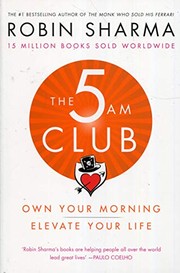
5 am club
In 60 seconds
An entrepreneur and an artist, both running on empty, meet a mysterious billionaire at a conference in Rome. He flies them to a private island in Mauritius and hands over the routine that built his fortune: rise at 5 a.m. and run the 20/20/20 Formula. Across the week he stacks on rules for focus, rest, gratitude, and habit-building. The core promise: own your morning. Elevate your life.
Before you start
Why it matters
If your days dissolve into email and exhaustion, this book hands you a concrete morning protocol instead of vague inspiration. It suits founders, creatives, and anyone who suspects their best hours are being spent on other people's priorities. The fiction is thin, but the routines are specific enough to try tomorrow at 5 a.m.
22 ideas, in the book's order
The big ideas
- 1Chapter 1
A Collapse Onstage Starts Everything
Chicago. A packed keynote. The Spellbinder, a legendary leadership speaker, is mid-performance when he collapses on stage and dies shortly after. His protégé, the billionaire, watches his mentor fall and decides the teachings cannot die with him. He resolves to carry the Spellbinder's teachings forward.
The idea
The billionaire inherits a mission rather than a fortune, which reframes every rule that follows as a legacy under deadline.
Try this: Write down the one teaching you would want passed on if you stopped tomorrow, then schedule time this week to actually teach it to someone.
- 2Chapters 2-3
Two Strangers, One Invitation in Rome
At a personal growth conference in Rome, an entrepreneur facing burnout and an artist seeking creative rejuvenation cross paths with a billionaire. He offers them an invitation to join him for a transformative experience. The entrepreneur and the artist accept, and he tells them the line that anchors the whole book: 'Own your morning. Elevate your life.'
The idea
Notice who gets invited: two people running on empty, not executives chasing more profit.
Try this: Identify the one hour of your day that currently belongs to everyone but you, and claim it for tomorrow morning before anyone else can.
- 3Chapters 3-4
Hard First, Messy Middle, Gorgeous End
Before the lessons begin, the billionaire sets expectations. He tells the entrepreneur and artist: 'All change is hard at first, messy in the middle and gorgeous at the end.' Then he flies them to Mauritius, where he begins teaching them the 5 AM Club method on a private island.
The idea
Knowing the middle will be messy gives you permission to keep going when it is.
Try this: Label your current attempt at change with its stage, hard, messy, or gorgeous, and judge your progress by surviving the stage, not by results yet.
- 4Chapter 5-6
The Billionaire's 5 a.m. Confession
On the island, the billionaire reveals the source of his edge: he wakes at 5:00 AM daily, a habit learned from the Spellbinder, and attributes his business success and vitality to this practice.
The idea
The reveal is deliberately unglamorous: a wake-up time, not a secret algorithm.
Try this: Set your alarm for 5:00 AM for one week and write down each morning what you did with the quiet hour before anyone else was awake.
- 5Chapters 6-7
The 20/20/20 Formula
The billionaire explains the 20/20/20 Formula: the first hour from 5:00 to 6:00 AM is split into three 20-minute pockets of intense exercise, reflection, and learning.
The idea
The 20/20/20 Formula makes self-improvement finite: three twenty-minute pockets, then the day begins.
Try this: Tonight, lay out three timers labeled Move, Reflect, Learn, and run all three back-to-back tomorrow from 5:00 to 6:00 AM.
- 6Chapter 8
Pocket One: Sweat Before Sunrise
The first 20-minute pocket, from 5:00 to 5:20 AM, is for vigorous physical exercise to spike cortisol and release BDNF, a brain-derived neurotrophic factor that repairs brain cells.
The idea
Pocket one earns alertness chemically instead of waiting for coffee to do it.
Try this: Do twenty minutes of hard movement, jumping jacks, a run, a fast cycle, within five minutes of waking, before checking any screen.
- 7Chapter 8
Pocket Two: Silence and a Journal
The second 20-minute pocket, from 5:20 to 5:40 AM, is for reflection through meditation, journaling, prayer, or planning, to deepen self-awareness and calm the mind.
The idea
After the body burns, the mind settles: this pocket is where the day gets decided instead of reacted to.
Try this: Tomorrow at 5:20 AM, sit with a notebook and write one page about what would make today a win, with your phone in another room.
- 8Chapter 8
Pocket Three: Feed Your Head
The third 20-minute pocket, from 5:40 to 6:00 AM, is for learning by reading books, listening to podcasts, or studying, to grow knowledge and cognitive function.
The idea
The hour closes with input, not output: twenty minutes of daily learning compounds into a private education.
Try this: Pick one book you have postponed for months and read it only in the 5:40 to 6:00 AM slot until it is finished.
- 9Chapter 9
The Four Focuses of History-Makers
The billionaire outlines the Four Focuses of History-Makers: Capitalization IQ (monetizing talents), freedom from distraction, personal mastery practice, and mindset of a titan.
The idea
The four focuses turn talent into a system rather than a hope.
Try this: Name your single most monetizable talent and take one concrete step this week to get paid for it, however small.
- 10Chapter 10
The 90/90/1 Rule
The billionaire teaches the 90/90/1 Rule: for the next 90 days, spend the first 90 minutes of your workday on your single most important project.
The idea
The 90/90/1 Rule converts ambition into a calendar entry: 90 days, 90 minutes, 1 project.
Try this: Choose your one project, block the first 90 minutes of your workday for it starting tomorrow, and hold the block for 90 days.
- 11Chapter 10
The 60/10 Method
The billionaire teaches the 60/10 Method: work in 60-minute blocks of intense focus followed by 10-minute breaks to renew energy and sustain peak performance.
The idea
The 60/10 Method treats energy like a muscle: cycles of load and recovery beat hours of foggy pretending.
Try this: Set a timer for 60 minutes of work, then a 10-minute timer for a real break away from your desk, and repeat through the day.
- 12Chapter 11
Design Your Week on Sunday Night
The billionaire introduces the Weekly Design System, a Sunday evening planning ritual to schedule the entire week in advance, allocating time for rest, work, and growth.
The idea
Rest that is not booked gets cancelled: schedule recovery in advance.
Try this: This Sunday evening, block your whole week ahead, including at least one slot each for rest and growth, before the week starts making demands.
- 13Chapter 12
The Second Wind Workout
The billionaire teaches the Second Wind Workout, a second exercise session at the end of the workday around 5:00 PM to trigger a second cortisol spike and renew energy for the evening.
The idea
The 5 a.m. hour is only half the energy story: a second workout renews the evening.
Try this: At the end of your workday tomorrow, around 5:00 PM, take a brisk 15-minute walk or quick workout before you sit down at home.
- 14Chapter 13
The Tight Bubble of Total Focus
The billionaire describes the Tight Bubble of Total Focus, a state of deep work where all notifications, interruptions, and distractions are eliminated for set periods.
The idea
Focus is not a personality trait, it is an environment you build.
Try this: For one 60-minute block this week, put your phone in another room, close every tab and app, and work on a single task with the door shut.
- 15Chapter 14
The 3/2/1 Bedtime Protocol
The billionaire explains the 3/2/1 Bedtime Protocol: three hours before bed, stop eating; two hours before bed, stop working; one hour before bed, stop all screen use.
The idea
A 5 a.m. wake-up only works if the night before cooperates: each cutoff protects the next morning's energy.
Try this: Tonight, set three alarms labeled 3, 2, and 1, and honor each cutoff: last bite, last email, last screen.
- 16Chapter 15
66 Days to Hardwire a Habit
The billionaire shares the Habit Installation Protocol, which requires performing a new behavior at the same time each day for 66 days to hardwire it into the brain's basal ganglia. The 66-day habit cycle is divided into three phases: the first 22 days of 'brutal discipline,' the next 22 days of 'emotional tolerance,' and the final 22 days of 'relative ease.'
The idea
The 66-day window replaces the folk myth of twenty-one days, and the three phases map the misery so you know it is on schedule.
Try this: Pick one habit, do it at the same time every day starting tomorrow, and mark day 22, 44, and 66 on your calendar as phase checkpoints.
- 17Chapters 16-17
Two Massages and a Grateful Mind
The billionaire teaches the Two Massage Protocol: receive two deep-tissue massages per week to lower cortisol, improve circulation, and speed physical recovery. He also describes the Pre-Sleep Gratitude Practice: spend the final moments before sleep visualizing the day's wins and expressing gratitude to condition the subconscious mind.
The idea
Recovery gets its own protocols: body and mind both get maintenance schedules.
Try this: Before sleep tonight, close your eyes and name three wins from the day, however small, and let that be the last thing your mind holds.
- 18Chapter 18
Responsibility Is the Switch
The billionaire states: 'The moment you accept total responsibility for everything in your life is the moment you claim the power to change anything in your life.'
The idea
Total responsibility is not about blame, it is about power: you cannot change what you insist is someone else's fault.
Try this: Take one situation you have been blaming on someone else and write down three actions that are fully within your control this week.
- 19Chapter 19
Your Income Is Your Ten Closest People
The billionaire teaches the 10-Person Rule: your income, influence, and success reflect the average of the ten people you spend the most time with.
The idea
The rule is uncomfortable because it makes friendship feel like portfolio management.
Try this: Write the names of the ten people you spend the most time with and note beside each whether they raise or lower your standards.
- 20Chapter 20
Twin Cycles: Push, Then Recover
The billionaire explains the concept of 'Twin Cycles of Elite Performance': alternating between periods of intense, focused work and deep recovery to avoid burnout and sustain excellence.
The idea
Burnout is not a badge, it is a scheduling error: elite performance runs on two alternating cycles.
Try this: Look at your next seven days and mark which ones contain genuine recovery, then schedule the missing recovery before the week begins.
- 21Chapter 21
From Victim to Hero
The billionaire reveals the 'Victim-to-Hero' transformation, urging the entrepreneur and artist to stop blaming circumstances and instead adopt a hero's mindset of agency and action.
The idea
The mindset follows the behavior rather than preceding it.
Try this: Catch yourself the next time you say 'I have to' and replace it with 'I choose to,' out loud, then act accordingly.
- 22Chapter 22
Distraction Is the End of Creation
The billionaire states: 'An addiction to distraction is the end of your creative production. Empire-makers and history-creators take one hour for themselves before dawn.'
The idea
Distraction is not a harmless habit but an addiction that ends creative production.
Try this: Count every notification and app check tomorrow, write the number down, and cut it in half the following day.
Worth remembering
Best lines
“Own your morning. Elevate your life.”
“All change is hard at first, messy in the middle and gorgeous at the end.”
“The moment you accept total responsibility for everything in your life is the moment you claim the power to change anything in your life.”
“An addiction to distraction is the end of your creative production. Empire-makers and history-creators take one hour for themselves before dawn.”
A fair critique
Where it falls short
The fiction is scaffolding, not storytelling: the entrepreneur, artist, and billionaire exist to deliver lectures, and their emotional arcs stay thin. The science is presented with more confidence than citation, and claims like BDNF repairing brain cells deserve a skeptical read. The advice skews toward people with control over their schedules; a nurse on night shifts cannot simply join the club. The billionaire's lifestyle prescriptions, like twice-weekly deep-tissue massages, will strike many readers as out of touch.
In one sentence
Take the first hour of your day back before the world takes it from you, and the rest of your life follows.
Is it for you?
Who should read it
Founders, creatives, and burned-out professionals who keep promising themselves they will start 'someday.' If you want a routine precise enough to try tomorrow morning, this is it; if you want literary fiction, lower your expectations.
4 questions
Quick quiz: how well do you know 5 am club?
0 of 4 answered
FAQ
What is 5 am club about?
The 5 AM Club is about leveraging the early morning hours (5 AM to 6 AM) to optimize personal productivity, creativity, and well-being. Through a fictional narrative, it teaches a specific routine called the '20/20/20 Formula' for exercise, reflection, and learning, aiming to help readers achieve peak performance and live a more fulfilling life by mastering their mornings.
Is 5 am club worth reading?
For individuals seeking to improve their morning routine, boost productivity, and cultivate personal discipline, "The 5 AM Club" offers actionable strategies and motivational insights. While some find the narrative style lengthy, the core principles of the 20/20/20 Formula and habit formation are highly practical for anyone committed to self-improvement and maximizing their daily potential.
How does 5 am club end?
Spoiler: The book ends with Tara and Hawkins, the entrepreneur and artist, having completed their transformative journey with the billionaire, Mr. Riley. They have internalized the principles of the 5 AM Club, including the 20/20/20 Formula and the 4 Imperatives of Genius. They return to their lives equipped with the tools and mindset to achieve extraordinary success and live legendary lives, ready to implement their newfound wisdom.
Who should read 5 am club?
This book is ideal for entrepreneurs, creatives, leaders, and anyone feeling stuck or overwhelmed who desires to reclaim control of their time and maximize their potential. It's particularly suited for those looking for a structured approach to morning routines and a motivational push to adopt disciplined habits for personal and professional growth.
How long does it take to read 5 am club?
On average, reading "The 5 AM Club" takes approximately 4 to 6 hours. This estimate is based on an average reading speed of 250 words per minute and the book's typical length of around 300-350 pages, which translates to roughly 75,000 to 85,000 words.
Who wrote 5 am club?
5 am club was written by Robin sharma and first published in 2018.
What genre is 5 am club?
5 am club is listed under Self-Help.
More Self-Help summariesHow many pages is 5 am club?
5 am club is about 360 pages long (the median page count across its editions, per Open Library).