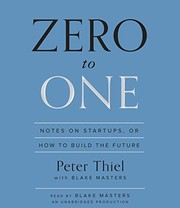
About zero to one
Peter Thiel's "Zero to One: Notes on Startups, or How to Build the Future" challenges the conventional wisdom of entrepreneurship, arguing that true progress comes from creating entirely new things (going from zero to one) rather than merely improving existing ones (going from one to N). Thiel, a co-founder of PayPal and early investor in Facebook, posits that innovation is not about incremental improvements or fierce competition, but about building unique, monopolistic businesses that offer genuinely new value to the world.
The book emphasizes the importance of contrarian thinking, encouraging founders to seek out "secrets" – valuable truths that few people agree on or have discovered. Thiel advocates for a definite vision of the future, where entrepreneurs actively build what they believe will be successful, rather than relying on indefinite optimism or luck. He covers critical aspects of building a successful startup, from the importance of strong foundations and company culture to sales, distribution, and the role of technology in shaping the future. Thiel's core message is that the next great innovators will not copy successful models but will forge entirely new paths, creating new markets and technologies.
Key takeaways
- Focus on creating something entirely new (zero to one) rather than merely iterating on existing ideas (one to N) to achieve true innovation and value.
- Strive to build a monopoly by offering a unique product or service that is difficult for others to replicate, as competition destroys profits.
- Cultivate contrarian thinking and seek out valuable "secrets" – truths about the world that are not widely recognized or acted upon.
- Develop a definite vision for the future, planning and executing specific steps to build what you believe will be successful, rather than relying on indefinite optimism.
- Ensure your startup has strong foundations, including a clear mission, a cohesive team, and effective sales and distribution strategies from the outset.
- Recognize that technology should empower humans, not replace them, and consider how human-computer collaboration can create unique value.
- Understand that every great business is built on a unique insight; don't just follow trends or mimic past successes.
Key ideas at a glance
Monopoly vs
- Strive to build a monopoly by offering a unique product or service that is difficult for others to replicate, as…
Future of innovation
- Understand that every great business is built on a unique insight; don't just follow trends or mimic past successes.
Contrarian thinking
- Cultivate contrarian thinking and seek out valuable "secrets" – truths about the world that are not widely recognized…
Definite optimism
- Develop a definite vision for the future, planning and executing specific steps to build what you believe will be…
Startup philosophy
- Ensure your startup has strong foundations, including a clear mission, a cohesive team, and effective sales and…
Value creation
- Focus on creating something entirely new (zero to one) rather than merely iterating on existing ideas (one to N) to…
- Recognize that technology should empower humans, not replace them, and consider how human-computer collaboration can…
Chapter summaries
Chapter 1: The Challenge of the Future
Thiel introduces the core concept of 'zero to one' – creating something entirely new – versus 'one to N' – copying existing successes. He argues that true progress comes from vertical, intensive innovation, not horizontal, extensive globalization. The chapter emphasizes that while globalization spreads what works, technology creates new ways of doing things. He challenges the conventional wisdom that all progress is good, asserting that only radical innovation can solve the world's biggest problems. The future is not predetermined; it's something we create. Building a better future requires thinking for ourselves and asking what important truth very few people agree with us on.
Chapter 2: Party Like It's 1999
This chapter reflects on the dot-com bubble of the late 1990s and the subsequent crash. Thiel identifies four big lessons that emerged from that era: make incremental advances, stay lean and flexible, improve on the competition, and focus on product, not sales. He then critically examines these lessons, arguing that they have become dogmas that often lead to failure. He suggests that the opposite principles—making bold bets, having a definite plan, seeking monopoly, and prioritizing sales—are often more effective for building successful, innovative companies. The chapter sets the stage for challenging conventional startup wisdom.
Chapter 3: All Happy Companies Are Different
Thiel argues that competition is overrated and destructive, while monopolies are beneficial for society and innovation. He states that 'all happy companies are different: each one earns a monopoly by solving a unique problem.' Monopolies, unlike competitive businesses, can afford to think long-term, invest in research and development, and provide better benefits to employees. He outlines four characteristics of a monopoly: proprietary technology (at least 10x better), network effects, economies of scale, and branding. The goal for any startup should be to create a unique product or service that allows it to achieve a temporary monopoly.
Chapter 4: The Ideology of Competition
This chapter delves deeper into why competition is detrimental. Thiel asserts that competition forces companies to focus on survival and fighting rivals rather than on creating new value. He uses examples like the rivalry between Microsoft and Google, which led both companies to become overly preoccupied with each other, diverting resources from truly innovative projects. He also highlights the restaurant industry as a hyper-competitive market where margins are thin and differentiation is difficult. Thiel argues that competition is a destructive force that makes people see opportunities where none exist and encourages them to pursue existing markets rather than creating new ones.
Chapter 5: Last Mover Advantage
Thiel challenges the conventional wisdom of 'first mover advantage.' He argues that it's better to be the 'last mover'—to build a monopoly that lasts into the future. The key is not just to be first, but to be the first to achieve significant scale and create a durable monopoly. He emphasizes that creating value is not enough; a company must also capture some of that value to be successful. Companies should focus on building a sustainable competitive advantage that will allow them to generate profits for decades, rather than just winning an initial race to market. Examples like PayPal's early strategy are discussed.
Chapter 6: You Are Not a Lottery Ticket
This chapter tackles the role of luck versus planning in success. Thiel argues against the idea that success is primarily a matter of randomness or being a 'lottery ticket.' He distinguishes between definite optimism (believing the future will be better and working to make it so) and indefinite optimism (believing the future will be better but not knowing how, leading to diversification and hedging). He advocates for definite optimism, emphasizing the importance of having a clear vision, a specific plan, and intentional design in building a company. Founders should not rely on serendipity but actively shape their future.
Chapter 7: Follow the Money
Thiel explains the concept of power laws in venture capital and business. He illustrates that a small number of companies account for the vast majority of returns in a venture portfolio. This means that diversification, while seemingly prudent, can actually be a mistake for investors and founders alike, as it dilutes focus from the few truly transformative opportunities. He advises founders to aim to build one of these outlier companies and investors to seek out the few companies that have the potential for exponential growth, rather than spreading their bets too thin across many average prospects.
Chapter 8: Secrets
Thiel argues that there are still many important secrets left to be discovered, both about nature and about people. He criticizes the modern belief that everything important has already been found or that secrets are too dangerous to pursue. He suggests that a belief in secrets is essential for innovation and progress. Founders should look for secrets—unconventional truths that few people agree with—as the foundation for their unique businesses. Discovering a secret allows a company to create a unique product or service that others haven't considered, leading to a monopoly.
Chapter 9: Foundations
This chapter stresses the critical importance of getting the foundational decisions right at the very beginning of a startup. Thiel argues that a startup is like a new government, and its initial structure, team, and culture are incredibly difficult to change later. Key decisions include choosing co-founders, determining equity splits, and ensuring everyone is full-time and fully committed. He emphasizes that a bad foundation cannot be fixed later, making the initial choices about who is on board and what their roles are paramount for long-term success. The founding team must be aligned and dedicated.
Chapter 10: The Mechanics of Mafia
Thiel discusses the importance of building a strong, cohesive company culture, which he likens to a 'mafia'—a group of people who are intensely loyal to each other and the company's mission. He emphasizes that every employee should be excited to work specifically for that company, not just for a job. This involves careful hiring, fostering strong internal relationships, and ensuring everyone is aligned with the company's unique vision. He also advises against remote work in the early stages, advocating for physical proximity to build strong bonds and a shared sense of purpose.
Chapter 11: If You Build It, Will They Come?
This chapter challenges the myth that a great product will sell itself. Thiel argues that sales and distribution are just as important as product development, if not more so. He outlines different types of distribution channels, including complex sales (for high-value products), personal sales (for medium-value products), marketing and advertising (for low-value products), and viral marketing. He stresses that founders must actively think about how their product will reach customers and choose the most effective distribution strategy, as even the best product will fail without a plan to sell it.
Chapter 12: Man and Machine
Thiel explores the relationship between humans and computers, arguing against the common fear that machines will replace humans. Instead, he advocates for a future where humans and computers work together as complements. He uses the example of 'freestyle chess,' where a human-computer team can outperform either a grandmaster or a supercomputer alone. The chapter suggests that the most valuable companies will be those that find ways to leverage the unique strengths of both humans (creativity, intuition) and machines (data processing, efficiency) to solve complex problems.
Chapter 13: Seeing Green
This chapter uses the example of clean energy startups, particularly the failure of Solyndra, to illustrate common pitfalls in building new technology companies. Thiel argues that many green tech companies failed because they didn't learn the lessons of 'zero to one.' They often lacked proprietary technology, failed to address distribution challenges, or entered highly competitive markets. He emphasizes that even in a noble cause like clean energy, a business must still adhere to the principles of creating a durable monopoly with superior technology and a clear path to profitability.
Chapter 14: The Founder's Paradox
Thiel concludes by examining the unique role of founders. He describes founders as often being seen as either eccentric geniuses or dangerous villains, embodying a paradox of extreme individuality and leadership. He argues that great founders are often distinct, even strange, individuals who possess a unique vision and the ability to inspire others to build something new. He suggests that society needs these singular individuals to drive innovation and create the future, despite their often unconventional personalities and approaches. The chapter celebrates the necessity of strong, visionary leadership in creating 'zero to one' companies.
Full summary
Book Overview
"Zero to One: Notes on Startups, or How to Build the Future" is a thought-provoking book authored by entrepreneur and investor Peter Thiel, co-founder of PayPal and Palantir. Published in 2014, the book distills Thiel's insights on innovation, startups, and the nature of progress in technology and business. Through a series of essays and reflections, Thiel challenges conventional wisdom about entrepreneurship and offers a blueprint for creating groundbreaking companies that can change the world.
Main Content/Plot
The central premise of "Zero to One" is the distinction between two types of progress: horizontal (or extensive) progress, which involves copying existing models (going from 1 to n), and vertical (or intensive) progress, which entails creating something entirely new (going from 0 to 1). Thiel argues that true innovation comes from developing unique technologies and ideas that transform industries rather than simply replicating existing ones.
The book is structured around Thiel's experiences and insights from his time as a venture capitalist and entrepreneur. It covers various topics, including the importance of monopolies in creating successful companies, the role of technology in advancing society, and the significance of a strong company culture. Thiel also emphasizes the necessity of a clear vision and the importance of asking the right questions to identify opportunities that others overlook.
Key Themes
1. Innovation vs. Imitation: Thiel advocates for the creation of new technologies rather than merely improving upon existing ones. He posits that true innovation is crucial for long-term success.
2. Monopoly vs. Competition: The book discusses the advantages of monopolistic companies, arguing that they can invest in innovation and maintain higher profits compared to firms in competitive markets.
3. The Power of a Vision: Thiel underscores the importance of having a clear and compelling vision for a startup. A strong vision guides decision-making and inspires teams.
4. The Role of Technology: Thiel explores how technology can solve pressing global challenges and improve human life, emphasizing the need for advancements that go beyond incremental improvements.
5. Critical Thinking: Thiel encourages entrepreneurs to question assumptions and conventional wisdom, urging them to think critically and creatively about problems.
Important Takeaways
- Create, Don’t Compete: Successful startups should focus on creating innovative solutions that set them apart rather than competing in crowded markets.
- Monopolies are Good: Mon
Memorable quotes
“Every moment in business happens only once. The next Bill Gates will not build an operating system. The next Larry Page or Sergey Brin won't make a search engine. And the next Mark Zuckerberg won't create a social network. If you are copying these guys, you aren't learning from them.”
“Competitive markets destroy profits.”
“Monopoly is the condition of every successful business.”
“Brilliant thinking is rare, but courage is in even shorter supply than genius.”
“The best entrepreneurs know this: every great business is built around a secret that's hidden from the outside.”
“Definite optimism is about building the future; indefinite optimism is about hoping the future will be good.”
Themes
- Monopoly vs. competition
- Future of innovation
- Contrarian thinking
- Definite optimism
- Startup philosophy
- Value creation
About Peter Thiel
Peter Thiel is a renowned entrepreneur, venture capitalist, and author. He co-founded PayPal (with Elon Musk and others) and was its CEO, later selling it to eBay. He also co-founded Palantir Technologies and was the first outside investor in Facebook. Through Founders Fund, he has invested in numerous successful tech companies. Thiel wrote "Zero to One" to share his unique insights on innovation, entrepreneurship, and the future of technology, based on his extensive experience building and funding groundbreaking companies.
FAQ
What is zero to one about?
Zero to One argues that true progress comes from creating entirely new things (going from zero to one) rather than just improving existing ones. It challenges entrepreneurs to build unique, monopolistic businesses by finding secrets, thinking contrarian, and having a definite vision for the future.
Is zero to one worth reading?
Yes, Zero to One is highly recommended for entrepreneurs, investors, and anyone interested in innovation. It offers a unique and thought-provoking perspective on building successful companies, emphasizing original thinking over incremental improvements. Its insights are valuable for understanding the dynamics of technology and business.
Who should read zero to one?
This book is ideal for aspiring and current entrepreneurs, startup founders, venture capitalists, and anyone in the technology industry. It's also valuable for business leaders and students who want to understand the principles of disruptive innovation and how to create lasting value in competitive markets.
What are the key takeaways from Zero to One?
Key takeaways include the importance of creating monopolies through unique innovation, avoiding direct competition, seeking out 'secrets' or overlooked truths, and having a definite plan for the future. It also stresses the significance of strong company foundations, effective sales, and human-machine collaboration.
How long does it take to read zero to one?
On average, it takes approximately 3 to 4 hours to read Zero to One. It's a relatively concise book, around 200 pages, making it accessible for a focused reading session or over a few sittings.