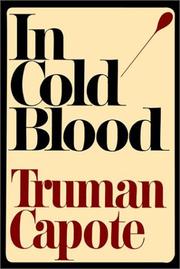
About In Cold Blood
Truman Capote's "In Cold Blood" is a groundbreaking non-fiction novel that meticulously reconstructs the brutal 1959 murders of the Clutter family in Holcomb, Kansas, and the subsequent capture, trial, and execution of their killers, Richard Hickock and Perry Smith. Capote spent six years researching the crime, immersing himself in the lives of the victims, the investigators, and especially the murderers themselves. The book is lauded for its innovative narrative style, blending journalistic rigor with literary techniques typically found in fiction, creating a chillingly intimate portrait of a senseless act of violence and its profound ripple effects.
The narrative unfolds from multiple perspectives, allowing readers to understand the idyllic, unsuspecting lives of the Clutters before the tragedy, the desperate hunt for the perpetrators by Kansas Bureau of Investigation agent Alvin Dewey, and the complex, often disturbing psychological landscapes of Hickock and Smith. Capote delves deep into the killers' backgrounds, motivations, and their twisted relationship, presenting them not as one-dimensional monsters but as deeply flawed individuals shaped by poverty, abuse, and mental illness. The book sparked widespread debate upon its publication, not only for its compelling storytelling but also for its ethical implications regarding Capote's close relationship with the killers, particularly Perry Smith, and his perceived manipulation of events for literary effect. "In Cold Blood" remains a seminal work in American literature, a chilling exploration of crime, punishment, and the dark underbelly of the American dream.
Key takeaways
- Senseless violence can shatter the illusion of safety and community, even in the most seemingly secure environments.
- The psychological profiles of criminals are often complex, shaped by a confluence of childhood trauma, mental illness, and desperate circumstances.
- The meticulous work of law enforcement, though often slow and frustrating, is crucial in bringing perpetrators to justice.
- The death penalty raises profound ethical questions about justice, retribution, and the state's role in ending human life.
- A single act of violence can have devastating, long-lasting consequences for an entire community and the families involved.
- The line between objective journalism and subjective storytelling can blur, especially when an author becomes deeply immersed in their subject matter.
Key ideas at a glance
Innocence lost
- A single act of violence can have devastating, long-lasting consequences for an entire community and the families…
Randomness of evil
- The line between objective journalism and subjective storytelling can blur, especially when an author becomes deeply…
Psychological pathology
- The psychological profiles of criminals are often complex, shaped by a confluence of childhood trauma, mental illness…
Justice and vengeance
- The meticulous work of law enforcement, though often slow and frustrating, is crucial in bringing perpetrators to…
The death penalty
- The death penalty raises profound ethical questions about justice, retribution, and the state's role in ending human…
American dream shattered
- Senseless violence can shatter the illusion of safety and community, even in the most seemingly secure environments.
Chapter summaries
The Last to See Them Alive
This section introduces the Clutter family – Herbert, Bonnie, Nancy, and Kenyon – portraying their idyllic, respected lives in Holcomb, Kansas, on the day before their murders. Capote meticulously details their routines, interactions, and the peaceful, prosperous atmosphere of their farm. Simultaneously, he introduces Richard Hickock and Perry Smith, two ex-convicts driving towards Holcomb with the intention of robbing the Clutter home, based on a tip about a hidden safe that doesn't exist. The chapter builds a stark contrast between the victims' innocence and the killers' sinister purpose.
Persons Unknown
This part details the horrifying discovery of the Clutter family's bodies by Nancy's friends and the subsequent shock and fear that grips the small, close-knit community of Holcomb. Kansas Bureau of Investigation agent Alvin Dewey takes charge of the investigation, facing immense pressure and a lack of immediate clues. The narrative follows Dewey's painstaking efforts to piece together the crime, interview witnesses, and manage the growing paranoia among the townspeople, who suddenly view their neighbors with suspicion. The killers, meanwhile, are shown fleeing Kansas, attempting to establish alibis and evade capture.
Answer
The investigation gains a crucial break when Floyd Wells, a former cellmate of Richard Hickock, comes forward with information about Hickock's plan to rob and murder the Clutters. This tip leads to the identification and eventual capture of Hickock and Smith in Las Vegas. Capote details their interrogation, during which both men eventually confess to their roles in the murders, revealing the chilling details of the night, including their lack of a clear motive beyond a botched robbery and Perry's impulsive violence. Their confessions provide the "answer" to the mystery that plagued Holcomb.
The Corner
The final section covers the trial of Hickock and Smith, their subsequent appeals, and their eventual execution by hanging. Capote delves into the legal proceedings, the psychological evaluations of the killers, and the emotional toll the entire process takes on Alvin Dewey and the community. He explores the complex relationship between the two murderers, particularly Perry Smith's internal struggles and his final moments. The chapter culminates in their executions, bringing a somber closure to the horrific events and raising profound questions about justice, punishment, and the human capacity for both good and evil.
Full summary
"In Cold Blood" by Truman Capote is a groundbreaking true crime novel published in 1966, detailing the 1959 murder of the Clutter family in Kansas. Capote blends journalism and literature, exploring the motivations behind the brutal crime.
The narrative follows the lives of the Clutter family and the two murderers, Perry Smith and Dick Hickock. After a botched robbery, the Clutters are killed, leading to the killers’ capture and trial. Major themes include the nature of evil, the American Dream, and the moral implications of violence. Capote delves into the psychological backgrounds of the perpetrators, presenting them as complex characters shaped by their circumstances.
Key elements include the Clutter family—successful and idyllic—and Smith and Hickock, whose troubled pasts reveal societal failures. Their relationships highlight contrasts between innocence and corruption. Capote's meticulous research and narrative style elevate the story into a profound examination of crime.
Ul...
Memorable quotes
“The village of Holcomb stands on the high wheat plains of western Kansas, a lonesome area that other Kansans call 'out there.'”
“I thought he was a very nice gentleman. Soft-spoken. I thought so right up to the minute I cut his throat.”
“A man's life is his castle. But not if he's a Clutter.”
“I didn't want to harm the man. I thought he was a very nice gentleman. Soft-spoken. I thought so right up to the minute I cut his throat.”
“He was a man who had nothing to gain, and everything to lose, by telling the truth.”
“The Clutter family, Herb, Bonnie, Nancy, and Kenyon, were dead. All four of them. Shotguns. At close range. In their beds.”
Themes
- Innocence lost
- Randomness of evil
- Psychological pathology
- Justice and vengeance
- The death penalty
- American dream shattered
About Truman Capote
Truman Capote (1924-1984) was an American novelist, short story writer, screenwriter, and playwright. Known for his distinctive voice and flamboyant personality, he achieved early fame with works like "Breakfast at Tiffany's." Capote spent six years researching and writing "In Cold Blood," immersing himself in the lives of the Clutter family and their killers. He pioneered the "non-fiction novel" genre with this work, aiming to create a journalistic account with the narrative drive of fiction. The intense emotional and psychological toll of writing the book, particularly his complex relationship with Perry Smith, significantly impacted his later life and literary output.
FAQ
What is In Cold Blood about?
"In Cold Blood" is about the 1959 murders of the Clutter family in Holcomb, Kansas, and the subsequent investigation, capture, and execution of the two perpetrators, Richard Hickock and Perry Smith. It meticulously reconstructs the crime and explores the lives of both the victims and the killers, examining the psychological motivations behind the senseless violence and its impact on a small American town.
Is In Cold Blood worth reading?
Yes, "In Cold Blood" is widely considered a masterpiece and is definitely worth reading. It pioneered the "non-fiction novel" genre, offering a gripping, detailed, and psychologically complex narrative of a true crime. Readers interested in true crime, American history, journalism, and human psychology will find it a compelling and thought-provoking experience, despite its dark subject matter.
How does In Cold Blood end?
Spoiler: The book ends with the execution by hanging of Richard Hickock and Perry Smith, the two men convicted of the Clutter family murders. After years of appeals, their sentences are carried out. The final pages reflect on the lingering impact of the crime on the community and the investigators, particularly Alvin Dewey, who visits the Clutter family graves years later, finding a measure of peace but never fully escaping the tragedy.
Who should read In Cold Blood?
Readers interested in true crime, investigative journalism, and the psychological underpinnings of criminal behavior will find this book compelling. It's also recommended for those who appreciate literary non-fiction and want to understand the origins of the genre. Anyone seeking a deep, unsettling exploration of justice, morality, and the human condition will find it a profound read.
How long does it take to read In Cold Blood?
On average, it takes approximately 6 to 7 hours to read "In Cold Blood." This estimate is based on an average reading speed of 250 words per minute and the book's typical length of around 340 pages. Individual reading times may vary depending on speed and engagement with the detailed narrative.