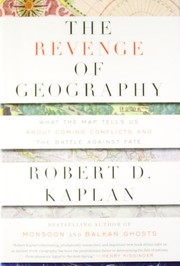
About revenge of geography
Robert D. Kaplan's "The Revenge of Geography" argues that physical geography remains a fundamental and often underestimated force shaping human destiny, state behavior, and international relations, despite the rise of globalization and technology. Kaplan contends that the enduring realities of mountains, rivers, coastlines, deserts, and climate continue to dictate political boundaries, economic development, and strategic imperatives for nations. He revisits and reinterprets the insights of classical geopolitical thinkers like Halford Mackinder, Nicholas Spykman, and Alfred Thayer Mahan, applying their frameworks to contemporary global challenges.
The book systematically examines various regions—Europe, Russia, China, India, the Middle East, Africa, and the Americas—through a geographical lens, demonstrating how their physical landscapes have historically influenced their political trajectories and will continue to do so in the 21st century. Kaplan challenges the notion that technology has rendered geography obsolete, asserting instead that it has merely made its influence more complex and often more acute. He advocates for a renewed geographical literacy among policymakers and the public to better understand and navigate the intricate web of global conflicts and collaborations, emphasizing that while human agency is vital, it operates within immutable geographical constraints that frequently lead to predictable patterns of behavior and conflict.
Key takeaways
- Physical geography remains a primary determinant of international relations and state behavior, despite technological advancements.
- Classical geopolitical theories, though old, offer enduring insights into contemporary global challenges and power dynamics.
- Understanding the physical landscape of a region is crucial for comprehending its historical development and predicting its future trajectory.
- Technological progress can mitigate some geographical constraints, but it cannot eliminate their fundamental influence on human societies.
- The rise of major powers like China and India is deeply intertwined with their unique geographical advantages and vulnerabilities.
- Policymakers and strategists must re-embrace geographical literacy to formulate effective foreign policies and national security strategies.
- The world is not flat; its crumpled, complex geography continues to shape conflicts, alliances, and economic opportunities.
Key ideas at a glance
Geopolitics
- Classical geopolitical theories, though old, offer enduring insights into contemporary global challenges and power…
Geographical Determinism
- Physical geography remains a primary determinant of international relations and state behavior, despite technological…
- Technological progress can mitigate some geographical constraints, but it cannot eliminate their fundamental influence…
International Relations
- The rise of major powers like China and India is deeply intertwined with their unique geographical advantages and…
Historical Influence
- Understanding the physical landscape of a region is crucial for comprehending its historical development and predicting…
Strategic Thinking
- Policymakers and strategists must re-embrace geographical literacy to formulate effective foreign policies and national…
Chapter summaries
Part I: The European Idea
Kaplan introduces the concept of geography's enduring influence, drawing on classical and modern geopolitical thinkers. He explores the European continent, highlighting how its fragmented geography of peninsulas, islands, and mountain ranges fostered distinct nation-states and a complex balance of power. He discusses the ideas of Halford Mackinder and Nicholas Spykman, particularly Mackinder's "Heartland" theory and Spykman's focus on the "Rimland," showing how these theories emerged from and shaped European geopolitical thought. The part emphasizes how Europe's physical landscape has historically driven conflict and cooperation, leading to its unique political development and its global impact through colonialism and two world wars.
Part II: The Russian Idea
This part delves into Russia's vast, flat, and largely indefensible geography, which Kaplan argues has historically driven its expansionist tendencies and its deep-seated sense of insecurity. He discusses how Russia's lack of natural barriers, particularly in the west, has led to a continuous drive for buffer states and warm-water ports. The text mentions historical figures and events that exemplify this, such as Peter the Great's push westward, Catherine the Great's expansion, and the Soviet Union's sphere of influence. Kaplan connects Russia's geographical predicament to its autocratic political traditions and its historical struggle to define itself between Europe and Asia, often viewing its neighbors as either threats or necessary extensions of its security perimeter.
Part III: The Chinese Idea
Kaplan examines China's unique geography, characterized by its vast interior, formidable mountain ranges, and long coastline, which has historically allowed for both internal unity and outward expansion. He discusses how China's "Middle Kingdom" mentality is rooted in its geographical isolation and self-sufficiency. The part explores China's historical dynasties, its control over Tibet and Xinjiang, and its modern rise as a maritime power, particularly in the South China Sea. Kaplan highlights the challenges China faces in securing its energy routes and managing its diverse internal regions, arguing that its geographical imperatives continue to shape its foreign policy, including its Belt and Road Initiative and its relationships with neighbors like India and Japan.
Part IV: The Indian Idea
This section focuses on India's distinct geographical identity, shaped by the Himalayas to the north, the Indian Ocean to the south, and its diverse river systems. Kaplan emphasizes how India's geography has fostered a unique civilization, characterized by immense internal diversity in language, religion, and culture, yet held together by a shared sense of identity. He discusses India's strategic position in the Indian Ocean, its historical role as a crossroads of trade and culture, and its modern geopolitical challenges, including its rivalry with Pakistan and China. The part explores how India's democratic traditions are constantly tested by its vastness and internal complexities, and how its geographical location makes it a crucial player in the emerging Indo-Pacific order.
Part V: The Iranian Idea
Kaplan explores Iran's ancient and enduring geopolitical significance, rooted in its central location at the crossroads of Europe, Asia, and Africa. He describes Iran's rugged plateau, surrounded by mountains, which has historically provided it with a degree of defensibility while also driving its imperial ambitions. The part discusses the legacy of the Persian Empire, its historical conflicts with Russia and Britain, and its modern role as a regional power. Kaplan emphasizes how Iran's Shiite identity, combined with its strategic geography, fuels its foreign policy, particularly its influence in the Levant and its rivalry with Saudi Arabia. He argues that understanding Iran's geographical imperatives is crucial to comprehending its actions on the global stage.
Part VI: The American Idea
This part analyzes the United States as an "island continent," protected by two vast oceans, which has historically fostered a sense of exceptionalism and allowed it to develop without constant external threats. Kaplan discusses how America's internal geography, with its navigable rivers and fertile plains, facilitated its westward expansion and economic development. He explores the ideas of Alfred Thayer Mahan regarding sea power and how America's geographical advantages enabled its rise as a global superpower. The summary touches upon how America's geographical isolation has also contributed to its historical tendency towards isolationism, contrasting with its post-World War II global engagement, and how its current challenges include managing its vast borders and maintaining its global reach.
Part VII: The Future of Geography
In this concluding section, Kaplan synthesizes the arguments from previous parts, reiterating that geography, far from being obsolete in the age of globalization and technology, is reasserting its fundamental influence on international relations. He discusses how climate change, resource scarcity, and demographic shifts are intensifying geographical pressures, leading to new geopolitical flashpoints. Kaplan emphasizes that understanding the physical world—its mountains, rivers, oceans, and deserts—is more critical than ever for policymakers. He argues that the 21st century will see a "revenge of geography" as states increasingly grapple with the immutable realities of their physical environments, shaping alliances, conflicts, and economic destinies in a multipolar world.
Full summary
In "The Revenge of Geography," Robert D. Kaplan explores how geography shapes the political landscape and influences global conflicts. He argues that geographical factors—such as mountains, rivers, and climate—play a crucial role in determining the fate of nations, impacting their strategies and interactions.
Kaplan examines historical and contemporary regions, including Eurasia, the Middle East, and Africa, illustrating how geography has driven political decisions. He emphasizes themes like the strategic importance of access to waterways and the challenges posed by natural barriers. The interplay between geography and culture also emerges as a key theme.
Key concepts include the significance of geopolitical rivalries and the role of historical legacies. Kaplan discusses figures like the Romans and Ottomans, revealing how geography has been a silent partner in shaping their destinies.
Ultimately, Kaplan’s work underscores the enduring power of geography in shaping human events, o...
Memorable quotes
“The map, in other words, is destiny.”
“Geography is the mother of history.”
“Technology may have shrunk the world, but it has not eliminated geography.”
“To understand the future, one must understand the map.”
Themes
- Geopolitics
- Geographical Determinism
- International Relations
- Historical Influence
- Strategic Thinking
About by robert d.kaplan
Robert D. Kaplan is a prominent American journalist, author, and geopolitical analyst known for his extensive travel and reporting from complex regions around the world. His work often explores the interplay of geography, culture, and politics, providing a unique perspective on international affairs. Kaplan has authored numerous influential books, including "Balkan Ghosts," "Warrior Politics," and "Monsoon." He served on the Defense Policy Board and is a senior fellow at the Center for a New American Security. He wrote "The Revenge of Geography" to reassert the fundamental importance of physical geography in an era where many believed it had been rendered obsolete by technology and globalization.
FAQ
What is revenge of geography about?
Robert D. Kaplan's "The Revenge of Geography" argues that physical geography—mountains, rivers, coastlines—fundamentally shapes history, conflicts, and the future of international relations. It challenges the idea that technology has made geography irrelevant, asserting its enduring power over human destiny and state behavior.
Is revenge of geography worth reading?
Yes, it is highly recommended for anyone interested in international relations, history, or foreign policy. Kaplan offers a compelling and well-researched argument for the enduring relevance of geography, providing a valuable framework for understanding global events that is often overlooked in contemporary discourse.
How does revenge of geography end?
Spoiler: The book concludes by emphasizing the ongoing and evolving relevance of geography in the 21st century. Kaplan urges policymakers and citizens alike to cultivate a deeper geographical literacy, arguing that understanding the map is crucial for anticipating future conflicts and navigating the complex challenges of a world still profoundly shaped by its physical features.
Who should read revenge of geography?
This book is ideal for students and professionals in international relations, political science, history, and foreign policy. It also appeals to general readers interested in understanding the deeper, underlying forces that shape global events, conflicts, and the rise and fall of nations.
How long does it take to read revenge of geography?
Given its length of approximately 384 pages, a typical reader at about 250 words per minute would likely take between 6 to 7 hours to read "The Revenge of Geography" from cover to cover.