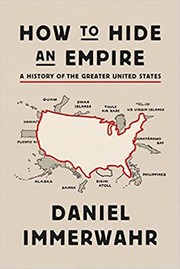
About How to Hide an Empire
How to Hide an Empire by Daniel Immerwahr fundamentally redefines the understanding of American history by challenging the popular image of the United States as a nation confined to its contiguous 48 states. Immerwahr argues that the U.S. has always been, and continues to be, an empire, but one that has masterfully obscured its territorial possessions and colonial history from its own citizens. He introduces the concept of a "pointillist empire," describing how the U.S. controls numerous scattered islands and territories—such as Puerto Rico, Guam, the Philippines (historically), American Samoa, and the U.S. Virgin Islands—whose inhabitants often lack full citizenship rights and political representation. This "Greater United States" remains largely invisible to mainland Americans, fostering a collective amnesia about its imperial past and present.
The book meticulously traces the evolution of this hidden empire from its late 19th-century acquisitions through to the present day. Immerwahr reveals how these territories served crucial strategic, economic, and military purposes, often at significant human cost to their indigenous populations. He highlights the paradox of a nation founded on anti-colonial principles becoming a major colonial power itself, and how this contradiction was managed through legal fictions and cultural narratives that prioritized the "map of the 48 states" as the true America. By bringing these forgotten histories to light, Immerwahr compels readers to reconsider American identity, its global role, and the ongoing implications for the millions living under U.S. sovereignty without full equality, making a powerful case for a more honest and complete understanding of the nation's past and present.
Key takeaways
- The United States has historically been, and remains, an empire with numerous overseas territories, not just the contiguous 48 states.
- Many U.S. territories, such as Puerto Rico and Guam, are inhabited by millions who lack full citizenship rights and political representation.
- The concept of a "pointillist empire" describes how the U.S. maintains control over scattered, often forgotten, non-contiguous territories.
- The U.S. has actively fostered a narrative that obscures its imperial history, leading to widespread ignorance about its territorial possessions.
- Understanding the history of U.S. territories is crucial for a complete and honest understanding of American identity and its global impact.
- The strategic importance of these territories, particularly for military bases and economic resources, has been a consistent driver of U.S. foreign policy.
- The legacy of U.S. colonialism continues to impact the political, economic, and social conditions of its territorial populations today.
Key ideas at a glance
US Imperialism
- The U.S. has actively fostered a narrative that obscures its imperial history, leading to widespread ignorance about…
Forgotten Territories
- The United States has historically been, and remains, an empire with numerous overseas territories, not just the…
- The concept of a "pointillist empire" describes how the U.S. maintains control over scattered, often forgotten…
Colonial History
- Understanding the history of U.S. territories is crucial for a complete and honest understanding of American identity…
- The legacy of U.S. colonialism continues to impact the political, economic, and social conditions of its territorial…
National Identity
- Many U.S. territories, such as Puerto Rico and Guam, are inhabited by millions who lack full citizenship rights and…
Military Strategy
- The strategic importance of these territories, particularly for military bases and economic resources, has been a…
Chapter summaries
Introduction: The Greater United States
Immerwahr introduces the book's central argument: the United States has historically presented itself as a continental "blob," obscuring its extensive overseas "dot" empire. He challenges the common perception of American exceptionalism and anti-imperialism, revealing how territories like Puerto Rico, Guam, and the Philippines have been integral to U.S. power and identity, yet simultaneously rendered invisible. The introduction sets the stage for exploring how this "Greater United States" was acquired, governed, and ultimately forgotten, shaping both domestic and foreign policy in profound ways. It highlights the strategic importance of these territories for military bases, resource extraction, and scientific experimentation, arguing that their erasure from national consciousness is a deliberate act of historical forgetting.
Chapter 1: The Blob
This chapter details the early expansion of the United States across the North American continent, establishing the "blob" narrative. Immerwahr discusses Manifest Destiny, the Louisiana Purchase, and the Mexican-American War, emphasizing how these acquisitions of contiguous land shaped the U.S. self-image as a non-imperial republic. He explores the displacement of indigenous populations and the expansion of slavery as integral parts of this continental growth. The chapter argues that this period solidified the idea of the U.S. as distinct from European colonial powers, even as it engaged in its own form of territorial expansion and conquest, laying the groundwork for later overseas ventures while simultaneously masking their imperial nature.
Chapter 2: The Dots
Immerwahr shifts focus to the often-overlooked early acquisitions of overseas territories, the "dots" that foreshadowed a larger empire. He highlights the Guano Islands Act of 1856, which allowed U.S. citizens to claim uninhabited islands for their valuable bird droppings, used as fertilizer. Examples like Baker Island and Jarvis Island demonstrate how the U.S. began acquiring small, strategically useful outposts long before the Spanish-American War. This chapter reveals that the legal and conceptual framework for overseas expansion was established decades earlier, challenging the notion that U.S. imperialism began abruptly in 1898 and showing a continuous, if often hidden, pattern of territorial acquisition.
Chapter 3: The War
This chapter focuses on the pivotal year of 1898 and the Spanish-American War, which dramatically expanded the U.S. overseas empire. Immerwahr details the swift American victory and the subsequent acquisition of Puerto Rico, Guam, and the Philippines from Spain. He explores the strategic motivations behind these annexations, particularly the desire for naval bases and access to Asian markets. The chapter also touches upon the intense domestic debates between imperialists, like President William McKinley, who saw expansion as a duty, and anti-imperialists, who warned against the dangers of colonial rule, marking a significant turning point in American foreign policy and national identity.
Chapter 4: The Philippines
Immerwahr delves into the brutal U.S. occupation and the Philippine-American War (1899-1902), a conflict often downplayed in American history. He describes the fierce resistance from Filipino nationalists led by Emilio Aguinaldo and the U.S. military's harsh tactics, including concentration camps and widespread atrocities. The chapter also examines the U.S. policy of "benevolent assimilation," spearheaded by figures like William Howard Taft, which aimed to "civilize" and modernize the Philippines through education, public health initiatives, and infrastructure projects, even as it denied Filipinos immediate self-governance and perpetuated racial hierarchies, highlighting the paradox of American imperial rule.
Chapter 5: The Map
This chapter explores how cartography played a crucial role in shaping and obscuring the American empire. Immerwahr discusses the challenges faced by mapmakers in representing the non-contiguous territories and how the dominant "blob" map of the contiguous 48 states became a powerful tool for national self-perception. He shows how the choice of map projections and the deliberate omission of territories from everyday maps contributed to the public's "forgetting" of the "dots." The chapter argues that these cartographic decisions were not neutral but actively reinforced a narrative of American exceptionalism, allowing the nation to maintain an empire while denying its imperial nature.
Chapter 6: The People
Immerwahr examines the legal and social status of the inhabitants of U.S. territories, focusing on the Insular Cases (1901-1922). These Supreme Court decisions established the doctrine that the Constitution does not "follow the flag" fully, creating "unincorporated territories" whose residents lacked full constitutional rights. The chapter highlights the racial and cultural prejudices underlying these rulings, which deemed many territorial populations "alien races" unfit for self-governance or full citizenship. It explores the implications for Puerto Ricans, Filipinos, and other territorial residents, who were subject to U.S. rule but denied equal rights, illustrating the inherent contradictions of American democracy in an imperial context.
Chapter 7: The Sugar
This chapter details the economic exploitation of U.S. territories, particularly focusing on the sugar industry in Puerto Rico and the U.S. Virgin Islands. Immerwahr describes how American corporations, like the American Sugar Refining Company, gained immense control over local economies, transforming landscapes and labor practices. He explains how U.S. tariff policies and trade agreements favored mainland interests, often at the expense of local farmers and workers, leading to widespread poverty and dependence. The chapter illustrates how the territories served as captive markets and sources of cheap raw materials, reinforcing their colonial status and hindering their economic self-sufficiency.
Chapter 8: The Rubber
Immerwahr explores the U.S. quest for strategic resources, specifically rubber, in the early 20th century, linking it to broader imperial ambitions. He recounts Henry Ford's ambitious but ultimately failed project, Fordlandia, a massive rubber plantation established in the Brazilian Amazon in the 1920s. This venture, though not in a U.S. territory, exemplifies the American drive for self-sufficiency in critical raw materials, especially in the context of global conflicts and reliance on foreign suppliers. The chapter highlights the challenges, cultural misunderstandings, and environmental impacts of such large-scale colonial resource extraction efforts, underscoring the global reach of American economic power.
Chapter 9: The War Again
This chapter focuses on World War II and the critical, yet often overlooked, role of U.S. territories in the Pacific and Caribbean. Immerwahr details the Japanese attacks on Pearl Harbor (Hawaii, then a territory), Guam, and the Philippines, emphasizing their strategic importance as military outposts and supply lines. He highlights the disproportionate impact of the war on territorial populations, who endured occupation, combat, and significant sacrifices. The chapter argues that the war underscored the vital military value of these "dots" for projecting American power and defending national interests, even as their contributions and suffering remained largely unacknowledged on the mainland.
Chapter 10: The Bomb
Immerwahr reveals the devastating impact of U.S. nuclear weapons testing on its Pacific territories, particularly the Marshall Islands. He details the displacement of islanders from Bikini and Enewetak Atolls and the long-term health and environmental consequences of numerous atomic and hydrogen bomb tests conducted from 1946 to 1958. The chapter argues that these remote islands were viewed as expendable "empty spaces" for military experimentation, with little regard for the indigenous populations or their ancestral lands. It exposes a dark chapter of American imperialism, where scientific advancement and national security came at an immense human and ecological cost to its territorial subjects.
Chapter 11: The Bases
This chapter examines the post-World War II expansion of U.S. military bases globally, many of which were located in or near its territories. Immerwahr discusses the strategic importance of bases in places like Guam, Okinawa (under U.S. administration after WWII), and Puerto Rico during the Cold War. He explores the tensions between the U.S. military presence and local populations, addressing issues of land expropriation, environmental degradation, and sovereignty concerns. The chapter argues that these bases were crucial for projecting American power and maintaining global influence, solidifying the territories' role as vital, yet often contested, outposts in the U.S. defense network.
Chapter 12: The Satellites
Immerwahr connects the U.S. empire to the space race and the development of satellite technology. He highlights the crucial role of remote territories, such as Kwajalein Atoll in the Marshall Islands, as missile testing ranges and tracking stations for the U.S. space program and military. The chapter explains how these seemingly isolated "dots" became indispensable sites for advanced technological development and national security, demonstrating the continued utility of territorial lands for cutting-edge scientific and military endeavors. It underscores how the empire adapted to new technological frontiers, maintaining its strategic importance in the Cold War era and beyond.
Chapter 13: The Commonwealth
This chapter focuses on the political evolution of Puerto Rico, particularly its establishment as a commonwealth in 1952. Immerwahr explores the complex debates surrounding its status—independence, statehood, or a unique form of self-governance. He discusses "Operation Bootstrap," an ambitious industrialization program aimed at modernizing Puerto Rico's economy, and its mixed results, including significant migration to the mainland. The chapter examines the ongoing questions of sovereignty and self-determination, arguing that commonwealth status, while granting some autonomy, ultimately maintained Puerto Rico's colonial relationship with the United States, leaving its political future unresolved.
Chapter 14: The State
Immerwahr contrasts the continued territorial status of many possessions with the admission of Alaska and Hawaii as states in 1959. He explores the reasons for their statehood, including their strategic importance during the Cold War, growing populations, and, in Hawaii's case, a significant non-indigenous population. The chapter highlights the racial and cultural factors that influenced which territories were deemed "ready" for statehood, often reflecting prevailing mainland prejudices. It underscores the selective nature of American expansion, where some territories were integrated into the "blob" while others remained "dots," perpetuating a hierarchy of citizenship and political rights.
Chapter 15: The Flags
This chapter examines the symbolic erasure of the U.S. empire from national consciousness, particularly through cartography and national symbols. Immerwahr discusses how the widespread use of maps depicting only the contiguous 48 states, and the 50-star flag, effectively rendered the territories invisible to most Americans. He argues that this "forgetting" was not accidental but a deliberate process that reinforced a continental self-image, allowing the U.S. to avoid confronting its imperial past and present. The chapter highlights the political and psychological implications of these symbolic choices, which perpetuate the marginalization of territorial citizens.
Chapter 16: The Citizens
Immerwahr delves into the complex legal and political limbo of territorial residents, who are U.S. citizens but lack full voting representation in Congress and the presidency. He explores the implications of this second-class citizenship for people in Puerto Rico, Guam, American Samoa, and the U.S. Virgin Islands. The chapter highlights the disparities in rights, access to federal programs, and political power compared to mainland citizens. It argues that this unequal status is a direct legacy of the Insular Cases and the ongoing "forgetting" of the empire, perpetuating a system where millions of Americans are governed without their full consent.
Chapter 17: The Migrants
This chapter explores the significant migration of people from U.S. territories to the mainland, particularly from Puerto Rico. Immerwahr discusses the various push and pull factors, including economic hardship, limited opportunities, and the desire for better education or healthcare. He examines the challenges faced by these migrants, who are U.S. citizens but often encounter cultural barriers, discrimination, and a lack of understanding about their territorial origins. The chapter connects this internal migration to the ongoing economic and political struggles in the territories, demonstrating how the "dots" continue to shape the "blob" through demographic shifts and cultural exchange.
Chapter 18: The Debt
Immerwahr focuses on the severe economic crises faced by U.S. territories, particularly Puerto Rico's devastating public debt crisis. He traces the historical roots of the debt, including colonial economic policies, lack of fiscal autonomy, and federal laws like the Jones Act. The chapter discusses the role of the U.S. federal government and the imposition of the PROMESA Act, which established an unelected fiscal control board to manage Puerto Rico's finances. It highlights how the territories' subordinate political status makes them vulnerable to economic shocks and limits their ability to implement effective solutions, underscoring the enduring economic consequences of empire.
Chapter 19: The Storm & Conclusion: The Future of the Greater United States
This combined section examines the catastrophic impact of Hurricane Maria on Puerto Rico in 2017, arguing that the inadequate federal response exposed the deep-seated inequalities and the second-class status of territorial citizens. Immerwahr details the widespread devastation, the prolonged power outages, and the significant loss of life, connecting the disaster's aftermath to the broader themes of neglect and the "forgetting" of the empire. The conclusion then synthesizes the book's central arguments about the hidden empire, reflecting on the implications of the "blob and dots" dynamic for U.S. identity and foreign policy. It discusses potential future paths for the territories—statehood, independence, or continued commonwealth—and calls for a more honest reckoning with the U.S. imperial past and present to shape a more just future for the Greater United States.
Full summary
Book Overview
"How to Hide an Empire: History of the Greater United States" by Daniel Immerwahr is a thought-provoking examination of American imperialism that extends beyond the conventional boundaries of the continental United States. Published in 2019, the book challenges readers to reconsider the historical narrative of American expansionism by highlighting the territories and peoples that have been overlooked or obscured in mainstream discussions of U.S. history. Immerwahr, a historian, argues that understanding these forgotten aspects is crucial to grasping the full impact of American power on the world stage.
Main Content/Plot
The book is divided into three main parts: the emergence of an American empire, its management, and the implications of its invisibility.
1. Emergence of Empire: Immerwahr begins by tracing the origins of American territorial expansion, from the acquisition of territories like Puerto Rico and the Philippines after the Spanish-American War to the establishment of various Pacific islands as strategic military outposts. He illustrates how these acquisitions were often justified under the guise of benevolence and civilization, a theme recurring throughout American history.
2. Management of Empire: The author explores the administrative and cultural mechanisms that helped maintain control over these distant territories. He discusses the establishment of governance structures that allowed the U.S. to exert influence without the formalities of annexation, a process that allowed the U.S. to "hide" its empire from public consciousness. This section reveals how the U.S. utilized various forms of governance, including colonial administrations, trusteeships, and military rule, to manage these regions effectively.
3. Implications of Invisibility: In the final part, Immerwahr examines the consequences of an empire that remains largely unacknowledged in American self-identity. He argues that the public's ignorance about these territories contributes to a distorted understanding of American history and identity, impacting contemporary discussions about race, imperialism, and global relations.
Key Themes
1. Imperialism and Colonialism: A central theme is the examination of American imperialism as a complex and often contradictory phenomenon. Immerwahr reveals that American expansion was not just a continental project but a global endeavor that involved significant colonial practices.
2. Cultural Amnesia: The book illustrates how the U.S. has engaged in a form of cultural amnesia regarding its empire, leading to a lack of awareness and acknowledgment of the lives impacted by American policies abroad.
3. Identity
Memorable quotes
“The United States is not just the fifty states. It is also a collection of islands, a 'Greater United States' that includes Puerto Rico, Guam, the U.S. Virgin Islands, American Samoa, and the Northern Mariana Islands.”
“The map of the forty-eight states is a powerful fiction.”
“The American empire is not a contiguous landmass, but a pointillist one—a scattering of dots across the globe.”
“To be an American, it turns out, is to be a citizen of a country that has always been an empire, but has learned to hide it.”
Themes
- US Imperialism
- Forgotten Territories
- Colonial History
- National Identity
- Legal Fictions
- Military Strategy
FAQ
What is How to Hide an Empire about?
It explores the hidden history of the United States as an empire, focusing on its overseas territories like Puerto Rico and Guam. Immerwahr argues that the U.S. has deliberately obscured its colonial past and present, leading to a widespread ignorance about millions of people living under U.S. sovereignty without full rights.
Is How to Hide an Empire worth reading?
Yes, it is highly recommended for anyone interested in American history, colonialism, and international relations. Immerwahr offers a meticulously researched and compelling argument that challenges conventional understandings of U.S. identity and power. It's an eye-opening account that reshapes perspectives.
How does How to Hide an Empire end?
Spoiler: The book concludes by emphasizing the ongoing invisibility of the U.S. empire and its profound implications. Immerwahr argues that this historical amnesia prevents a full understanding of American identity and perpetuates the unequal status of millions in U.S. territories. He calls for a reckoning with this hidden history.
Who should read How to Hide an Empire?
This book is ideal for students of American history, political science, and postcolonial studies, as well as general readers interested in a more complete and nuanced understanding of the United States. Anyone curious about the origins of U.S. global power and its territorial legacy will find it insightful.
How long does it take to read How to Hide an Empire?
The book is approximately 500 pages long. At an average reading speed of 250 words per minute, it would take roughly 12-15 hours to read the entire book, depending on individual reading pace and engagement with the detailed historical accounts.