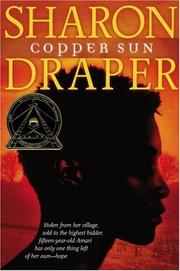
Copper sun
In 60 seconds
In 1739, fifteen-year-old Amari loses her fiancé, her family, and her Ghanaian village to slave raiders. She survives the Middle Passage and is sold in South Carolina to a plantation owner as a 'gift' for his son. There she befriends Polly, a white indentured girl, and Teenie, the kitchen cook who teaches her to survive. When Amari and Polly are ordered to kill a newborn baby, they run — south, toward Spanish Florida, where freedom is a place, not a dream.
Before you start
Why it matters
This is historical fiction that refuses to look away: the Middle Passage, auction blocks, and plantation rape are rendered plainly, for readers ready to face them. Draper pairs that brutality with fierce tenderness — women teaching each other to survive, a white girl unlearning her prejudice, a found family forming in flight. It matters for teens and adults studying slavery's human cost, and for anyone who wants a story where endurance is an act of rebellion.
Spoilers ahead
The story
- 1
Act 1
The World Before It Burns
Ziavi, an Ewe village in West Africa, 1739. Fifteen-year-old Amari is giddy with news: she is betrothed to Besa, a young man with skin like the color of the midnight sky. Her little brother Kwasi teases her mercilessly about it. When Besa visits, he gives her a copper sun — a small square of copper etched with a sun design — a promise of the life they will build. Her mother adds golden, topaz-colored earrings, telling her, 'We do not want to forget.' Her father is the village storyteller. The village life is depicted with rich detail, including her mother's storytelling, her father's pottery, the yam harvest, and the coming betrothal ceremony. Then the raiders come. Ashanti warriors and pale-skinned strangers attack Ziavi. Amari watches her father beheaded, sees her mother and brother killed, sees Besa shot with arrows. The village burns. The survivors are captured and chained together.
- 2
Act 2
The Coffle, the Castle, the Ship
Amari is forced to march with other captives to the coast, a brutal journey where many die, and she would not survive it without Afi, an older woman who becomes her anchor. Afi tells her, 'The spirit of the copper sun will never leave you. It is the flame of your spirit.' At Cape Coast Castle, a slave fortress, Amari is branded with a hot iron and thrown into a dark, filthy dungeon with other captives. She is stripped, examined, and raped by a white man. In the dungeon, Amari sees Besa one last time among the male captives; he has been broken. He tells her not to hope for him; he says he is 'no longer a man.' Then the ship. Afi arms her for the Middle Passage: 'We are the only ones who can help us. We must find strength within ourselves to survive,' and 'You must find beauty wherever you can and do whatever you must to survive.' Amari endures the Middle Passage chained in the ship's hold amid filth, disease, and death; women are raped by the crew, some captives jump into the sea to die, and Amari herself is repeatedly assaulted by a sailor. Afi gives Amari her final gift before they are separated at auction: she tells her, 'If you survive, then I live.'
- 3
Act 3
Derbyshire Farms
Charles Town, South Carolina. The auction block scene emphasizes the dehumanization of slavery: Amari is poked, examined, and valued like livestock, and she resolves inwardly never to let them take her spirit. Percival Derby of Derbyshire Farms buys her for sixty dollars, a birthday present for his sixteen-year-old son, Clay. Amari is renamed 'Myna' by the Derby household, a name she is forced to answer to, though she privately keeps her true name and identity. Teenie, a small, wise, elderly house slave, takes Amari under her wing at Derbyshire Farms, teaching her the rules of survival in the big house and warning her about Clay. Teenie is a strong-willed slave who runs the kitchen and cares for her young son, Tidbit. Teenie teaches her survival wisdom, including the warning to 'never let them see you cry.' Tidbit, a lively boy with a dog named Hushpuppy, becomes like a little brother. Fifteen-year-old Polly Pritchard, an indentured white servant, arrives at Derbyshire Farms to work off her parents' debt; she resents being assigned to work alongside 'savages' and initially holds deep racial prejudice. Amari is forced to work in the kitchen with Teenie and Polly; the two girls begin as adversaries but gradually form a bond through shared labor and shared suffering. Clay Derby brutally asserts his 'ownership' of Amari, raping her and declaring that she belongs to him; he calls her his 'personal property.' Polly witnesses Clay's abuse of Amari and, despite her prejudice, begins to understand the horror of Amari's situation. The girls' friendship deepens as Polly teaches Amari English and Amari teaches Polly about her African homeland. Amari discovers she is pregnant with Clay's child, a devastating realization that fills her with shame and despair. Polly secretly helps Amari by bringing her herbs (provided by Teenie) to induce a miscarriage, an act of solidarity that cements their friendship.
- 4
Act 4
The Baby, the Order, the Run
Mr. Derby receives news that his young wife, Isabelle Derby, is pregnant; he is overjoyed, unaware that the child's father is actually his handsome young slave, Noah. Mrs. Derby, a kind, lonely young woman, secretly confides in Amari and Polly that she is in love with Noah, a slave her own age, and that the baby she carries is his. During the hunt, Clay uses Tidbit as bait for an alligator, tying the boy near the water's edge; Amari and Polly watch in terror as Hushpuppy and Tidbit narrowly escape death. Mrs. Derby goes into labor prematurely; Amari and Polly help deliver the baby, who is clearly of mixed race, with light brown skin. Percival Derby discovers the truth about the baby's paternity; in a rage, he shoots and kills Noah in front of his wife, then orders the newborn infant to be killed as well. Mrs. Derby collapses in grief; Mr. Derby orders Amari and Polly to take the baby away and kill it. Instead they flee with the infant, Tidbit, and Hushpuppy, heading south toward Spanish Florida, where they hope to find freedom at Fort Mose near St. Augustine. Amari's knowledge of nature, learned in Africa, proves invaluable. The runaways are captured by a search party led by Mr. Derby's men; they are brought back, but a doctor named Dr. Hoskins, who is part of the party, secretly releases them, telling them to head south. Dr. Hoskins gives them food and supplies and sets them free, explaining that he cannot own another human being; he tells them about the Spanish settlement in Florida that offers freedom to escaped slaves. The fugitives encounter a group of Spanish soldiers who initially seem threatening but give them food and directions to St. Augustine. They are helped by an elderly woman named Fiona, an Irish woman living alone in the woods, who feeds them, hides them from a search party, and gives them supplies for their journey. The group crosses into Spanish territory and reaches Fort Mose, the free black settlement near St. Augustine, Florida, where they are welcomed. The Spanish authorities at St. Augustine formally declare the fugitives free, in accordance with Spain's policy of granting liberty to escaped English-colony slaves who reach Florida and accept Catholicism. At Fort Mose, Amari, Polly, and Tidbit are granted freedom by the Spanish; the baby is adopted by a nursing mother in the settlement. Amari chooses to stay at Fort Mose; Polly realizes she has no future in the colonies and decides to stay with Amari and Tidbit, declaring that they are a family. The novel ends with Amari looking toward the future, holding onto hope, her African identity intact, and her found family around her; she has found freedom at last.
Who's who
Characters
- AmariA fifteen-year-old Ewe girl from Ziavi whose betrothal gift — a copper sun — becomes her emblem of survival. Enslaved, renamed 'Myna,' and repeatedly violated, she keeps her true name private and walks to freedom at Fort Mose.
- Polly PritchardA fifteen-year-old white indentured servant working off her parents' debt, who arrives calling enslaved people 'savages.' Shared suffering in Teenie's kitchen remakes her into Amari's committed friend — and, at the end, her family.
- TeenieThe small, wise, elderly cook who runs the Derbyshire kitchen and mothers her son Tidbit. She schools Amari in the big house's survival rules, including 'never let them see you cry.'
- Clay DerbyThe sixteen-year-old son who receives Amari as a birthday present and calls her his 'personal property.' His violence — including using Tidbit as alligator bait — makes him the face of slavery's casual cruelty.
- AfiAn older captive who mothers Amari on the march and the Middle Passage, teaching her to find strength within. Her parting words — 'If you survive, then I live' — become Amari's charge.
- BesaAmari's betrothed, who gives her the copper sun. Seen once more in Cape Coast Castle's dungeon, broken, he tells her he is 'no longer a man' and not to hope for him.
- Mrs. Isabelle DerbyMr. Derby's kind, lonely young wife, in love with Noah, the slave her own age. Her baby's birth triggers the killing that sends Amari and Polly running.
- TidbitTeenie's lively little boy, with his dog Hushpuppy, who becomes a little brother to Amari. Clay uses him as alligator bait; he escapes and flees south with the women.
What it's really about
Themes
Identity that cannot be renamed
The Derby household calls Amari 'Myna'; she answers, but privately keeps her true name. Her mother's earrings — given with the words 'We do not want to forget' — are lost or taken during captivity, the physical stripping of her past, yet her memories of Ziavi remain her true treasure. Draper keeps testing what can be confiscated and what cannot: the body can be branded, sold, and violated, but the girl who remembers her father's stories and Besa's copper sun is still Amari. The book's point: slavery could command the name and the body, but memory was a country it could not burn.
Women teaching each other to survive
Survival in this novel is passed hand to hand. Afi walks Amari through the march and the ship hold, insisting, 'We are the only ones who can help us. We must find strength within ourselves to survive.' Teenie's kitchen becomes a refuge and school, where the lesson is 'never let them see you cry.' Polly, a white girl with every prejudice intact, brings the herbs that end Amari's pregnancy — solidarity crossing the color line at real risk. Draper's argument: under a system designed to isolate and break people, care itself is resistance, and the teachers are ordinary women with nothing left to give but wisdom.
Prejudice unlearned
Polly arrives at Derbyshire Farms resentful of working alongside 'savages,' sure of her own distance from the enslaved. Then she witnesses Clay's abuse of Amari, and the distance collapses. The girls trade knowledge — Polly teaches Amari English, Amari tells her of her African homeland — and shared labor does the rest. On the flight south, Polly's transformation from prejudiced servant to committed friend becomes one of the novel's central arcs, ending with her declaration that they are a family. Draper's point: racism is not a fixed essence but a position that proximity, honesty, and shared danger can dismantle.
Freedom as a place you can reach
The escape has a destination, not just a direction: Fort Mose near St. Augustine, the Spanish settlement offering liberty to escaped slaves from English colonies. Dr. Hoskins, who frees the runaways, explains it; Spanish soldiers feed them and point the way; Fiona hides them from a search party. When the Spanish authorities formally declare them free, the promise is kept in law, not just in hope. Draper's point: for the enslaved, freedom was not an abstraction — it was geography, borders, and people willing to defy their own side, and knowing the place existed is what made the running possible.
The body as battleground
Draper refuses euphemism. Amari is raped in Cape Coast Castle's dungeon, assaulted repeatedly by a sailor on the Middle Passage, and claimed by Clay Derby as his 'personal property.' Her pregnancy by Clay fills her with shame and despair, and Polly's herbs are an act of bodily self-defense the law would call a crime. Even a puppy given as a 'gift' becomes an instrument of control. The book's point: slavery's core violence was ownership of the body, and every act — from a miscarriage induced in secret to a run through the swamp — was a claim to one's own flesh.
Look closer
Symbols
- The copper sun
- Besa's betrothal gift — a small square of copper with a sun design — stands for the future Amari loses and the self she refuses to surrender. Afi names its power on the march: 'The spirit of the copper sun will never leave you. It is the flame of your spirit.' What the raiders burn, Amari carries.
- The golden earrings
- Her mother's betrothal gift, given with 'We do not want to forget,' is the last physical piece of Ziavi. Lost or taken during captivity, it marks the stripping away of identity — while the memory it stood for survives inside Amari, untouchable.
- The name 'Myna'
- The Derby household's imposed name is slavery's claim to own even language. Amari answers to it outwardly and keeps her true name privately — the split between the self the system sees and the self she preserves.
- Fort Mose
- The free Black settlement near St. Augustine is the novel's physical promise: freedom as a place on a map, not a metaphor. Reaching it — and being formally declared free by Spain — turns hope into law.
Spoilers
Ending explained
The ending is deliberately quiet after so much violence: a declaration of freedom, a baby adopted by a nursing mother, and Polly choosing to stay because, as she says, they are a family. Some readers may find the escape's helpers — a doctor, Irish settler, Spanish soldiers — too conveniently kind, a chain of good luck after chapters of cruelty. But the choice reads as intentional: Draper has shown the system's full machinery of evil, so she shows the real historical counterforce, Spain's policy of liberty for escaped English-colony slaves, which made Fort Mose a genuine refuge. The deeper resolution is internal. Amari ends with her African identity intact and hope intact — the two things the auction block was designed to strip. Whether you read the close as hard-won realism or as a necessary light for young readers, it lands because the cost was paid in full: Afi's words, 'If you survive, then I live,' are answered by a life actually lived.
For class or book club
Discussion questions
- 1.Polly's arc: does shared suffering genuinely dismantle prejudice in this novel, or does Draper rely on an idealized conversion? What would a less redemptive version look like?
Worth remembering
Best lines
“We do not want to forget.”
“The spirit of the copper sun will never leave you. It is the flame of your spirit.”
“If you survive, then I live.”
“never let them see you cry.”
A fair critique
Where it falls short
The novel's honesty about rape, branding, and murder is its strength and its barrier — it is a hard assign for younger teens, and some classrooms will need scaffolding. The escape sequence leans on a run of merciful strangers — Dr. Hoskins, Fiona, Spanish soldiers — that can feel engineered, and the villains, Clay above all, are drawn with less interiority than the women. Polly's prejudice dissolves quickly enough that skeptics may want more friction. None of this undoes the book's power, but readers should expect a moral clarity that simplifies some of the era's messier complicity.
In one sentence
They could brand her, rename her, and sell her body — but Amari carried her name, her memory, and her copper sun all the way to freedom.
Is it for you?
Who should read it
Readers who want the unvarnished history of slavery told through one girl's eyes, not a textbook. It's also for anyone who believes found family can be stronger than blood — and who needs a story where survival and hope win.
4 questions
Quick quiz: how well do you know Copper sun?
0 of 4 answered
FAQ
Who wrote Copper sun?
Copper sun was written by Sharon m. draper and first published in 2006.
What genre is Copper sun?
Copper sun is listed under Children & Young Adult.
More Children & Young Adult summariesWhere is Copper sun set?
Copper sun is set in South Carolina, 1565-1763 Spanish colony and Florida.
How many pages is Copper sun?
Copper sun is about 314 pages long (the median page count across its editions, per Open Library).