About the nudge
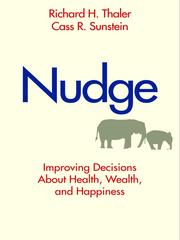
Nudge: Improving Decisions About Health, Wealth, and Happiness" by Richard H. Thaler and Cass R. Sunstein introduces the concept of "nudges" and "libertarian paternalism." The book argues that individuals often make suboptimal choices due to cognitive biases and heuristics, even when faced with important decisions regarding their health, finances, and well-being. Rather than relying on traditional economic models that assume perfectly rational actors ("Econs"), Thaler and Sunstein propose a more realistic view of human behavior ("Humans") which acknowledges our predictable irrationalities.
A central tenet of the book is that "choice architects"—anyone who designs the context in which people make choices—can subtly influence decisions without restricting options or significantly altering economic incentives. These influences, or nudges, guide people towards better outcomes while preserving their freedom of choice. Examples range from defaulting employees into retirement savings plans to arranging food in a cafeteria to promote healthier eating. The authors advocate for "libertarian paternalism," a philosophy that combines the libertarian ideal of free choice with the paternalistic goal of improving welfare.
The book's significance lies in its practical application of behavioral economics to public policy and private sector design. It demonstrates how small, seemingly insignificant changes in presentation or default settings can have a profound impact on individual and societal outcomes. "Nudge" has influenced governments and organizations worldwide to implement policies that leverage behavioral insights to help people make choices that align with their long-term interests, from organ donation programs to energy conservation efforts, making it a foundational text in applied behavioral science.
Key takeaways
- Recognize that humans are predictably irrational, often relying on heuristics and biases rather than pure logic.
- Understand that every choice environment has a "choice architect" whose design influences decisions, whether intentionally or not.
- Implement "nudges" – subtle interventions that guide people towards better outcomes without removing their freedom of choice.
- Consider default options carefully, as they are powerful nudges that significantly impact behavior.
- Design systems that make desired behaviors easier and more convenient, leveraging inertia and cognitive shortcuts.
- Use transparent and non-coercive methods to improve welfare, adhering to the principles of libertarian paternalism.
- Be aware of the power of social norms and feedback mechanisms to encourage positive change.
Key ideas at a glance
Behavioral Economics
- Consider default options carefully, as they are powerful nudges that significantly impact behavior.
- Design systems that make desired behaviors easier and more convenient, leveraging inertia and cognitive shortcuts.
Choice Architecture
- Understand that every choice environment has a "choice architect" whose design influences decisions, whether…
- Implement "nudges" – subtle interventions that guide people towards better outcomes without removing their freedom of…
Libertarian Paternalism
- Use transparent and non-coercive methods to improve welfare, adhering to the principles of libertarian paternalism.
Cognitive Biases
- Recognize that humans are predictably irrational, often relying on heuristics and biases rather than pure logic.
Public Policy
- Be aware of the power of social norms and feedback mechanisms to encourage positive change.
Chapter summaries
Part I: Humans and Econs
This section introduces the foundational concepts of "libertarian paternalism" and "choice architecture," arguing that it's possible to influence people's decisions without restricting their freedom of choice. Thaler and Sunstein distinguish between "Econs," who are perfectly rational, and "Humans," who are susceptible to various cognitive biases and heuristics. They detail several biases, including anchoring (e.g., the influence of an initial number), availability (overestimating risks based on vivid memories), representativeness (judging probability based on stereotypes), and loss aversion (the pain of losing is greater than the pleasure of gaining). The authors also discuss the two systems of thinking – the Automatic System (intuitive, fast) and the Reflective System (deliberate, slow) – explaining how these systems interact to shape our choices and why nudges are often necessary to help Humans make better decisions for themselves.
Part II: Choice Architecture
This part delves into the practical application of nudges through the design of "choice architecture." The authors highlight the profound impact of defaults, using examples like opt-in versus opt-out systems for retirement savings (e.g., 401(k) plans) or organ donation, where changing the default significantly alters participation rates. They explore other effective nudging tools, such as clear disclosure (e.g., nutritional labels), simplification of complex information, and timely reminders (e.g., for appointments or bill payments). The concept of "when less is more" is introduced, arguing that reducing the number of choices can sometimes improve decision-making by preventing overload. The authors also introduce the negative counterpart to a nudge, "sludge," which refers to choice architecture that makes decisions unnecessarily difficult or burdensome, often to the detriment of the decision-maker.
Part III: Money
Thaler and Sunstein apply nudging principles to the realm of personal finance and public policy related to money. A key example is the "Save More Tomorrow" (SMarT) program, designed to help employees increase their retirement savings by automatically escalating their contribution rates with future pay raises, allowing them to commit to saving more without feeling the immediate pinch. The book also discusses the complexities of Social Security, arguing against full privatization due to behavioral pitfalls and advocating for nudges to improve the existing system, such as clearer communication about benefits. They touch upon investment decisions, highlighting how individuals often make suboptimal choices due to biases like overconfidence or herd mentality, and suggest ways choice architecture can guide people towards better financial security.
Part IV: Health
This section explores how nudges can be effectively used to improve health outcomes and public health policies. The authors critically examine the Medicare Part D prescription drug program, illustrating how its complex structure and overwhelming number of plan options led many elderly beneficiaries to make poor choices, often resulting in higher costs or inadequate coverage. They propose simpler choice architectures and defaults to guide people toward more suitable plans. Another significant example discussed is organ donation, where the book contrasts different national systems (e.g., presumed consent in some European countries versus explicit consent in the US) to demonstrate how a simple change in the default option can dramatically increase the supply of organs for transplantation, saving lives without coercing individuals.
Part V: The Environment and Marriage
Expanding the application of nudges beyond individual decisions, this part addresses broader societal issues. For environmental concerns, the authors discuss how behavioral insights can encourage more sustainable behaviors. Examples include providing households with clear, comparative feedback on their energy consumption relative to neighbors, which acts as a powerful social norm nudge to reduce usage. They also explore how default options, such as opting into green energy programs, can increase participation. On the topic of marriage, the book advocates for marriage equality, arguing that legal frameworks and social norms significantly influence individual well-being and societal fairness. They suggest that removing legal barriers and promoting inclusive policies can serve as a powerful societal nudge towards greater equality and happiness.
Part VI: Improving Decision Making
This section presents a diverse range of applications for nudges across various public policy domains. The authors discuss how choice architecture can be used to improve educational outcomes, specifically in the context of school choice programs, by designing enrollment processes and information presentation to help parents make better decisions for their children. They also explore health care reform, suggesting nudges to encourage healthier lifestyles, improve adherence to medical treatments, and streamline the healthcare system for both providers and patients. Further applications include using nudges in international development to promote economic growth and well-being in developing countries, and even in national security contexts, demonstrating the broad and versatile potential of behavioral insights to enhance decision-making in complex environments.
Part VII: Objections and Extensions
The final part addresses common criticisms and ethical considerations surrounding the concept of nudging and libertarian paternalism. Thaler and Sunstein tackle concerns about manipulation, the potential for government overreach, and whether nudges infringe on individual autonomy. They reiterate that nudges, by definition, preserve freedom of choice, as individuals can always opt out or choose differently. The authors also discuss the "slippery slope" argument, asserting that transparent and well-intentioned nudges are distinct from coercive measures. They look to the future of nudging, envisioning its continued application in public policy, private sector initiatives, and even personal self-nudging, emphasizing its potential to improve human welfare while respecting individual liberty and fostering ongoing debate about its appropriate scope and implementation.
Full summary
"Nudge," authored by Richard H. Thaler and Cass R. Sunstein, explores how behavioral economics can influence decision-making. The book examines the concept of "libertarian paternalism," advocating for subtle policy shifts that steer individuals towards better choices without restricting freedom.
Key ideas include the importance of choice architecture, where the way options are presented significantly impacts decisions. The authors discuss how defaults, framing, and social norms can nudge people towards healthier behaviors, smarter financial choices, and improved personal outcomes, especially in areas like health and finance.
Thaler and Sunstein introduce concepts like "nudges"—small changes that can lead to significant behavioral shifts. They emphasize the role of government and organizations in facilitating beneficial nudges while respecting individual autonomy.
Through insights into human psychology, the book challenges traditional economic theories and promotes a better unders...
Memorable quotes
“A nudge, as we will use the term, is any aspect of the choice architecture that alters people's behavior in a predictable way without forbidding any options or significantly changing their economic incentives.”
“The libertarian aspect of our approach lies in the insistence that, in general, people should be free to choose what they like.”
“The paternalistic aspect lies in the claim that it is legitimate for choice architects to try to influence people's behavior in order to make their lives longer, healthier, and better.”
“If you want people to do something, make it easy.”
“There is no such thing as a neutral design.”
“Small and apparently insignificant details can have major effects on people's behavior.”
Themes
- Behavioral Economics
- Choice Architecture
- Libertarian Paternalism
- Cognitive Biases
- Public Policy
- Decision Making
About the author
Richard H. Thaler is an American economist and Nobel laureate known for his contributions to behavioral economics. He is a professor at the University of Chicago Booth School of Business and has authored several books, including "Misbehaving: The Making of Behavioral Economics." Cass R. Sunstein is an American legal scholar and former Administrator of the White House Office of Information and Regulatory Affairs. He is a professor at Harvard Law School and has written extensively on constitutional law, environmental law, and behavioral economics. They co-wrote "Nudge" to popularize the idea that subtle interventions can significantly improve human decision-making in areas like health, wealth, and happiness, bridging the gap between academic theory and practical application.
FAQ
What is the nudge about?
"Nudge" explores how subtle changes in the way choices are presented, known as "nudges," can significantly influence human behavior without restricting freedom. It introduces "libertarian paternalism," advocating for policies that guide people towards better decisions in health, wealth, and happiness by leveraging insights from behavioral economics, while still preserving their right to choose.
Is the nudge worth reading?
Yes, "Nudge" is highly influential and worth reading for anyone interested in understanding human decision-making, public policy, or behavioral science. It offers practical insights into how environments can be designed to help people make better choices, making it relevant for policymakers, marketers, educators, and individuals seeking to improve their own lives.
How does the nudge end?
Spoiler: The book concludes by reinforcing the ethical framework of libertarian paternalism and discussing the future potential of nudging. It addresses common objections, emphasizes the transparency and freedom-preserving nature of effective nudges, and calls for thoughtful, evidence-based choice architecture to improve societal welfare across various domains.
Who should read the nudge?
Policymakers, economists, psychologists, marketers, business leaders, and anyone interested in understanding human behavior and how environmental design influences choices will find "Nudge" highly valuable. It's particularly relevant for those looking to design systems that encourage better decision-making without resorting to mandates or bans.
How long does it take to read the nudge?
"Nudge" is approximately 300 pages long. At an average reading speed of 250 words per minute, it would take roughly 6-8 hours to read the entire book.