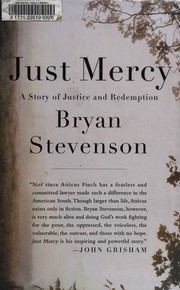
About Just Mercy
Bryan Stevenson's "Just Mercy" is a powerful memoir and exposé that chronicles his work as a civil rights lawyer and founder of the Equal Justice Initiative (EJI) in Alabama. The book primarily focuses on the case of Walter McMillian, a Black man wrongly convicted and sentenced to death for the murder of a white woman in Monroeville, Alabama, in the late 1980s. Stevenson meticulously details the systemic racism, prosecutorial misconduct, and judicial indifference that led to McMillian's unjust incarceration, highlighting how poverty and race often determine legal outcomes in America.
Beyond McMillian's story, Stevenson weaves in accounts of other clients—juveniles sentenced to life without parole, women abused by the system, and individuals with mental disabilities facing execution—to illustrate the pervasive injustices within the U.S. criminal justice system. He argues that proximity to the marginalized is essential for understanding and addressing these issues, and that mercy, not just justice, is crucial for a truly fair society. The book is a compelling call to action, challenging readers to confront uncomfortable truths about America's past and present, and to advocate for a more compassionate and equitable legal system.
Key takeaways
- Recognize that the American justice system is deeply flawed and disproportionately impacts the poor and people of color.
- Understand that proximity to those suffering injustice is essential for true empathy and effective advocacy.
- Advocate for reforms that address systemic issues like wrongful convictions, excessive sentencing, and racial bias in the courts.
- Support organizations like the Equal Justice Initiative that provide legal representation to the most vulnerable.
- Challenge the prevailing narratives about crime and punishment, and embrace the importance of mercy and redemption.
- Never lose hope in the possibility of justice, even in the face of overwhelming adversity and resistance.
- Consider how your own biases might contribute to or perpetuate injustice, and actively work to dismantle them.
Key ideas at a glance
Racial injustice
- Understand that proximity to those suffering injustice is essential for true empathy and effective advocacy.
- Consider how your own biases might contribute to or perpetuate injustice, and actively work to dismantle them.
Wrongful conviction
- Advocate for reforms that address systemic issues like wrongful convictions, excessive sentencing, and racial bias in…
Systemic bias
- Recognize that the American justice system is deeply flawed and disproportionately impacts the poor and people of color.
Mercy and redemption
- Challenge the prevailing narratives about crime and punishment, and embrace the importance of mercy and redemption.
Juvenile justice
- Support organizations like the Equal Justice Initiative that provide legal representation to the most vulnerable.
- Never lose hope in the possibility of justice, even in the face of overwhelming adversity and resistance.
Chapter summaries
Introduction: Higher Ground
Bryan Stevenson recounts his early experiences working with death row inmates in Georgia, which profoundly shaped his understanding of systemic injustice and led him to found the Equal Justice Initiative (EJI) in Alabama. He describes the profound impact of witnessing the despair and marginalization faced by the poor and racially discriminated within the legal system. This section introduces his unwavering commitment to representing those on death row, particularly in the Deep South, where racial bias and poverty heavily influence legal outcomes. He shares his initial, pivotal encounter with Walter McMillian, a Black man wrongly convicted of murder and sentenced to death, setting the stage for the central narrative of the book and establishing the overarching themes of injustice, mercy, and the relentless fight for human dignity against overwhelming odds.
Chapter 1: Mockingbird
Stevenson details his move to Alabama to establish the Equal Justice Initiative (EJI) and immediately takes on the case of Walter McMillian. Walter, a Black man, was convicted and sentenced to death for the 1987 murder of Ronda Morrison, a young white woman, in Monroeville, Alabama – the hometown of Harper Lee. Stevenson quickly uncovers disturbing irregularities: Walter had a strong alibi, corroborated by multiple witnesses, placing him at a fish fry at the time of the murder. Despite this, he was swiftly arrested, held on death row before trial, and convicted based solely on the coerced testimony of a white career criminal named Ralph Myers, who later recanted parts of his story. This chapter highlights the immediate racial prejudice and procedural misconduct Stevenson encountered.
Chapter 2: The Old Rugged Cross
This chapter delves deeper into the circumstances surrounding Walter McMillian's arrest and conviction. Stevenson details how Walter, a respected Black businessman with no prior criminal record, was targeted by law enforcement. He was arrested months after the murder, without any physical evidence linking him to the crime, and immediately placed on death row, a highly unusual pre-trial detention. The narrative exposes the intense racial animosity in Monroeville, where Walter's interracial affair was widely known and likely fueled the desire for his conviction. The chapter further elaborates on the coercion of Ralph Myers, who was pressured by police to implicate Walter, and the devastating impact of Walter's incarceration on his family and community.
Chapter 3: Stand
Stevenson begins the arduous legal battle to appeal Walter McMillian's conviction, immediately encountering significant resistance from the local legal establishment, including the district attorney and the judge, who are deeply entrenched in the racially biased system of Monroeville. Stevenson describes the immense challenges of navigating a justice system that seems determined to uphold convictions, even in the face of mounting evidence of innocence and clear procedural misconduct. He highlights the difficulty of convincing courts to re-examine cases, especially when racial prejudice is a clear underlying factor, and how the community's desire for a quick conviction overshadowed the pursuit of truth. This chapter underscores the isolation and hostility Stevenson and EJI encountered in their efforts to challenge deeply ingrained injustices in the Deep South.
Chapter 4: The Stonecatchers
This chapter broadens the scope beyond Walter McMillian's case to illustrate the systemic issues EJI confronts daily. Stevenson introduces other clients, such as Joe Sullivan, a child offender sentenced to life without parole for a non-lethal crime committed at age thirteen, and Ian Manuel, another child sentenced to life without parole for a robbery where no one was killed. These stories highlight the harshness of mandatory sentencing laws and the criminalization of youth, particularly children of color. Stevenson uses these examples to demonstrate how the justice system often fails to consider mitigating factors like trauma, mental illness, or developmental immaturity, instead opting for punitive measures that disproportionately affect the most vulnerable.
Chapter 5: The Gospel of the Trees
Stevenson continues to build Walter McMillian's defense, focusing on dismantling the prosecution's case. He meticulously investigates Ralph Myers's coerced testimony, finding numerous inconsistencies and contradictions in his various statements. Stevenson also uncovers the complete lack of physical evidence connecting Walter to the crime scene or the victim. He details the efforts to interview witnesses who could corroborate Walter's alibi and expose the flaws in the state's narrative. This chapter emphasizes the painstaking work required to expose a wrongful conviction, highlighting how the initial investigation was rushed and biased, ignoring any evidence that did not fit the predetermined narrative of Walter's guilt.
Chapter 6: The Color of Water
Stevenson explores the deep historical roots of racial injustice in the American South, connecting the legacy of slavery and Jim Crow laws to contemporary issues in the criminal justice system. He discusses how racial terror and violence were used to maintain social order and and how these patterns persist in the disproportionate sentencing and treatment of Black individuals. The chapter includes the story of a young Black man sentenced to death for a non-lethal crime, illustrating how racial bias can lead to extreme punishments. Stevenson argues that the system is not merely broken but was designed in ways that perpetuate racial hierarchy, making the fight for justice a struggle against deeply entrenched societal prejudices.
Chapter 7: The Lemon Tree
This chapter focuses on the story of Herbert Richardson, a Vietnam War veteran suffering from severe PTSD and brain damage, who was on death row. Stevenson describes his efforts to appeal Herbert's conviction and sentence, arguing for clemency due to his mental health issues and the trauma he endured serving his country. Despite Stevenson's passionate advocacy and the clear evidence of Herbert's psychological distress, the state proceeds with his execution. Stevenson recounts the emotional toll of witnessing Herbert's final moments, sharing the deeply personal impact of these experiences on him and his team, and underscores the profound moral questions surrounding capital punishment for the mentally ill.
Chapter 8: All God's Children
Stevenson broadens his focus to the issue of children sentenced to life without parole, arguing against the notion that children are inherently irredeemable. He introduces the case of Antonio Nunez, a young boy from a troubled background who committed a crime at a young age and was sentenced to die in prison. Stevenson highlights the scientific understanding of adolescent brain development, which shows that children lack the full capacity for judgment and impulse control of adults. He details EJI's legal challenges to these extreme sentences, advocating for rehabilitation and second chances, and exposing how poverty and lack of resources often funnel vulnerable children into the criminal justice system.
Chapter 9: I'll Fly Away
The narrative returns to Walter McMillian's case, detailing the ongoing appeal process and the growing momentum for his release. Stevenson describes the painstaking work of gathering more evidence, including affidavits from witnesses who saw Walter at the fish fry, and further exposing the inconsistencies in Ralph Myers's testimony. The Alabama Court of Criminal Appeals begins to take notice of the irregularities. This chapter emphasizes the slow, incremental nature of legal change and the immense perseverance required to challenge a wrongful conviction. Stevenson highlights the emotional toll on Walter, who remains on death row despite the mounting evidence of his innocence, and the hope that begins to emerge.
Chapter 10: The Season of the Dead
Stevenson recounts the story of George Daniel, a mentally ill man on death row who suffered from severe delusions and paranoia. Despite his obvious mental incapacitation, the state moved forward with his execution. Stevenson describes his desperate attempts to secure a stay of execution, arguing that George was not competent to be executed, as he could not understand the reason for his punishment. This chapter powerfully illustrates the justice system's failure to adequately address mental illness, often conflating it with criminality. Stevenson shares the harrowing experience of witnessing George's execution, further highlighting the moral and ethical dilemmas of capital punishment and its impact on those who administer it.
Chapter 11: The Sticking Place
The fight for Walter McMillian intensifies as Stevenson uncovers crucial exculpatory evidence that had been deliberately withheld by the prosecution. He discovers that the state had suppressed police reports and witness statements that directly contradicted Ralph Myers's testimony and supported Walter's alibi. This revelation leads to the involvement of the state's new Attorney General, who, unlike the local authorities, shows a willingness to investigate the misconduct. The chapter details the growing public and media attention on Walter's case, which begins to shift public opinion and put pressure on the legal system to address the injustice.
Chapter 12: The Reckoning
This chapter describes the pivotal evidentiary hearing for Walter McMillian, a dramatic turning point in his case. Stevenson presents the overwhelming evidence of Walter's innocence, including the suppressed exculpatory evidence that had been deliberately withheld by the prosecution, and the detailed testimonies of multiple alibi witnesses. The most impactful moment comes when Ralph Myers, the key prosecution witness, publicly recants his entire testimony, admitting under oath that he was coerced by law enforcement to falsely implicate Walter. The judge, faced with irrefutable proof of prosecutorial misconduct and Walter's innocence, is compelled to rule in Walter's favor, setting the stage for his eventual release from death row.
Chapter 13: Recovery
Walter McMillian is finally released from death row, after six years of wrongful incarceration. Stevenson describes the emotional moment of his freedom and the initial joy, but also the profound challenges Walter faces in adjusting to life outside prison. Walter struggles with the psychological trauma of his experience, the loss of his business and family relationships, and the difficulty of navigating a changed world. This chapter highlights that freedom is not a simple solution for exonerees; they often receive little support and must contend with lasting emotional and physical scars. Stevenson emphasizes the ongoing need for compassion and assistance for those who have been unjustly imprisoned.
Chapter 14: Broken
Stevenson reflects on the long-term consequences of wrongful convictions and the systemic issues that persist even after an individual is exonerated. He details Walter McMillian's declining health, both physical and mental, as he struggles with dementia and the lingering trauma of his time on death row. Walter eventually passes away, never fully recovering from his ordeal. This chapter underscores the devastating, irreversible damage inflicted by a flawed justice system. Stevenson uses Walter's story to emphasize the ongoing work of EJI in fighting for systemic reform, advocating for better support for exonerees, and challenging the death penalty and extreme sentencing practices that disproportionately affect the poor and people of color.
Epilogue: Mercy
In the epilogue, Stevenson offers his concluding reflections on the themes of justice, mercy, and redemption. He emphasizes the importance of "proximity" – getting close to those who are suffering and marginalized – as essential for understanding injustice and inspiring change. He argues that true justice requires not only fairness but also compassion and a willingness to acknowledge the humanity of all individuals, even those society has condemned. Stevenson reiterates the need for systemic reform, challenging the punitive culture of the American justice system and advocating for a more hopeful and redemptive approach. He concludes with a powerful message about the enduring power of hope and the ongoing fight for a more just and merciful society.
Full summary
"Just Mercy" by Bryan Stevenson is a powerful exploration of the injustices within the American criminal justice system, particularly as they affect marginalized communities. Stevenson, a lawyer and social justice advocate, shares his experiences defending those wrongfully convicted, illuminating systemic racism and the death penalty’s flaws.
The narrative centers on Walter McMillian, a Black man wrongfully accused of murder in Alabama. Stevenson delves into McMillian's case, exposing the deep-seated corruption and bias in law enforcement and legal proceedings. Major themes include mercy, redemption, and the impact of poverty on justice, prompting readers to reflect on their own beliefs about punishment and forgiveness.
Key characters include Walter McMillian, whose tragic story serves as a catalyst for Stevenson’s advocacy, and the numerous clients who exemplify the systemic failures of the legal system. Stevenson’s personal anecdotes create emotional resonance, allowing readers ...
Memorable quotes
“Each of us is more than the worst thing we've ever done.”
“The opposite of poverty is not wealth; the opposite of poverty is justice.”
“We have a system of justice in this country that treats you much better if you're rich and guilty than if you're poor and innocent.”
“Mercy is most needed when it is least deserved.”
“You can't understand most of the important things from a distance, Bryan. You have to get close.”
Themes
- Racial injustice
- Mass incarceration
- Wrongful conviction
- Systemic bias
- Mercy and redemption
- Juvenile justice
About Bryon Stevenson
Bryan Stevenson is an American lawyer, social justice activist, founder and executive director of the Equal Justice Initiative (EJI), and a professor at New York University School of Law. He has dedicated his career to defending the poor, the incarcerated, and the condemned. "Just Mercy" is his most acclaimed book, written to shed light on the systemic injustices he has witnessed and fought against throughout his career, particularly in the context of mass incarceration and racial bias in the U.S. criminal justice system. He is also known for his powerful TED Talk on the need for justice.
FAQ
What is Just Mercy about?
"Just Mercy" is about Bryan Stevenson's work as a civil rights lawyer and founder of the Equal Justice Initiative (EJI) in Alabama. It primarily details the wrongful conviction and death sentence of Walter McMillian, a Black man, and explores the systemic racism, poverty, and injustice prevalent in the American criminal justice system through various client stories.
Is Just Mercy worth reading?
Yes, "Just Mercy" is widely considered a profoundly important and impactful book. It offers a deeply personal and unflinching look at the injustices within the U.S. legal system, particularly concerning race and poverty. Readers praise its ability to evoke empathy, challenge assumptions, and inspire action for a more just society.
How does Just Mercy end?
Spoiler: "Just Mercy" culminates with the successful exoneration and release of Walter McMillian, the central figure of the book, after years of Bryan Stevenson's relentless legal efforts. While celebrating this victory, the book also highlights the ongoing struggles of other clients and the pervasive issues within the justice system, ending with a call for continued hope and advocacy for mercy and justice.
Who should read Just Mercy?
"Just Mercy" is essential reading for anyone interested in civil rights, criminal justice reform, racial equality, and social justice. It is particularly recommended for students, legal professionals, activists, and general readers who wish to understand the human cost of systemic injustice and the power of dedicated advocacy.
How long does it take to read Just Mercy?
On average, it takes approximately 7 to 9 hours to read "Just Mercy" for most readers. This estimate can vary based on individual reading speed and whether the reader pauses to reflect on the complex legal and ethical issues presented in the book.