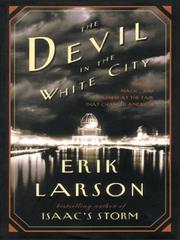
About The Devil in the White City: Murder, Magic, and Madness at the Fair That Changed America.
Erik Larson's "The Devil in the White City" masterfully intertwines the stories of two men whose lives intersected with the 1893 Chicago World's Columbian Exposition. On one hand is Daniel H. Burnham, the brilliant architect and director of works, who, alongside his partner John Root, faced immense pressure and logistical challenges to transform a swampy patch of land into the breathtaking 'White City' – a symbol of American ingenuity, progress, and architectural grandeur. His narrative details the Herculean efforts, political maneuvering, and personal sacrifices required to bring such a monumental undertaking to fruition, showcasing the birth of modern urban planning and the dazzling spectacle that captivated millions.
Running parallel to this tale of ambition and creation is the chilling story of Dr. H.H. Holmes, a charismatic and psychopathic serial killer who used the fair's allure and the city's transient population as a hunting ground. Holmes, whose real name was Herman Webster Mudgett, built a hotel near the fairgrounds, meticulously designed with gas chambers, soundproofed rooms, and a basement crematorium, which he dubbed his 'Murder Castle.' Larson skillfully contrasts the dazzling idealism of the fair with the dark underbelly of human depravity, exploring how the anonymity and excitement of the era provided perfect cover for Holmes's horrific crimes. The book is a gripping historical account that reveals both the heights of human achievement and the depths of human evil during a pivotal moment in American history.
Key takeaways
- Grand visions require extraordinary perseverance and collaboration, as exemplified by Daniel Burnham and his team in building the White City.
- Beneath the veneer of progress and spectacle, human depravity can lurk undetected, exploiting the very conditions that foster innovation and excitement.
- The 1893 World's Columbian Exposition was a pivotal moment in American history, showcasing technological advancements and influencing urban planning and culture.
- Even with meticulous planning, large-scale projects are susceptible to unforeseen challenges, political infighting, and the whims of powerful individuals.
- The anonymity of a rapidly growing city can provide fertile ground for individuals with sinister intentions to operate without immediate detection.
- The book highlights the stark contrast between human ambition to create beauty and progress, and the capacity for immense cruelty and destruction.
- Historical events are often shaped by a complex interplay of individual genius, collective effort, and the darker aspects of human nature.
Key ideas at a glance
Ambition and progress
- The book highlights the stark contrast between human ambition to create beauty and progress, and the capacity for…
Good vs
- Grand visions require extraordinary perseverance and collaboration, as exemplified by Daniel Burnham and his team in…
Urban development
- The 1893 World's Columbian Exposition was a pivotal moment in American history, showcasing technological advancements…
Deception and spectacle
- Even with meticulous planning, large-scale projects are susceptible to unforeseen challenges, political infighting, and…
Human depravity
- Beneath the veneer of progress and spectacle, human depravity can lurk undetected, exploiting the very conditions that…
- Historical events are often shaped by a complex interplay of individual genius, collective effort, and the darker…
Anonymity of cities
- The anonymity of a rapidly growing city can provide fertile ground for individuals with sinister intentions to operate…
Chapter summaries
Prologue
The prologue introduces the dual narrative of the book, setting the stage in late 19th-century Chicago. It briefly touches upon the city's ambition to host the World's Columbian Exposition and introduces the two main figures whose lives will intertwine: Daniel Burnham, the architect tasked with building the Fair, and H.H. Holmes, a charming but sinister doctor who begins constructing his 'World's Fair Hotel' in Englewood. The chapter hints at the immense challenges Burnham will face in creating the 'White City' and the dark secrets Holmes will conceal within his 'Murder Castle,' establishing the contrasting themes of creation and destruction, beauty and horror.
Part I: The Fair
This section delves into the arduous process of organizing and designing the World's Columbian Exposition. Daniel Burnham and his partner John Root are appointed as the lead architects, facing immense pressure, political infighting, and the daunting task of transforming a swampy site into a grand 'White City.' They assemble a team of prominent architects and landscape designers, including Frederick Law Olmsted. Simultaneously, H.H. Holmes establishes himself in Chicago, building his elaborate hotel near the fairgrounds, meticulously designing it with secret passages, soundproof rooms, and a basement equipped for his horrific purposes. He begins to lure and defraud victims, primarily women, into his deadly trap.
Part II: The Palace of Fine Arts
Construction of the World's Fair progresses, fraught with engineering challenges, labor disputes, and the relentless Chicago weather. A major setback occurs with the sudden death of John Root, leaving Daniel Burnham to shoulder the immense burden of the Fair's completion alone. Burnham, though devastated, pushes forward, driven by the vision of the 'White City.' Meanwhile, H.H. Holmes's murderous activities escalate. He continues to exploit and kill his victims, often women drawn to Chicago by the promise of the Fair, disposing of their bodies with chilling efficiency, utilizing his custom-built crematorium and acid vats in the hotel's basement. The fair's deadline looms, and the pressure on Burnham is immense.
Part III: The City of the Dead
The World's Columbian Exposition finally opens, initially struggling with low attendance and public perception, partly due to the ongoing economic depression. However, the Fair eventually becomes a resounding success, drawing millions of visitors who marvel at its grandeur, technological innovations, and architectural beauty. The 'White City' becomes a symbol of American ingenuity and progress. Amidst this triumph, H.H. Holmes continues his reign of terror, preying on fair visitors and employees. His crimes become more audacious, including the murder of his mistress and her children, as he skillfully evades suspicion, using his charm and cunning to manipulate those around him. The contrast between the fair's brilliance and Holmes's darkness is stark.
Part IV: The Last Dance
The World's Fair concludes, leaving behind a profound legacy but also the melancholy of its dismantling. Daniel Burnham reflects on the monumental achievement and the personal cost. Simultaneously, H.H. Holmes's carefully constructed world begins to unravel. He flees Chicago, embarking on a cross-country crime spree that includes insurance fraud and the brutal murder of his business partner, Benjamin Pitezel, and three of Pitezel's children. Detective Frank Geyer is assigned to the case, meticulously tracking Holmes across multiple states. The investigation eventually leads to Holmes's capture in Boston and the horrifying discovery of his 'Murder Castle' in Chicago, revealing the full extent of his atrocities.
Epilogue
The epilogue details the aftermath of Holmes's capture and the subsequent investigation into his crimes. Detective Geyer's relentless pursuit leads to the discovery of numerous bodies and evidence within Holmes's hotel, shocking the nation. Holmes is brought to trial, convicted, and eventually executed, maintaining a chilling composure to the end. The chapter also revisits the fates of the key figures involved in the World's Fair, including Daniel Burnham, who continued to shape American cities, and Frederick Law Olmsted. It reflects on the lasting impact of the 'White City' on architecture, urban planning, and American identity, contrasting its ephemeral beauty with the enduring horror of Holmes's legacy.
Full summary
Book Overview
"The Devil in the White City: Murder, Magic, and Madness at the Fair That Changed America" by Erik Larson is a non-fiction narrative that interweaves the stories of the 1893 Chicago World's Fair and the infamous serial killer H.H. Holmes. The book highlights the juxtaposition of human triumph and despair, examining how the architectural marvels of the fair were constructed alongside the dark machinations of Holmes, who exploited the fair’s excitement for his own nefarious purposes.
Main Content/Plot
The narrative is divided into two primary threads: one follows Daniel H. Burnham, the chief architect behind the Chicago World's Fair, and the other centers on H.H. Holmes, who lured victims to his hotel, dubbed the "Murder Castle."
Burnham faces numerous challenges while assembling the fair, including financial setbacks, political interferences, and logistical hurdles. His vision of a grand architectural showcase—a “White City”—emerges as a symbol of American ingenuity and progress, featuring neoclassical structures and innovative designs that would influence urban architecture for generations.
In parallel, Holmes, a charming but sinister figure, uses the excitement of the fair to attract young women to his hotel, where he commits heinous acts. His cunning and manipulative nature is explored through the accounts of his victims and the investigation that eventually leads to his capture.
Key Themes
Architecture as a Reflection of Society
One of the prominent themes in the first half of the book is the role of architecture as both a representation of societal aspirations and a catalyst for urban transformation. The Chicago World's Fair epitomizes the ambition of a nation striving for greatness, showcasing cutting-edge design and a commitment to progress. Burnham's architectural endeavors reflect a collective desire to redefine American identity in the post-Civil War era.
Moreover, the fair’s structures symbolize hope and innovation, contrasting sharply with the dark undercurrents embodied by Holmes. The duality of beauty and horror—exemplified through the fair's awe-inspiring buildings and Holmes’s gruesome acts—illustrates how architecture can simultaneously uplift and conceal societal issues.
Important Takeaways
1. Duality of Human Nature: The contrast between the ambitious spirit of the fair and the malevolent actions of Holmes serves as a commentary on the complexity of human nature, where progress and depravity can coexist.
2. Impact of Architecture: The Chicago World's Fair not only transformed the city but also set precedents for
Memorable quotes
“Make no little plans; they have no magic to stir men's blood and probably themselves will not be realized.”
“The fair, in the end, was a kind of urban dream, a place where the ordinary rules of the city did not apply.”
“He was a man of many names, but he was also a man of many faces, and he wore them all with equal ease.”
“The White City was a place of dreams, but the Black City was a place of nightmares.”
“The city was a place of constant motion, of ceaseless change, and in its vastness, a man could disappear without a trace.”
Themes
- Ambition and progress
- Good vs. evil
- Urban development
- Deception and spectacle
- Human depravity
- Anonymity of cities
About Erik Larson
Erik Larson is an American journalist and author known for his popular narrative non-fiction books. He specializes in meticulously researched historical accounts that read like thrillers, often intertwining multiple storylines. His other notable works include "In the Garden of Beasts," "Dead Wake," and "The Splendid and the Vile." Larson's ability to bring history to life through compelling characters and dramatic events has earned him widespread critical acclaim and a devoted readership. He wrote "The Devil in the White City" to explore the fascinating contrast between the idealism of the 1893 World's Fair and the dark reality of a serial killer operating within its shadows.
FAQ
What is The Devil in the White City: Murder, Magic, and Madness at the Fair That Changed America. about?
The book tells the parallel stories of Daniel H. Burnham, the visionary architect behind the 1893 Chicago World's Columbian Exposition, and H.H. Holmes, a charming serial killer who used the fair's allure to prey on visitors. It contrasts the fair's grandeur and progress with the dark underbelly of human evil and the anonymity of a rapidly growing city.
Is The Devil in the White City: Murder, Magic, and Madness at the Fair That Changed America. worth reading?
Yes, it is widely considered worth reading for its gripping narrative, meticulous historical research, and unique dual storyline. Readers interested in American history, architecture, true crime, or the Gilded Age will find it a fascinating and immersive experience. Larson's storytelling makes complex historical events feel immediate and compelling.
How does The Devil in the White City: Murder, Magic, and Madness at the Fair That Changed America. end?
Spoiler: The book concludes with the successful closing of the Chicago World's Fair and the subsequent, relentless pursuit and capture of H.H. Holmes by Detective Frank Geyer. Holmes is eventually tried, convicted, and executed for his horrific crimes. The narrative also reflects on the lasting legacy of the fair and the ultimate fates of the key figures involved in its creation.
Who should read The Devil in the White City: Murder, Magic, and Madness at the Fair That Changed America.?
This book is ideal for readers who enjoy narrative non-fiction, historical accounts, and true crime. It appeals to those interested in the Gilded Age, urban planning, architecture, and the darker aspects of human psychology. Anyone who appreciates a well-researched story with a compelling dual narrative will find it engaging.
How long does it take to read The Devil in the White City: Murder, Magic, and Madness at the Fair That Changed America.?
On average, it takes approximately 8 to 10 hours to read "The Devil in the White City." This estimate can vary based on individual reading speed and engagement with the detailed historical accounts and narrative.