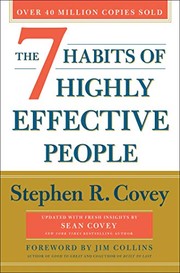
About 7 habits of highly effective people
Stephen R. Covey's "The 7 Habits of Highly Effective People" is a seminal self-help book that presents a principle-centered approach to personal and professional effectiveness. It argues that true effectiveness stems not from superficial personality traits, but from deeply ingrained character ethics, based on universal and timeless principles. Covey introduces a paradigm shift, urging readers to move beyond quick-fix solutions and instead cultivate fundamental habits that lead to profound, lasting change. The book is structured around a progression from dependence to independence (the Private Victory) and then to interdependence (the Public Victory), culminating in continuous self-renewal.
Covey's core argument is that effectiveness is achieved by aligning one's life with principles like fairness, integrity, honesty, and human dignity. The seven habits are presented as a sequential, integrated approach to personal and interpersonal effectiveness, designed to help individuals gain control over their lives, build strong relationships, and achieve meaningful results. The book's enduring relevance lies in its emphasis on proactive choice, purpose-driven living, empathetic communication, and collaborative problem-solving, making it a guide for anyone seeking to improve their leadership, productivity, and overall well-being by focusing on character development rather than mere behavioral adjustments.
Key takeaways
- Take responsibility for your choices and actions by being proactive, focusing on your Circle of Influence rather than your Circle of Concern.
- Define your personal mission and values before you act, ensuring your daily efforts contribute to your ultimate goals.
- Prioritize tasks based on importance, not just urgency, to effectively manage your time and achieve significant results.
- Approach negotiations and relationships with a Win/Win mindset, seeking mutually beneficial solutions for all parties involved.
- Listen with the intent to truly understand others' perspectives before attempting to make yourself understood.
- Collaborate with others to create synergistic solutions that are greater than the sum of individual contributions.
- Continuously renew yourself physically, mentally, spiritually, and socially to maintain and enhance your effectiveness.
- Shift your paradigm from a personality ethic to a character ethic, focusing on principles and values for lasting change.
Chapter summaries
Introduction: The Character Ethic and the Personality Ethic
Covey introduces the core premise that true effectiveness stems from character, not just personality traits or quick-fix techniques. He distinguishes between the "Character Ethic," based on principles like integrity, humility, and fidelity, which dominated success literature for 150 years, and the "Personality Ethic," which emerged in the last 50 years, focusing on public image, attitudes, and behaviors. Covey argues that while personality skills are important, they are secondary to a foundation of character. He introduces the concept of "paradigms" – the way we see the world – and how shifting these internal maps is crucial for fundamental change, rather than merely altering attitudes or behaviors. The book aims to help readers achieve "P/PC Balance" (Production/Production Capability) in all areas of life.
Part 1: Paradigms and Principles
This section lays the groundwork for understanding the 7 Habits by explaining fundamental concepts. Covey elaborates on paradigms, illustrating how our perceptions profoundly influence our reality and actions, often through the famous "old woman/young woman" optical illusion. He emphasizes that true effectiveness is rooted in universal, timeless principles – natural laws like fairness, integrity, honesty, and human dignity – which are external to us and govern human effectiveness, unlike values which are internal and subjective. Covey introduces the "P/PC Balance" (Production/Production Capability) as a key principle for long-term effectiveness, using the fable of the goose and the golden eggs to illustrate the importance of maintaining the asset that produces results. This part sets the stage for the "Private Victory" habits.
Habit 1: Be Proactive
This habit is the foundation of the Private Victory, focusing on taking responsibility for one's own life. Covey defines proactivity as more than just taking initiative; it means recognizing our "response-ability" – our ability to choose our response to any given situation. He contrasts proactive individuals, who focus their energy on their "Circle of Influence" (things they can control), with reactive people, who focus on their "Circle of Concern" (things they have little or no control over), often using reactive language like "I can't" or "If only." Covey stresses that between stimulus and response, there is a space where we have the freedom to choose, guided by our self-awareness, imagination, conscience, and independent will. This habit empowers individuals to be the creators of their own lives.
Habit 2: Begin with the End in Mind
This habit is about envisioning your desired future and aligning your actions with your deepest values and principles. Covey introduces the concept of "mental creation before physical creation," meaning all things are created twice. He urges readers to develop a personal mission statement, which serves as a constitution or blueprint for their life, defining their character, contributions, and values. This mission statement acts as a personal standard for evaluating all decisions and actions, ensuring they are congruent with one's ultimate goals. Covey uses the powerful visualization exercise of imagining one's own funeral to help clarify what truly matters and what legacy one wishes to leave, ensuring that daily activities contribute to a meaningful life rather than just busy work.
Habit 3: Put First Things First
This habit is the practical application of Habits 1 and 2, focusing on effective self-management and prioritizing activities based on importance, not just urgency. Covey introduces the Time Management Matrix, dividing activities into four quadrants: Urgent/Important (Quadrant I), Not Urgent/Important (Quadrant II), Urgent/Not Important (Quadrant III), and Not Urgent/Not Important (Quadrant IV). He argues that highly effective people spend most of their time in Quadrant II, focusing on planning, prevention, relationship building, and recognizing new opportunities, which are important but not urgent. This proactive approach minimizes crises and maximizes long-term effectiveness. The habit emphasizes organizing and executing around priorities established in the personal mission statement, ensuring that one's daily schedule reflects one's deepest values and goals.
Part 2: The Public Victory
This section transitions from independence (the Private Victory) to interdependence, focusing on successful relationships and teamwork. Covey explains that true interdependence can only be achieved by independent individuals who have mastered the first three habits. He introduces the concept of the "Emotional Bank Account," a metaphor for the trust built in relationships through deposits (kindness, honesty, keeping commitments) and withdrawals (breaking promises, disrespect). A high balance in this account allows for more effective communication and problem-solving. This part emphasizes that effective public interaction requires a foundation of character and self-mastery, moving beyond mere personality techniques to build deep, lasting trust and cooperation.
Habit 4: Think Win/Win
This habit is about seeking mutually beneficial solutions in all human interactions, where all parties feel good about the decision and are committed to the action plan. Covey outlines six paradigms of interaction: Win/Win, Win/Lose, Lose/Win, Lose/Lose, Win, and Win/Win or No Deal. He argues that Win/Win is the only viable paradigm for long-term interdependent relationships, as other approaches lead to resentment, competition, or short-term gains at the expense of trust. Achieving Win/Win requires courage and consideration, focusing on mutual benefit rather than competition. It involves understanding and agreeing on desired results, guidelines, resources, accountability, and consequences, fostering an environment of cooperation and shared success.
Habit 5: Seek First to Understand, Then to Be Understood
This habit emphasizes empathetic listening as the key to effective communication and influence. Covey highlights that most people listen with the intent to reply, not to understand, often filtering what they hear through their own paradigms, advising, probing, or interpreting. He stresses the importance of "empathetic listening," which means listening with the intent to truly understand the other person's frame of reference, feelings, and meaning, not just their words. This involves mirroring content, reflecting feelings, and rephrasing. Only after genuinely understanding another person's perspective can one effectively present one's own ideas (the "then to be understood" part), making one's communication more credible and impactful.
Habit 6: Synergize
This habit is about achieving creative cooperation and valuing differences to produce results greater than the sum of individual parts. Synergy means that the whole is greater than the sum of its parts, where 1 + 1 can equal 8, 16, or even 1,600. Covey explains that synergy thrives on diversity and open-mindedness, where individuals combine their unique strengths and perspectives to solve problems and create new alternatives. It involves a process of valuing differences, engaging in creative collaboration, and seeking a "third alternative" that is better than any original proposal. This habit requires a high level of trust and communication (built through Habits 4 and 5) and leads to breakthrough solutions and innovation in interdependent situations.
Part 3: Renewal
This section focuses on the principle of continuous improvement and balancing the four dimensions of human nature. Covey emphasizes that to maintain and enhance effectiveness, individuals and organizations must regularly renew their physical, mental, spiritual, and social/emotional selves. This part serves as a capstone, reinforcing that all habits are interconnected and require ongoing effort. It highlights the importance of self-care and continuous development to avoid burnout and maintain the "P/PC Balance" (Production/Production Capability) over the long term. Renewal is not a one-time event but an ongoing process that keeps the other habits fresh and effective, ensuring sustained growth and productivity.
Habit 7: Sharpen the Saw
This habit is about continuous self-renewal in four fundamental dimensions of life: physical, mental, spiritual, and social/emotional. Covey uses the analogy of a woodcutter who is too busy sawing to sharpen his saw, illustrating that neglecting self-care ultimately reduces effectiveness. The physical dimension involves exercising, eating well, and resting adequately. The mental dimension includes reading, writing, planning, and visualizing. The spiritual dimension focuses on clarifying values, meditation, connecting with nature, and service. The social/emotional dimension involves building relationships, empathetic listening, and contributing to others. Sharpening the Saw is the habit that makes all other habits possible, as it provides the energy, clarity, and resilience needed to practice them consistently.
Inside-Out Again
This concluding section reiterates the central theme of the book: that true and lasting change comes from within. Covey emphasizes the "inside-out" approach, meaning that personal effectiveness and public victories are ultimately rooted in character and a paradigm shift. He reminds readers that the 7 Habits are not a set of techniques but a process of personal and interpersonal growth, moving from dependence to independence, and then to interdependence. The journey of mastering these habits is continuous, requiring patience, persistence, and a commitment to principle-centered living. This final part encourages readers to continue applying the principles, understanding that the greatest influence one can have is on oneself, which then ripples outward to affect others and the world.
Full summary
Book Overview
"7 Habits of Highly Effective People," authored by Stephen R. Covey and first published in 1989, is a self-help classic that has influenced millions of readers worldwide. The book provides a holistic approach to personal and professional effectiveness, blending principles of character development with practical strategies. Covey emphasizes the importance of aligning personal values with professional goals to achieve meaningful success.
Main Content/Plot
The book is structured around the seven habits that Covey identifies as essential for achieving effectiveness in various aspects of life. These habits are categorized into three distinct sections:
1. Private Victory: The first three habits focus on self-mastery and personal growth:
- Habit 1: Be Proactive - Advocates for taking responsibility for one’s actions and choices.
- Habit 2: Begin with the End in Mind - Encourages envisioning desired outcomes to guide daily actions.
- Habit 3: Put First Things First - Stresses the importance of prioritizing tasks based on their importance rather than urgency.
2. Public Victory: The next three habits address interpersonal relationships and collaboration:
- Habit 4: Think Win-Win - Promotes a mindset of mutual benefit in all interactions.
- Habit 5: Seek First to Understand, Then to Be Understood - Highlights the importance of empathetic communication.
- Habit 6: Synergize - Encourages collaborative efforts that produce better outcomes than individual efforts.
3. Renewal: The final habit focuses on continuous improvement and self-renewal:
- Habit 7: Sharpen the Saw - Advocates for regular self-care and growth across four dimensions: physical, mental, emotional, and spiritual.
Key Themes
- Proactivity: The importance of taking initiative and responsibility for one’s life.
- Vision and Purpose: The necessity of having clear goals and a life mission.
- Interdependence: Recognizing that effective relationships and collaboration are crucial for success.
- Continuous Improvement: The need for ongoing personal and professional development.
Important Takeaways
- Personal Responsibility: Effectiveness stems from a proactive mindset that embraces accountability.
- Goal-Oriented Living: Establishing a clear vision is essential for aligning daily actions with long-term aspirations.
- Empathetic Communication: Listening to understand others enhances relationships and builds trust
Memorable quotes
“Sow a thought, reap an action; sow an action, reap a habit; sow a habit, reap a character; sow a character, reap a destiny.”
“I am not a product of my circumstances. I am a product of my decisions.”