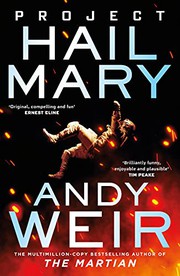
Project Hail Mary
In 60 seconds
The Sun is dimming fast, and microscopic aliens called Astrophage are to blame. Ryland Grace, a science teacher forced onto a suicide mission, wakes from a coma with amnesia to find his crewmates dead. Alone near Tau Ceti, he meets Rocky, a rock-like alien engineer whose own planet is dying the same way. Together they hunt a microbe that eats Astrophage, sacrifice everything for each other, and Grace chooses to save his friend over going home.
Before you start
Why it matters
This is hard science fiction with a huge heart: real chemistry and physics drive every problem, yet the emotional core is a friendship conducted through musical tones between species. If you loved The Martian's problem-solving joy but wanted more warmth, this delivers both. Perfect for readers who like their science accurate, their stakes planetary, and their aliens genuinely alien — plus anyone who cries at engineers being heroes.
Spoilers ahead
The story
- 1
Act 1
The Man Who Forgot Himself
A man wakes from a coma aboard a spacecraft. His mind is blank and his body weak. He finds two desiccated corpses in the crew quarters—Yao (mission commander) and Ilyukhina (science specialist). His own name comes from a label on his jumpsuit: Ryland Grace. As he explores, memory returns in fragments. The ship is called the Hail Mary and it is approaching Tau Ceti. He finds a lab with equipment and samples, and the fragments assemble into a past: he was a junior high school science teacher, and before that a molecular biologist. Dr. Irina Petrova observes an infrared line stretching from the Sun to Venus, later named the Petrova line. Scientists determine the Sun is dimming at an exponential rate due to microscopic organisms called Astrophage, which absorb sunlight and convert it to mass, traveling to Venus along this line, threatening a catastrophic ice age within thirty years. Eva Stratt, a former ESA administrator given near-unilateral authority by world governments, recruits Grace to study a sample from the Petrova line, bringing him to a secret lab in San Francisco. He names them 'Astrophage' (star-eater) and determines they breed by absorbing energy from the Sun and carbon dioxide from Venus. Stratt reveals that Tau Ceti has resisted the infection. A plan is formed to send the Hail Mary on a one-way trip. Grace trains Yao and Ilyukhina, but they are killed in an explosion during a fuel test. With no time to train a replacement, Stratt forces Grace to join the suicide mission against his will, sedating him and administering an amnesia-inducing drug.
- 2
Act 2
First Contact, Second Chances
Grace has spent 4 years and 8 months in a coma and is the sole survivor of the Hail Mary crew. The Hail Mary is approached by an alien starship, which Grace dubs 'Blip-A' after its radar designation. The ship sends a star-map sculpture indicating it came from 40 Eridani. Grace decides to dock with it. Grace meets the alien, a spider-like, five-legged, rock-skinned, eyeless being from 40 Eridani A b. He names it 'Rocky' and develops a communication system using musical tones and a vocabulary grid. Rocky is an engineer and the last survivor of his crew, having been in the Tau Ceti system for 46 Earth years, the others having died of radiation sickness. Rocky reveals his planet, which Grace calls 'Erid,' is also threatened by Astrophage. Two species, two doomed planets, one shared problem. Grace learns Rocky's ship has more than enough Astrophage fuel for both to return home, as Eridians are unaware of relativity and thus carry excess fuel. Grace and Rocky find Tau Ceti has its own Petrova line leading to a planet Grace names 'Adrian.' They hypothesize Adrian hosts a predator that preys on Astrophage, keeping its population in check. Grace and Rocky construct a 10-kilometer chain made of xenonite, an Eridian super-material, to lower a sample collector into Adrian's atmosphere. During collection, a hull breach occurs, and Grace risks his life to save Rocky, who reciprocates by repairing the breach, solidifying their friendship. From the Adrian sample, Grace identifies a microbe that preys on Astrophage and names it 'Taumoeba.'
- 3
Act 3
The Cure That Eats the Cure
Taumoeba escapes into the Hail Mary's fuel lines and consumes most of the Astrophage. Grace and Rocky jettison the infected tank and sterilize the ship by flooding it with nitrogen, which kills Taumoeba. Rocky repairs and refuels the Hail Mary using his ship's excess fuel. Grace and Rocky use selective breeding to produce Taumoeba strains that can survive the atmospheres of Venus and the Astrophage-breeding planet around 40 Eridani. They part ways, with Grace heading to Earth and Rocky to Erid, each carrying Taumoeba to save their worlds. En route to Earth, Grace discovers the Taumoeba he bred can now penetrate xenonite containers. The Taumoeba will escape and consume the Astrophage fuel on Rocky's xenonite-built ship. He realizes Rocky will be stranded and die if he does nothing. Grace faces a choice: return to Earth as a hero but doom the Eridians, or save Rocky and the Eridians while facing his own starvation on Erid, where the food is toxic to humans. He chooses to save Rocky, sending the beetles back to Earth with Taumoeba farms and instructions.
- 4
Act 4
Sixteen Years Later
Grace locates Blip-A and rescues Rocky, who is overjoyed. Rocky suggests Grace could survive on Erid by eating Taumoeba, which is biochemically compatible with human digestion. Grace agrees to live on Erid. Sixteen years later, Grace is living on Erid in a comfortable environment built by Eridians using his digital archive of human knowledge. He eats synthetic food derived from Taumoeba. Rocky tells Grace that Earth's Sun has returned to its original luminance, confirming the success of the Taumoeba mission. Grace contemplates returning to Earth but decides to stay on Erid, content with his life as a teacher. He teaches science to young Eridian students. The novel ends with Grace reflecting on his dual identity as a human and an honorary Eridian, having found a new home and purpose. He continues teaching, bridging two civilizations through science.
Who's who
Characters
- Ryland GraceA molecular biologist turned junior high science teacher, conscripted against his will onto a one-way mission to save the Sun. He wakes with no memory, finds a best friend in an alien, and gives up Earth to keep that friend alive.
- RockyA five-legged, rock-skinned, eyeless engineer from Erid who speaks in musical tones and lost his entire crew to radiation sickness. He refuels Grace's ship, co-invents the cure, and refuses to let his human friend die.
- Eva StrattThe cold pragmatist with near-unilateral authority who recruits Grace, then forces him onto the mission after the original crew dies, wiping his memory to guarantee compliance. Her ruthlessness saves two worlds.
- Yao and IlyukhinaThe Hail Mary's original commander and science specialist, trained by Grace and killed in an explosion during a fuel test. Their deaths are why a schoolteacher ends up twelve light-years from home.
What it's really about
Themes
Science as a universal language
Grace and Rocky share no biology, no planet, and no words — so they build communication from musical tones and a vocabulary grid, then solve Astrophage together through observation, hypothesis, and experiment. The xenonite chain to Adrian, the nitrogen sterilization, the selective breeding program: every breakthrough comes from method, not luck. Even the ending runs on science, with Grace teaching Eridian children using humanity's accumulated knowledge. The book's point is that the scientific method isn't a human invention — it's a tool any curious mind can pick up, and it's how strangers become collaborators.
Sacrifice and what a hero actually owes
Grace never volunteers for anything. Stratt sedates him and wipes his memory to put him on a suicide mission, and his first act of heroism is simply surviving long enough to do the job. The real test comes later, when he must choose between returning to Earth as a celebrated savior or turning around to save Rocky, knowing Erid's food is toxic to him. He chooses his friend. The book argues that heroism isn't a grand gesture made under orders — it's a choice made freely, at personal cost, when no one is forcing your hand.
Friendship across absolute difference
Rocky is eyeless, rock-skinned, five-legged, and communicates in musical tones; Grace is a soft mammal who nearly died getting here. Their bond forms through mutual rescue — Grace risks his life during the hull breach, Rocky repairs it, Rocky refuels the Hail Mary, Grace turns his ship around. Each act of care compounds the last. The friendship costs them both everything and gives them both a reason to keep going. The book's point: connection doesn't require similarity, only the willingness to learn someone else's language and trust them with your life.
Coercion in the name of survival
Stratt operates with near-unilateral authority because the alternative is an ice age within thirty years. She kills nothing and saves everything, but her methods — forcing Grace aboard, drugging him into amnesia — are the actions of a person who has decided the ends erase the means. Grace resents her, then accepts his role, and ultimately surpasses her: where she coerced sacrifice, he chooses it. The book asks whether desperation justifies stripping a person of their consent, and answers by showing what Grace does with the choice Stratt never gave him.
Look closer
Symbols
- The Petrova line
- A visible thread connecting the Sun to Venus — the path Astrophage travels and the first clue humanity gets. It stands for how catastrophe announces itself quietly: a single infrared line one scientist notices before the sky goes dark. Its counterpart around Tau Ceti leads Grace to the cure, turning the symbol of doom into the map of salvation.
- Xenonite
- The Eridian super-material that builds the 10-kilometer sampling chain and, unknowingly, Rocky's entire ship. It represents shared ingenuity — until the bred Taumoeba learn to chew through it, and the material that symbolized cooperation becomes the trap that nearly kills Rocky. What saves you and what endangers you can be the same thing.
- Taumoeba
- The microbe that eats Astrophage: the cure that escapes, devours fuel, and must be bred, contained, and finally eaten by Grace himself. It embodies the book's core idea that solutions are living things — they adapt, they escape your control, and survival means working with them rather than commanding them.
- The beetles
- The unmanned mini-ships that carry findings home, and ultimately carry Taumoeba farms and instructions back to Earth. They stand for the mission's one-way logic: Grace was never meant to return, so he built messengers in his place. They are how a man who gives up going home still saves everyone he left behind.
Spoilers
Ending explained
The ending refuses both obvious resolutions. Grace doesn't die a martyr on Erid, and he doesn't return to a hero's welcome; Rocky's observation that Taumoeba is edible dissolves the false choice between his life and his friend's, letting sacrifice and survival coexist. Sixteen years later, the confirmation that Earth's Sun has recovered validates everything — but the book spends its final pages not on triumph, on belonging. Grace, a man who was coerced into leaving Earth, freely chooses to stay away, teaching science to Eridian children. One reading: the ending completes his arc from reluctant conscript to willing citizen of two worlds, his identity no longer split but doubled. Another: it's a quiet melancholy — he contemplates going home and doesn't, and the book lets that ambivalence stand without resolving whether he's at peace or simply settled. Either way it lands because the story earned it: a man stripped of his memory and his consent ends up choosing, with full knowledge, exactly the life he was forced into — and finds it good.
For class or book club
Discussion questions
- 1.Stratt forces Grace onto the mission and wipes his memory 'for his own good' and humanity's — does the ending, where he freely chooses the life he was coerced into, vindicate her methods or complicate them?
- 2.The book makes communication itself the first great obstacle: Grace and Rocky invent a shared language before they can share a goal. What does their vocabulary grid suggest about whether true understanding between radically different minds is possible?
- 3.Grace's selective breeding solves one problem and creates a worse one — Taumoeba that can penetrate xenonite. Is the book arguing that every intervention in a complex system breeds unpredictable consequences, and if so, does Grace's final choice redeem that?
Worth remembering
Best lines
“You're the only one who can do this. I'm sorry.”
A fair critique
Where it falls short
The amnesia framing means the first act is a slow reassembly of backstory the reader eventually gets anyway, which can feel like a delay rather than a mystery. Some of Grace's problems stem from oversights a trained mission specialist — or even a careful teacher — might have avoided, and critics have noted that basic checklists and common sense could have prevented several disasters. The science is rigorous but occasionally front-loaded, with explanations that pause the momentum. And Stratt's coercion raises ethical questions the narrative largely waves past rather than interrogating.
In one sentence
A man forced to save a world he can't remember discovers that the family you choose might not be human at all.
Is it for you?
Who should read it
Anyone who wants hard science fiction that treats equations and friendship with equal seriousness. Ideal for readers who loved The Martian, teachers who secretly dream of space, and anyone moved by the idea of two species building a language from scratch.
4 questions
Quick quiz: how well do you know Project Hail Mary?
0 of 4 answered
FAQ
What is Project Hail Mary about?
Project Hail Mary is about Ryland Grace, a former science teacher who wakes up on a spaceship with amnesia. He gradually remembers he's on a desperate mission to the Tau Ceti star system to find a solution to the Astrophage, an alien organism consuming the sun and threatening all life on Earth. He forms an unlikely alliance with an alien named Rocky to save both their species.
Is Project Hail Mary worth reading?
Yes, Project Hail Mary is highly acclaimed and worth reading for its engaging blend of hard science fiction, humor, and compelling characters. It offers intricate scientific puzzles, a thrilling plot, and a heartwarming story of interspecies friendship, making it an enjoyable and thought-provoking read for sci-fi enthusiasts and general readers alike.
How does Project Hail Mary end?
Spoiler: Ryland Grace sacrifices his chance to return to Earth, giving Rocky the fuel needed to save his home planet, Erid. Grace then travels to Erid himself, helping the Eridians deploy the solution and choosing to remain there as a science teacher, finding a new purpose among his alien friends while ensuring humanity's survival from afar.
Who should read Project Hail Mary?
Readers who enjoy science fiction, especially those who appreciate scientifically accurate and optimistic stories like 'The Martian,' will love this book. It's also suitable for anyone who enjoys a good mystery, humor, and stories about unlikely friendships and humanity's resilience in the face of existential threats.
How long does it take to read Project Hail Mary?
On average, it takes approximately 545 minutes (about 9 hours) to read Project Hail Mary, assuming a reading speed of 250 words per minute. This can vary based on individual reading pace and engagement with the scientific details.
Who wrote Project Hail Mary?
Project Hail Mary was written by Andy Weir and first published in 2021.
What genre is Project Hail Mary?
Project Hail Mary is listed under Science Fiction.
More Science Fiction summariesWhere is Project Hail Mary set?
Project Hail Mary is set in Epsilon Eridani, Earth and Tau Ceti.
How many pages is Project Hail Mary?
Project Hail Mary is about 496 pages long (the median page count across its editions, per Open Library).