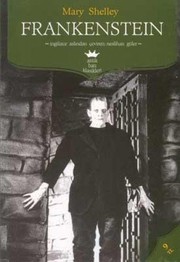
Frankenstein
In 60 seconds
Victor Frankenstein, a gifted young Genevese, discovers how to animate lifeless matter and assembles an eight-foot creature from stolen body parts. Horrified by what he has made, he abandons it, and the creature, rejected by every human it meets, turns to murder. It kills Victor's little brother, frames an innocent servant, and hangs the deaths around Victor's conscience. When Victor destroys the female companion he promised to build, the creature slaughters Victor's best friend and bride. The chase ends on Arctic ice, where a dying Victor tells his story to a doomed explorer, and the creature vanishes into darkness to burn itself alive.
Before you start
Why it matters
Written by an eighteen-year-old, this is the book that invented science fiction as we know it: a scientist makes a deliberate choice in a laboratory, and the consequences are moral, not magical. It asks who is responsible for a creation the maker refuses to love. Read it if you care about ambition, parenthood, exclusion, or every monster film you have ever seen.
Spoilers ahead
The story
- 1
Act 1
The Night the Thing Opens Its Eyes
The story opens with Robert Walton writing letters to his sister Mrs. Saville (Margaret) in England from St. Petersburg, describing his planned expedition to the North Pole and his ambition to discover a passage near the pole and the secret of the earth's magnetism. Then his crew spots something impossible: a gigantic figure driving a dog-sledge across the ice. The next morning they haul a dying, half-frozen stranger off a broken sledge, and that stranger, speaking English, melancholy and despairing, turns out to be Victor Frankenstein. He begins to talk, and his story swallows the book. Victor was born in Naples to a wealthy Genevese family, one of the most distinguished in the republic of Geneva. His mother Caroline discovered Elizabeth Lavenza, an orphan of a Milanese nobleman from a poor Italian cottage, during a charitable visit and adopted her as a 'pretty present' for Victor; Elizabeth became the adored center of his childhood, which he calls a paradise shared with her and his friend Henry Clerval. At thirteen he found a volume of Cornelius Agrippa, and though his father waved it off as 'sad trash' without explaining why, he devoured the occult sciences of Agrippa, Albertus Magnus, and Paracelsus. Lightning destroyed an old oak near his home, a scientist explained electricity to him, and galvanism pulled him toward modern science. At seventeen, after his mother Caroline died of scarlet fever after nursing Elizabeth through the illness, he left Geneva for the University of Ingolstadt in Germany. There, over two years of obsessive study, he discovered the secret of bestowing animation upon lifeless matter and constructed an eight-foot-tall creature from body parts collected from charnel houses, dissecting rooms, and slaughterhouses (and graves). On a dreary November night, Victor brought the creature to life; the creature's yellow skin, watery eyes, and straight black lips horrified Victor, who fled his apartment in terror. In a dream, Victor embraced Elizabeth, who transformed into the corpse of his dead mother with worms in the shroud; he woke to find the creature standing by his bed, grinning and attempting to speak. It was gone by morning. The shock broke him into months of fever, nursed by Henry Clerval.
- 2
Act 2
The Creature Learns to Hate
The creature's own tale takes over. It woke with its senses confused, fled Victor's apartment, discovered fire in a forest (left by wandering beggars), learned to cook food and warm itself but burned itself, learning its pain; humans fled or attacked it because of its appearance. It took shelter in a hovel attached to a cottage inhabited by the De Lacey family—blind old man De Lacey, his son Felix, daughter Agatha, and the foreigner Safie—observing them through a chink in the wall. It learned their language as Felix taught Safie French, learned to read from papers in a coat taken from Victor's laboratory, and quietly helped them, hauling firewood at night and refusing to steal from people so poor. It read Paradise Lost, Plutarch's Lives, and the Sorrows of Werter (found in a leather portmanteau), and compared itself to Adam and to Satan, feeling that it was 'like Satan' because it was alone and miserable. Then came the gamble. While the blind old man sat alone, the creature spoke to him, and De Lacey, who could not see the horror, was kind. When Felix, Safie, and Agatha returned, they were horrified and Felix beat the creature with a stick, driving it away, never to return. Later it saved a young girl from drowning in a stream, but her companion (father), thinking the creature was attacking her, shot it in the shoulder. 'I am malicious because I am miserable,' it tells Victor on the Mer de Glace glacier, where Victor, grieving, has climbed Montanvert for solace and found his creation waiting. 'I ought to be thy Adam, but I am rather the fallen angel, whom thou drivest from joy for no misdeed.' Near Plainpalais it encountered William Frankenstein in the woods, and when it learned the boy was a Frankenstein related to Victor, it strangled him and took the miniature portrait from his neck; it then planted the miniature in the sleeping Justine's pocket to frame her. Justine was tried, falsely confessed under pressure (despite protestations of innocence), and executed. Victor knew she was innocent but remained silent, tormented by the knowledge that his creature was the true murderer. Now the creature makes its demand: build a female as hideous as itself, and it will vanish to South America forever. Victor, terrified, agrees.
- 3
Act 3
The Wedding-Night Promise
Victor delays, then agrees to a tour with Henry Clerval through England and Scotland, slipping away secretly to work on the second creature. He leaves Henry Clerval in Perth, Scotland, and travels alone to one of the Orkney Islands, where he establishes a laboratory in a remote hut to create the female creature; as he works, he sees the original creature watching him through the window with a ghastly grin. Then doubt strangles him. He imagines the two creatures breeding, a race of monsters spreading over the earth, and tears the half-finished female to pieces in front of the window. The creature does not rage. It says, coldly: 'Remember, I shall be with you on your wedding-night.' After destroying the female creature, Victor rows out to sea and dumps the remains, then falls asleep in his boat and is blown off course to an Irish shore, where he is arrested on suspicion of murdering a man found strangled on the beach. He is taken before the magistrate Mr. Kirwin and shown the body, which is Henry Clerval's, murdered by the creature. Victor falls ill for two months in an Irish prison and is eventually released after the evidence proves he was on the Orkney Islands at the time of the murder; he returns to Geneva with his father. There he marries Elizabeth, carrying pistols and a dagger, certain the threat is aimed at him. On their wedding night at an inn in Evian, Victor patrols the house while Elizabeth retires. The creature was never coming for him. Victor hears a scream, and finds his bride strangled on the bed. His father Alphonse Frankenstein dies a few days after Elizabeth's murder, overcome by grief. With nothing left, Victor vows revenge and follows the creature's taunting clues across Europe and into Russia, out onto the Arctic ice.
- 4
Act 4
Ice, Confession, and Fire
The chase ends where the book began. Victor, picked up by Walton's ship in the Arctic, tells Walton his story and urges Walton's crew to continue their expedition. The crew refuses; they want to turn back. Victor dies aboard the ship from exhaustion and illness. Then Walton, writing to his sister, records what happens next. The creature appears aboard Walton's ship after Victor's death, mourns over Victor's body, and tells Walton he regrets his murders but was driven by misery, abandoned and spurned. 'I, the miserable and the abandoned, am an abortion, to be spurned at, and kicked, and trampled on.' It quotes Milton against its maker: 'Did I request thee, Maker, from my clay / To mould me Man, did I solicit thee / From darkness to promote me?' Then it says it will depart to the farthest pole and immolate itself on a funeral pyre. It leaps from the cabin window onto an ice raft and disappears into the darkness, 'borne away by the waves, and lost in darkness and distance.' Walton is left with a ship pointed home, a dead friend's story, and a monster who chose its own ending. The creature's final act is the only one nobody forced on it: grief, confession, and self-destruction, all in one leap into the dark.
Who's who
Characters
- Victor FrankensteinA brilliant, obsessive Genevese student who discovers how to animate dead matter and then abandons his creation in horror. His silence and broken promises cost him his brother, his friend, his bride, and finally his life on the Arctic ice.
- The CreatureVictor's eight-foot creation, articulate and tender until every human it meets beats, shoots, or flees it. Rejected by its maker and the world, it becomes the murderer it was made to look like, then mourns the man it destroyed.
- Elizabeth LavenzaThe Italian orphan adopted into the Frankenstein family as Victor's 'pretty present' and future wife. She is the gentle center of Victor's world, and the creature strangles her on her wedding night.
- Henry ClervalVictor's childhood friend, the selfless nurse who pulls him back from fever twice. The creature strangles him on an Irish beach and leaves Victor to be accused of the murder.
- Robert WaltonThe Arctic explorer whose letters frame the whole story; he wants glory at the pole the way Victor wanted glory in the lab. He listens to Victor's dying caution and turns his ship home.
- Justine MoritzThe Frankenstein family's servant, framed for William's murder by the locket the creature planted in her pocket. She falsely confesses and is executed while Victor, the only one who knows the truth, stays silent.
- The De Lacey familyThe blind old man, Felix, Agatha, and Safie, whose cottage teaches the creature language, love, and books. Their terrified rejection of it, led by Felix's beating, is the wound that turns it against humanity.
What it's really about
Themes
Responsibility of the creator
Victor assembles a living being and then runs from it the moment it opens its eyes, leaving it to learn fear, fire, and language alone. Every murder in the book traces back to that first abandonment: the creature kills William and frames Justine only after the De Laceys and the world reject it, and it warns Victor plainly that the wedding-night threat follows the destroyed female companion. The creature's question on the Mer de Glace, asking why it was driven from joy for no misdeed, is the book's accusation. Shelley's point: making something is the easy part; answering to what you made is the duty Victor never meets.
Isolation and the need for companionship
The creature's fall is measured in refusals of company. It watches the De Laceys through a chink in the wall, learning affection it can never share, and its one hope is a blind man who cannot see its face. When Felix drives it away with a stick and a drowning girl's companion shoots it, it vows hatred on all humanity, and its single demand is a female companion as hideous as itself. Victor, meanwhile, loses everyone by isolating himself in study and then in secrecy. The book argues that we are made monstrous less by nature than by being shut out of every door.
Dangerous ambition
The frame story pairs Victor with Walton, two men chasing glory past the limits of ordinary life, one in a laboratory, one on the ice. Victor's two years of obsessive study, neglecting family and friends, produce the creature; Walton's polar expedition nearly kills his crew before a dying stranger talks him into turning back. The creature itself names the pattern when it compares its fate to Satan's in Paradise Lost, asking its maker why it was summoned from darkness. Shelley's warning is that ambition without responsibility creates victims, and the ambition itself is never worth the cost.
Injustice and silence
Justine Moritz is the book's clearest innocent: the creature plants Caroline's locket in her pocket, she is tried, confesses falsely under pressure, and is executed. Victor knows the truth from the moment he sees the creature lurking near Plainpalais, yet says nothing, telling himself no one would believe him. His silence makes him complicit, and the creature later notes that she innocently suffered for its crime. The book's point is that witnessing evil and staying quiet is its own act, and Victor's guilt over Justine is the first crack that his later losses widen into ruin.
Appearance versus soul
The creature is born gentle: it gathers firewood for the poor De Laceys, stops stealing their food, and saves a girl from drowning. Each kindness is answered with horror because of its yellow skin and giant frame, and only the blind De Lacey, the one person who cannot see it, treats it kindly. Shelley keeps asking what the creature would have been if anyone had accepted it, and answers through its own words: malicious because miserable. The book's verdict is that monstrosity is made in the eye of the beholder and the hand that turns the beholder away.
Look closer
Symbols
- Fire and lightning
- The ice
- Paradise Lost
- The locket
Spoilers
Ending explained
The ending refuses to comfort anyone. Victor dies still demanding that Walton chase the creature, unreformed, unable to see that his own abandonment made the monster; his last speech is ambition talking past its own corpse. The creature, by contrast, gets the book's most human scene: it mourns its maker, admits regret, and sentences itself to a pyre at the pole. Some readers see repentance and suicide; others see a final performance, a murderer curating his own legend for the one man left listening. Either way, the creature ends the story with more self-knowledge than Victor ever shows. Walton turning back is the quiet verdict: the survivor of the two obsessions chooses his crew over the pole, which is the choice Victor never made. The last image, the creature borne away by the waves into darkness and distance, leaves judgment deliberately open, which is why the book still argues with itself two centuries on.
For class or book club
Discussion questions
- 1.Victor abandons the creature at first sight, yet the novel gives him the narrator's chair for most of it. Whose account do we trust, and how does the creature's counter-story change what we believe about the murders?
Worth remembering
Best lines
“I ought to be thy Adam, but I am rather the fallen angel, whom thou drivest from joy for no misdeed.”
“I am malicious because I am miserable. Am I not shunned and hated by all mankind?”
“Remember, I shall be with you on your wedding-night.”
“I, the miserable and the abandoned, am an abortion, to be spurned at, and kicked, and trampled on.”
A fair critique
Where it falls short
The machinery shows its age. Victor's secret is never explained: the book admits the method of animation dies with him, which can feel like a dodge. Coincidence does heavy lifting, from the creature finding Victor's own journal in a stolen coat to the boat drifting precisely to the shore where Henry's body lies. Elizabeth and Justine are written mainly to suffer, and the women have little agency. Some critics have noted the three narrators sound alike. The melodrama is real, and readers wanting hard science should adjust expectations: this is moral philosophy wearing a shroud.
In one sentence
A creator who refuses to love his creation teaches it to be a monster, and both are destroyed by the lesson.
Is it for you?
Who should read it
Anyone who has ever felt shut out, and anyone who has ever made something they were not ready to answer for. Readers of Gothic horror, early science fiction, and moral philosophy will find the original source of all of them here.
4 questions
Quick quiz: how well do you know Frankenstein?
0 of 4 answered
FAQ
What is Frankenstein about?
Frankenstein is about a brilliant but arrogant scientist, Victor Frankenstein, who creates a sentient being and then abandons it. The Creature, ostracized and alone, seeks revenge on its creator, leading to a tragic series of deaths and a relentless pursuit across the globe. It explores themes of scientific ethics, responsibility, and the impact of societal prejudice.
Is Frankenstein worth reading?
Yes, Frankenstein is absolutely worth reading. It's a foundational work of science fiction and Gothic literature, offering timeless insights into human nature, the dangers of unchecked ambition, and the profound consequences of neglect. Its exploration of identity, empathy, and moral responsibility remains highly relevant today.
How does Frankenstein end?
Spoiler: The novel ends with Victor Frankenstein dying on Robert Walton's ship in the Arctic, exhausted from his relentless pursuit of the Creature. The Creature appears to Walton, expressing profound remorse and despair over Victor's death and his own existence. He then declares his intention to commit suicide by burning himself at the North Pole, ensuring no other being like him can exist.
Who wrote Frankenstein?
Frankenstein was written by Mary Shelley and first published in 1818.
What genre is Frankenstein?
Frankenstein is listed under Classics.
More Classics summariesWhere is Frankenstein set?
Frankenstein is set in Geneva (Switzerland), St. Petersburgh and Archangel.
How many pages is Frankenstein?
Frankenstein is about 240 pages long (the median page count across its editions, per Open Library).