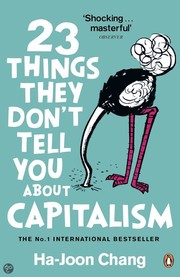
About 23 Things They Don’t Tell You About Capitalism
Ha-Joon Chang's "23 Things They Don’t Tell You About Capitalism" systematically debunks many of the conventional wisdoms and assumptions underpinning free-market capitalism. Through 23 concise essays, Chang challenges the notion that markets are inherently 'free,' that companies should solely prioritize shareholder value, or that deregulation always leads to economic prosperity. He argues that the global economy is far more complex and interventionist than free-market ideologues suggest, highlighting the historical role of government intervention, protectionism, and social policies in the development of today's rich nations.
The book's main argument is that there is no single, universally optimal form of capitalism. Instead, different countries have achieved success through varied economic models, often involving significant state guidance and regulation, contrary to the advice given to developing nations. Chang advocates for a more nuanced understanding of economic history and theory, suggesting that a well-regulated, mixed economy with strong social safety nets and strategic industrial policies is not only possible but often superior to unfettered free markets. He encourages readers to question dominant economic narratives and consider alternative approaches to achieve greater equity and sustainable growth, making a compelling case for active government involvement in shaping economic outcomes.
Key takeaways
- Recognize that all markets are regulated and shaped by rules, meaning there is no truly 'free' market in existence.
- Understand that maximizing shareholder value is not the only or best way to run a company; other stakeholders' interests are crucial.
- Challenge the belief that making rich people richer automatically benefits everyone else; trickle-down economics often fails.
- Consider that government intervention and strategic industrial policies have historically been vital for economic development, even in today's rich countries.
- Question the idea that we live in a post-industrial age; manufacturing remains a critical component of strong economies.
- Acknowledge that greater macroeconomic stability does not necessarily lead to a more stable or resilient global economy.
- Advocate for a more active and intelligent role for government in managing the economy, rather than assuming markets can self-regulate perfectly.
- Realize that economic policies should be tailored to specific national contexts and historical experiences, rather than applying a one-size-fits-all free-market approach.
Key ideas at a glance
Critique of capitalism
- Question the idea that we live in a post-industrial age; manufacturing remains a critical component of strong economies.
Economic intervention
- Understand that maximizing shareholder value is not the only or best way to run a company; other stakeholders'…
- Consider that government intervention and strategic industrial policies have historically been vital for economic…
Government's role
- Advocate for a more active and intelligent role for government in managing the economy, rather than assuming markets…
Development economics
- Challenge the belief that making rich people richer automatically benefits everyone else; trickle-down economics often…
- Acknowledge that greater macroeconomic stability does not necessarily lead to a more stable or resilient global economy.
Market regulation
- Recognize that all markets are regulated and shaped by rules, meaning there is no truly 'free' market in existence.
- Realize that economic policies should be tailored to specific national contexts and historical experiences, rather than…
Chapter summaries
Chapters 1-4: Deconstructing the Free Market and Redefining Progress
This section challenges fundamental tenets of free-market ideology. Chang argues that the 'free market' is a myth, as all markets are defined by regulations and political choices, citing examples like child labor laws and intellectual property rights. He critiques the shareholder primacy model, advocating for companies to serve multiple stakeholders for long-term health, contrasting this with models in Germany or Japan. The author also disputes the idea that wages perfectly reflect merit, highlighting political and social influences on pay, using the example of bus drivers in different countries. He provocatively asserts that the washing machine had a greater societal impact than the internet by liberating women and transforming labor markets, emphasizing tangible social change over technological novelty.
Chapters 5-8: Rethinking Human Nature, Stability, and National Development
Chang explores the consequences of economic assumptions about human behavior, suggesting that assuming self-interest can lead to a self-fulfilling prophecy of negative outcomes. He debunks the notion that increased macroeconomic stability has led to a more stable global economy, pointing to the rise in financial crises since the 1980s. The author challenges the effectiveness of free-market policies in enriching poor countries, providing historical evidence that successful development often involved protectionism and state intervention, contrary to neoliberal advice. This section concludes by arguing that capital retains a national identity despite globalization, influencing investment patterns and economic outcomes in ways often overlooked by free-market advocates.
Chapters 9-12: Industrialization, Global Living Standards, and State Intervention
This part refutes the concept of a 'post-industrial age,' emphasizing the enduring importance of manufacturing for innovation, productivity growth, and national prosperity, even for advanced economies. Chang challenges the common perception that the US enjoys the highest living standard globally, using broader metrics beyond GDP per capita, such as healthcare, leisure, and income inequality, to compare quality of life across nations. He counters the narrative that Africa is inherently destined for underdevelopment, attributing its struggles to historical factors and policy choices rather than intrinsic deficiencies. The author argues that governments can successfully 'pick winners' through strategic industrial policies, citing historical examples from East Asian economies like South Korea and Japan.
Chapters 13-16: Wealth Distribution, Corporate Leadership, and Market Fallibility
Chang directly challenges the 'trickle-down' theory, arguing that making the rich richer does not automatically benefit the rest of society, often exacerbating inequality instead. He critiques the excessive compensation of US managers, suggesting their high salaries are often disconnected from actual performance and are significantly higher than their counterparts in other developed nations. The author highlights that poor countries often exhibit greater entrepreneurial dynamism than rich ones, driven by necessity and innovative adaptation to challenging environments. He concludes this section by asserting that humans are not rational enough to leave complex economic decisions entirely to the market, advocating for intelligent regulation and planning to correct market failures and irrational exuberance.
Chapters 17-20: Education, Corporate Purpose, and the Limits of Market Logic
This section argues that education alone does not guarantee national wealth, emphasizing that its economic value is contingent on the productive capacity and industrial structure of an economy. Chang uses the example of General Motors' decline to illustrate how prioritizing short-term shareholder interests can lead to corporate failure and broader societal costs, reinforcing his earlier critique of shareholder primacy. He contends that the most effective way to enrich the wealthy is by improving the economic conditions of the poor, fostering broader demand and stability, rather than through tax cuts for the rich. The author reiterates that the market is not always right, highlighting its inherent imperfections, biases, and tendency towards instability.
Chapters 21-23: Reclaiming Government's Role and Rethinking Economic Expertise
This concluding section asserts that governments are not always wrong, challenging the anti-state bias prevalent in free-market ideology and demonstrating their crucial role in economic development, stability, and social welfare. Chang argues for making financial markets less, not more, efficient, to curb excessive speculation and reduce systemic risk, advocating for measures like the 'Tobin tax' on currency transactions. He concludes by stating that good economic policy does not necessarily require highly specialized economists, but rather common sense, historical understanding, and a willingness to challenge dominant paradigms, empowering citizens to engage in economic debates and shape their collective future.
Full summary
Ha-Joon Chang's "23 Things They Don’t Tell You About Capitalism" challenges conventional economic wisdom, arguing that capitalism is not a universal solution. The book presents 23 assertions that counter mainstream economic narratives, emphasizing the complexities and nuances of capitalism. Chang discusses topics like the fallacy of free markets, the importance of state intervention, and how globalization can harm local economies.
Key elements include concepts like "the invisible hand" and "creative destruction," as well as the roles of government and institutions in shaping markets. Chang's accessible language seeks to demystify economics, making it relatable and relevant. By examining historical and contemporary examples, he reveals the often-overlooked impacts of policies and economic theories.
The analysis reveals that capitalism is not a one-size-fits-all system; it requires careful regulation and adaptation to serve society effectively. Ultimately, Chang argues for a more ...
Memorable quotes
“There is no such thing as a free market.”
“The washing machine has changed the world more than the internet has.”
“Assume the worst about people, and you get the worst.”
“Making rich people richer doesn’t make the rest of us richer.”
“We are not smart enough to leave things to the market.”
Themes
- Critique of capitalism
- Economic intervention
- Government's role
- Income inequality
- Development economics
- Market regulation
About Ha‑Joon Chang
Ha-Joon Chang is a South Korean institutional economist specializing in development economics. He is a Reader in the Political Economy of Development at the University of Cambridge. Chang is known for his heterodox approach to economics, challenging free-market orthodoxy and advocating for greater state intervention and protectionism in economic development. His other notable works include 'Kicking Away the Ladder' and 'Economics: The User's Guide.' He wrote '23 Things They Don’t Tell You About Capitalism' to make complex economic ideas accessible to a wider audience and to provoke critical thinking about the prevailing capitalist system, especially in the wake of the 2008 financial crisis.
FAQ
What is 23 Things They Don’t Tell You About Capitalism about?
The book challenges conventional free-market economic wisdom, arguing that many common assumptions about capitalism are flawed. Ha-Joon Chang presents 23 'things' or essays that debunk myths about free markets, corporate governance, economic development, and the role of government, advocating for a more regulated and interventionist approach to economic policy.
Is 23 Things They Don’t Tell You About Capitalism worth reading?
Yes, it is highly recommended for anyone interested in economics, politics, or understanding the global economy beyond mainstream narratives. Chang's accessible writing style and compelling arguments make complex economic concepts understandable, providing a refreshing and critical perspective on how capitalism actually works, rather than how it's often idealized.
How does 23 Things They Don’t Tell You About Capitalism end?
Spoiler: The book concludes by advocating for a more active and interventionist role for government in managing the economy. Chang argues that a 'bigger government' is necessary to address contemporary challenges like inequality, financial instability, and climate change, and to foster long-term economic development and social well-being, challenging the prevailing dogma of minimal state intervention.
Who should read 23 Things They Don’t Tell You About Capitalism?
This book is ideal for students of economics, policymakers, and general readers who are curious about how the global economy functions and are open to questioning dominant economic theories. It's particularly valuable for those who feel that current economic systems are not working for everyone and are looking for alternative perspectives and solutions.
How long does it take to read 23 Things They Don’t Tell You About Capitalism?
On average, it takes approximately 6 to 7 hours to read '23 Things They Don’t Tell You About Capitalism.' The book is structured into short, digestible essays, making it suitable for reading in segments.