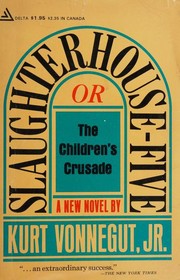
Slaughter house - five
In 60 seconds
Kurt Vonnegut, a former POW, spends decades trying to write about the firebombing of Dresden and finally does it through Billy Pilgrim, a meek optometrist who has come unstuck in time. Billy bounces between his 1945 capture by the Germans, the slaughterhouse where he survives the bombing, his 1967 abduction by aliens who see all time at once, and his own death in 1976. The aliens teach him that every moment exists forever, so death is nothing to fear. The book is jumbled on purpose, because there is nothing intelligent to say about a massacre. It ends with a bird asking, 'Poo-tee-weet?'
Before you start
Why it matters
This is the great anti-war novel that refuses to make war exciting. Vonnegut watched a beautiful city burn and came back with no heroes, no battles, just a dazed optometrist and a lot of corpses. If you have ever wondered how to talk about atrocity without glamour, or how to keep living after the worst thing happens, this book is for you. It is funny, strange, and devastating, often in the same sentence.
Spoilers ahead
The story
- 1
Act 1
A Duty-Dance with Death
The narrator, Kurt Vonnegut himself, a former POW who was there, struggles for years to write about the firebombing of Dresden, and every attempt turns into a disaster. He drinks with his old war buddy Bernard V. O'Hare. O'Hare's wife Mary gets angry when she hears what kind of book he means to write: she fears it will make heroes of the men who fought. 'You were just babies then!' she says, and she is right. Vonnegut promises her the book will be called 'The Children's Crusade,' and that promise shapes everything that follows. In 1967, Guggenheim Foundation money sends the narrator and O'Hare back to Dresden, and on the plane he scribbles the whole book on scraps of paper. A friend named Harrison Starr tells him an anti-war book is as pointless as an anti-glacier book, since wars are as unstoppable as glaciers. The narrator agrees, sort of. He says the book will be short and 'jumbled and jangled,' because there is nothing intelligent to say about a massacre. Everyone in the story is dead except him and O'Hare. So the book begins and ends with a bird asking, 'Poo-tee-weet?', the only sound left worth making.
- 2
Act 2
Unstuck in Time
Billy Pilgrim, an optometrist from Ilium, New York, born in 1922, has come unstuck in time. He served as a chaplain's assistant in World War II, was captured during the Battle of the Bulge in December 1944, survived Dresden, married Valencia Merble, had two children, got rich, and in 1967 was abducted by aliens from Tralfamadore. All of this happens to him out of order. His first slip comes while he is lost behind German lines with Roland Weary, an antitank gunner, and two scouts. Weary fantasizes that they are a heroic trio like the Three Musketeers, but the scouts abandon him and Billy, so Weary transfers the fantasy onto Billy, casting himself as savior and Billy as the ungrateful sidekick. He grows to hate Billy for his passivity. Meanwhile Billy blinks through his whole life: a small boy thrown into the deep end of a YMCA pool by his father, sinking to the bottom, feeling peaceful, resisting rescue. A nursing home in 1965, where his mother asks about the war and he tells her he was in Dresden when it was bombed; she knew, she says, but forgot. A flying saucer in 1967, where he stands naked and asks why, and a voice explains it is an 'Earthling custom' to be naked when captured. His wedding night with Valencia in Cape Ann, Massachusetts, where he feels no desire and leaves the bed to stare out the window.
- 3
Act 3
Prisoners and the Zoo
In a snowy forest in Luxembourg in December 1944, German soldiers capture Billy and Roland Weary. A war photographer takes a picture of Billy standing in the snow with his hands on his head, and the shot later turns up in a book as proof of how wretched American soldiers looked. The Germans confiscate Weary's things, including a pornographic photo of a woman and a pony; Weary demands it back and a soldier throws it into the snow. Weary dies of gangrene in a boxcar, blaming Billy, and with his last breath tells Paul Lazzaro, a small, vengeful, frail prisoner, to avenge him by killing Billy someday. Lazzaro swears he will, and years later, he keeps the promise. The boxcars carry the Americans to a POW camp near Dresden, where Billy arrives on his twenty-third birthday wearing a coat too small for him and silver boots, a ridiculous figure. The prisoners are housed in Schlachthof-fünf, Slaughterhouse-Five, a former livestock-killing plant, and put to work in a factory making malt syrup for pregnant women. An English colonel welcomes them and warns them against escape. The English prisoners stage a musical 'Cinderella,' and Billy laughs so hard he has to be sedated with morphine, which sends him to a mental ward in 1948, where Eliot Rosewater introduces him to the science fiction of Kilgore Trout. Then Tralfamadore: a geodesic dome zoo, where Billy is displayed alongside Montana Wildhack, a kidnapped film star, and the aliens explain that all moments exist at once, so death is only a momentary condition. 'So it goes.'
- 4
Act 4
The Moon and the Bird
The Tralfamadorians tell Billy the universe will end when one of their test pilots presses a button that destroys it. Billy asks why they do not stop him. 'He has always pressed it, and he always will,' the guide says. 'We always let him and we always will let him. The moment is structured that way.' When Billy asks why they chose him for the zoo, they answer, 'Why you? Why us for that matter? Why anything? Because this moment simply is. Have you ever seen bugs trapped in amber?' and then, 'Well, here we are, Mr. Pilgrim, trapped in the amber of this moment. There is no why.' Back in 1945, the Americans are marched into Dresden, an open, beautiful city with no war industries, and shelter in the slaughterhouse's concrete basement, built for meat storage. On February 13, the firebombing comes, and Billy survives in the meat locker. The next day the prisoners emerge into a moonscape of rubble and corpses, and German guards force them to dig bodies from the ruins. Howard W. Campbell Jr., an American Nazi propagandist in a uniform of his own design, had visited the camp earlier, trying to recruit Americans to fight for Germany against the Russians. Years later, Billy's wife Valencia dies of carbon monoxide poisoning after rushing to the hospital when his plane crashes; her last words are 'How's Billy?' In that same hospital, history professor Bertram Copeland Rumfoord, writing a book about Dresden, dismisses Billy's presence as irrelevant and insists the bombing was necessary, until Billy finally speaks: 'I was there.' In 1976, in Chicago, giving a speech about the Tralfamadorians, Billy is shot by a laser gun, killed by Paul Lazzaro keeping an old promise. He has foretold it many times. The book ends with the bird: 'Poo-tee-weet?'
Who's who
Characters
- Billy PilgrimA meek optometrist from Ilium, New York, who has come unstuck in time and drifts through war, zoo captivity, and family life without resistance. He wants nothing, which is exactly what makes him unbearable to men like Roland Weary, and he dies on schedule in 1976, having seen it coming.
- Kurt Vonnegut (the narrator)A former Dresden POW who spent decades failing to write about the firebombing until he promised Mary O'Hare he would write about babies, not heroes. He frames the book, admits it is jumbled, and leaves himself and O'Hare as the only survivors.
- Roland WearyA cruel, fantasy-prone antitank gunner who casts himself as a heroic savior after the scouts abandon him. He dies of gangrene in a boxcar, blaming Billy, and his dying grudge sets Billy's death in motion decades later.
- Paul LazzaroA small, frail, vengeful prisoner who swears to Weary that Billy will die for his death. He is the book's one man of follow-through, and he keeps his promise in 1976.
- Valencia MerbleBilly's large, sweet wife, whose father's money made Billy rich. She dies of carbon monoxide poisoning rushing to the hospital after his plane crash, asking 'How's Billy?'
- Montana WildhackA pornographic film star kidnapped and displayed in the Tralfamadorian zoo beside Billy. She becomes his mate in the geodesic dome, the closest thing the book offers to a love story.
- Bertram Copeland RumfoordA history professor writing a book about Dresden, sharing Billy's hospital room. He insists the bombing was necessary and dismisses Billy's presence as irrelevant, until Billy says, 'I was there.'
- Howard W. Campbell Jr.An American Nazi propagandist in a uniform of his own design who visits the POW camp to recruit Americans to fight for Germany against the Russians. He wrote a monograph on the sexual behavior of American prisoners.
- Eliot RosewaterA wealthy fellow veteran in Billy's 1948 mental ward who hands Billy his first Kilgore Trout novels. He tells Billy that Trout's books help him understand life, and that the same author will become Billy's favorite too.
- Mary O'HareBernard O'Hare's wife, who gets angry when she learns the narrator plans to write about the war, fearing it will glorify it. Her anger, and the phrase 'You were just babies then!', gives the book its subtitle.
What it's really about
Themes
The impossibility of writing about a massacre
The narrator opens by admitting he has nothing intelligent to say about Dresden, so the book will be short and 'jumbled and jangled,' like the thoughts of a man who watched a city burn. Harrison Starr's joke that an anti-war book is like an anti-glacier book hangs over everything: wars keep coming no matter what anyone writes. Vonnegut's answer is not a polished argument but a shape, a book that begins and ends with a bird asking 'Poo-tee-weet?' because that is the only sound appropriate to the aftermath. The point: some subjects break language, and honesty about that break is more truthful than eloquence.
War is fought by children
Mary O'Hare's anger gives the book its spine: 'You were just babies then!' The men who fought were children drafted into an adult catastrophe, and every book that makes them heroes lies about that. Billy Pilgrim is the proof, a chaplain's assistant in a too-small coat and silver boots, photographed with his hands on his head as an example of how wretched American soldiers looked. There are no heroes here, only boys who sink to the bottom of pools and resist rescue. The point: the glory version of war erases the children who actually did the dying.
Time and fatalism
The Tralfamadorians see all moments at once: every moment exists simultaneously, death is only a momentary condition, and the universe ends because a test pilot has always pressed the button and always will. 'The moment is structured that way.' Billy absorbs this philosophy and it frees him from fear, but it also explains his passivity, the same passivity that made Roland Weary hate him. If you cannot change anything, you can only look at each moment as it is. The point: the comfort of seeing all time at once is also the surrender of ever trying to change it.
Death as an ordinary event
Every death in the book, from Roland Weary's gangrene to Valencia's carbon monoxide poisoning to Billy's laser gunshot in Chicago, is followed by the same flat phrase: 'So it goes.' The repetition is not callousness; it is a discipline, borrowed from the Tralfamadorian view that the dead are still alive in other moments. Billy foresees his own death many times and does nothing to stop it, because it cannot be stopped. The point: a phrase that shrugs at death is the only way to keep narrating a world full of it.
Free will as an illusion
Billy asks the Tralfamadorians why they chose him for the zoo, and they answer with a question: 'Why you? Why us for that matter? Why anything?' Humans are bugs trapped in amber, fixed in the moment they occupy, and asking why is a human mistake. The Tralfamadorians let the test pilot destroy the universe because they always have and always will. Billy never struggles against capture, the boxcar, the zoo, or the bullet waiting for him in 1976. The point: the book offers fatalism as both a genuine consolation and a quiet indictment of everyone who stops asking why.
Look closer
Symbols
- Slaughterhouse-Five
- The bird's 'Poo-tee-weet?'
- Bugs trapped in amber
- Billy's too-small coat and silver boots
- The circle with a cross
Spoilers
Ending explained
Billy's death in 1976 is not a shock; he has foretold it many times, and the Tralfamadorian view of time means it has always already happened. The question the ending poses is whether that fatalism is wisdom or surrender. One reading: Billy has achieved peace, seeing every moment as permanent, so the laser in Chicago is no worse than a birthday in a POW camp. Another, darker reading: the man who learned to stop asking why is murdered by a grudge from the war, and his acceptance is just the war's final victory over him. The book closes not on Billy but on the bird asking 'Poo-tee-weet?', returning to the narrator's promise that there is nothing intelligent to say about a massacre. After all the time-hopping, the last word belongs to a creature that never pretended to understand any of it. That is why it lands: the ending refuses both comfort and outrage, leaving only the sound a bird makes over ruins.
For class or book club
Discussion questions
- 1.Is Billy's Tralfamadorian fatalism a healthy response to trauma or a symptom of it? Consider whether 'So it goes' is consolation or surrender, and what Billy's passivity costs the people around him.
- 2.Mary O'Hare insists the war book must not glorify its subjects as heroes. Does Vonnegut keep that promise, or does the novel's strangeness and humor make Dresden bearable in a way she would object to?
- 3.The narrator says there is nothing intelligent to say about a massacre, yet writes a book anyway. What can fiction do about atrocity that history books, like Rumfoord's, cannot?
Worth remembering
Best lines
“You were just babies then!”
“He has always pressed it, and he always will. We always let him and we always will let him. The moment is structured that way.”
“Well, here we are, Mr. Pilgrim, trapped in the amber of this moment. There is no why.”
“I was there.”
A fair critique
Where it falls short
The book's refusal to build a conventional plot can read as evasion: Billy never acts, never changes, and some readers find his passivity frustrating rather than profound. The Tralfamadorian philosophy, repeated as a joke and a creed, can feel like a dodge from moral judgment, and the novel never fully reckons with whether the bombing's planners or the Germans bear responsibility. Women fare poorly: Valencia exists mostly as a death, and Montana Wildhack as a zoo exhibit. The humor, deadpan and relentless, is not for everyone, and readers wanting heroes, resolution, or meaning will leave hungry.
In one sentence
A man who has seen the worst thing in the world writes a jumbled book about it anyway, because there is nothing intelligent to say about a massacre and silence is worse.
Is it for you?
Who should read it
Anyone who has ever wondered how to talk about something too terrible to talk about, and readers tired of war stories with heroes. Also ideal for fans of dark, deadpan humor who want a short, strange classic that earns its reputation.
4 questions
Quick quiz: how well do you know Slaughter house - five?
0 of 4 answered
FAQ
What is Slaughterhouse-Five about?
Slaughterhouse-Five is about Billy Pilgrim, a soldier who becomes unstuck in time and experiences his life out of order, including his time as a POW in Dresden during the firebombing. It's a semi-autobiographical anti-war novel that uses science fiction to explore trauma, fate, and the absurdity of war.
Is Slaughterhouse-Five worth reading?
Yes. It's a landmark of 20th-century literature, praised for its innovative structure, dark humor, and profound anti-war message. It offers a unique perspective on trauma and memory that remains relevant. Many readers find it both thought-provoking and emotionally powerful.
How does Slaughterhouse-Five end?
Spoiler: The novel ends with Billy Pilgrim being assassinated by a radical, but the Tralfamadorians tell him that this is just one moment in his life. The narrator then reflects on the difficulty of writing the book and the senselessness of the Dresden bombing. The final line is 'Poo-tee-weet?' a bird's song, suggesting the absurdity of trying to find meaning in war.
Who should read Slaughterhouse-Five?
Readers interested in anti-war literature, postmodern fiction, or the psychological effects of trauma. It's also a great choice for fans of Vonnegut's unique blend of satire and science fiction. The non-linear narrative may challenge some, but it's accessible to most readers.
How long does it take to read Slaughterhouse-Five?
The book is about 275 pages long. At an average reading speed of 250 words per minute, it takes roughly 4-5 hours to read. Many readers finish it in a few sittings due to its engaging and fast-paced style.
Who wrote Slaughter house - five?
Slaughter house - five was written by Kurt Vonnegut and first published in 1956.
What genre is Slaughter house - five?
Slaughter house - five is listed under Science Fiction.
More Science Fiction summariesWhere is Slaughter house - five set?
Slaughter house - five is set in Dresden and Germany.
How many pages is Slaughter house - five?
Slaughter house - five is about 203 pages long (the median page count across its editions, per Open Library).