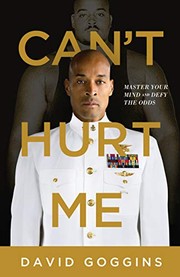
Can't hurt me
In 60 seconds
David Goggins grew up abused in Buffalo, weighed 297 pounds killing bugs for a living, and decided one night to become a Navy SEAL. He lost over 100 pounds in under three months, survived Hell Week twice with pneumonia and broken shins, and went on to run 100-mile races on shattered feet. Along the way he built mental tools: the Accountability Mirror, the 40% Rule, and the Cookie Jar. His message: your mind lies to you about your limits, and you can callous it through voluntary suffering.
Before you start
Why it matters
This is the rawest memoir of mental toughness ever written—no hacks, no morning routines, just a man documenting how he rewired himself from abused kid to the toughest athlete alive. Read it if you feel stuck, soft, or secretly know you're operating at a fraction of your capacity. It's brutal, profane, and impossible to put down.
14 ideas, in the book's order
The big ideas
- 1Part 1 / Chapter 10
The Mirror That Doesn't Lie
Goggins stuck Post-it notes on his bathroom mirror with his goals, insecurities, and dreams, including his weight (265 lbs) and 'no college degree.' No filter, no excuses—just his failures written in his own handwriting, staring back at him. He called it the Accountability Mirror. He wrote his goals, insecurities, and dreams on the notes. If he lied to himself anywhere else, he couldn't lie here.
The idea
Most self-improvement starts with a vision board. Goggins starts with an indictment. The Accountability Mirror works because it removes the one escape hatch we all use: the story we tell ourselves about why we haven't changed yet. Write your actual state down—in plain, ugly words—and you can't hide from it. The mirror doesn't motivate you. It confronts you, and confrontation is where change begins.
Try this: Tonight, write your three biggest excuses on Post-it notes and stick them on your bathroom mirror. Read them out loud every morning this week.
- 2Part 1 / Chapters 2-3
297 Pounds and a Box of Doughnuts
Goggins was working as an exterminator, weighing 297 pounds, eating a box of doughnuts every morning before spraying bug poison in other people's homes. Then one night he watched a Navy SEAL documentary on TV and something cracked open. He decided to become one. There was just one problem: SEAL training had a weight requirement, and he was 106 pounds over it. He'd already failed the ASVAB twice. So he studied for months, passed it on the third try, and lost 106 pounds in less than three months—dropping from 297 to 191 pounds.
The idea
The gap between who you are and who you want to be isn't closed by inspiration—it's closed by a deadline and a number. Goggins didn't 'start his fitness journey.' He had a specific weight to hit in a specific timeframe or the door closed forever. Specificity is what separates transformation from daydreaming. When your goal has a number and a clock attached, excuses run out of room to breathe.
Try this: Pick one measurable goal with a hard deadline—weight, miles, pages—and write the number where you'll see it daily.
- 3Part 2 / Chapters 3, 5
Hell Week, Twice
During his first Hell Week in SEAL training, Goggins developed severe pneumonia and stress fractures in both shins. Most men would've quit—medical discharge is the honorable exit. He refused. He completed the week and was rolled back to the next class for medical reasons, then completed Hell Week again. That experience taught him something he'd carry for life: 'When your mind is telling you you're done, you're really only 40 percent done.'
The idea
The 40% Rule is the book's central claim: your brain sends a 'quit' signal long before your body actually fails. It's a survival mechanism, not a truth. Goggins discovered it not in a lab but while coughing up blood with fractured shins, deciding to keep going anyway. Once you accept that the first 'I'm done' is a lie, every limit you thought you had becomes negotiable. The reserve tank is bigger than the gauge shows.
Try this: Next workout, when you want to stop, do 10% more—then notice the quit signal was early, not accurate.
- 4Part 2 / Chapter 4
The Man Who Couldn't Swim
Goggins nearly drowned as a child, and the fear followed him into SEAL training where he failed the drown-proofing evolution multiple times. In a program where you can't graduate without passing, he was stuck. His solution was pure Goggins: he tied his own hands and feet, sank to the bottom of the pool, pushed off, and gasped for air—repeating this for over an hour. He passed.
The idea
Fear doesn't shrink when you avoid it; it shrinks when you walk into it deliberately. Goggins didn't practice swimming until he felt confident—he engineered situations where panic was guaranteed and survival was the only option. This is exposure therapy done without a therapist, using the pool as the couch. The surprise is how fast fear collapses when you stop negotiating with it and start drowning it, literally.
Try this: Identify the one task you've been avoiding out of fear and do it first thing tomorrow, before your brain can negotiate.
- 5Part 2 / Chapter 5
The Cookie Jar
During SEAL training, at his lowest moment, Goggins reached into his memory and pulled out the worst experiences of his life—the beatings from his father, and the time a teacher in Brazil, Indiana called him 'nigger' in third grade—and used them as fuel. He called this mental reserve the Cookie Jar: a collection of past victories and hardships overcome that you raid when doubt creeps in. The abuse that should have broken him became the evidence that he'd already survived worse.
The idea
The Cookie Jar inverts how we handle trauma. Instead of burying painful memories, Goggins catalogs them as proof of resilience. When you're at mile 70 of anything—literal or figurative—you need receipts, not affirmations. Your past suffering, properly filed, becomes an arsenal. The surprising part: the darker the memory, the more fuel it holds, because surviving it is undeniable evidence you're harder than your current problem.
Try this: Write down three hard things you've already survived. Keep the list in your wallet for the next bad day.
- 6Part 3 / Chapter 5
101 Miles With No Training
Goggins had never trained for an ultramarathon. He entered the San Diego One Day, a 24-hour relay race, and decided to run it solo—just him, a track, and 24 hours. He completed 101 miles in 18 hours and 56 minutes. Afterward, he urinated blood and suffered kidney failure. His body was wrecked. He'd found the next mountain.
The idea
Goggins didn't wait until he felt ready, because ready is a feeling, not a fact. He signed up for something absurd, then became the person who could do it—backward from how we're told to approach challenges. The kidney failure isn't a footnote to skip past; it's part of the price he accepted upfront. This is the difference between testing your limits and assuming they exist.
Try this: Sign up for something 30% beyond your current ability—before you feel prepared.
- 7Part 3 / Chapter 6
Badwater: 135 Miles Through Death Valley
The Badwater 135 runs through Death Valley in July, where temperatures hit 130°F. Goggins had never finished a 100-mile race. His first attempt ended at mile 70—heat exhaustion, vomiting, done. Most people would call that a fair lesson and never return. He came back the next year and finished fifth overall.
The idea
The gap between dropping out and finishing fifth wasn't physical preparation—it was returning. Goggins treats failure as data, not identity. Most of us quit once and build a story around it: 'I tried, it wasn't for me.' He quit once and built a training plan around the exact mile where he broke. The comeback isn't inspiring because he won; it's inspiring because he went back to the scene of the failure on purpose.
Try this: Return to one thing you quit—same task, this month, with one adjustment based on why you stopped.
- 8Part 3 / Chapter 8
Broken Feet, Finished Race
At the HURT 100 in Hawaii, by mile 20, Goggins had broken every small bone in both feet. He taped his ankles and kept going. The race took 33 hours and 23 minutes. He hallucinated. He crawled at points. He finished.
The idea
There's a line between toughness and self-destruction, and Goggins spends most of the book on the wrong side of it—which is exactly why the story works. He's not prescribing 'run on broken feet.' He's demonstrating what the human body tolerates when the mind refuses to accept the diagnosis. You'll never need to finish a race on shattered bones. But knowing someone did recalibrates what 'too hard' means for your Tuesday workout.
Try this: When you catch yourself saying 'I can't,' ask: is that my body or my schedule talking?
- 9Part 3 / Chapter 6
4,030 Pull-Ups
Goggins went after the Guinness World Record for pull-ups. His first attempt ended at 2,588 due to a torn palmar fascia in his right hand. He succeeded on his third attempt, completing 4,030 pull-ups in 17 hours.
The idea
Two failures before the record. The torn hand, the failed second attempt—none of it registered as a stop sign. What looks like obsession from the outside is, from the inside, just refusing to let a single attempt define the outcome. Most people give a goal one shot and treat the result as a verdict. Goggins treats each attempt as a draft, and he's willing to bleed through the edits.
Try this: Take one goal you failed at once and schedule attempt number two this week.
- 10Part 4 / Chapter 10
The Governor in Your Head
Goggins describes a mental mechanism he calls the Governor—a built-in limiter that reduces your effort to protect you from pain and failure. It's not your body quitting; it's your brain preemptively throttling you. The only way past it, he argues, is to callous the mind: repeated, deliberate exposure to suffering until the Governor's alarm stops firing at every discomfort.
The idea
The Governor explains why comfort makes us weaker. Every time you skip the hard thing, the Governor learns that discomfort means stop, and its trigger point drops. Callousing works in reverse: each voluntary hardship raises the threshold. This is why Goggins's advice isn't 'think positive'—it's 'do hard things on purpose, repeatedly, until your nervous system stops treating them as emergencies.'
Try this: End every shower cold this week—30 seconds, no negotiation. Start callousing.
- 11Part 4
The 4 a.m. Stretch
Years of ultramarathons and military training wrecked Goggins's body. His response: stretch for two hours every morning, starting at 4:00 a.m., for years. At age 36, he did his first 'Hell Week' test, a self-imposed week of extreme physical challenges including 20-mile runs, thousands of push-ups, and minimal sleep, to prove he could still endure. The punishment never stops; it just changes shape.
The idea
Maintenance is the unsexy half of toughness nobody posts about. Goggins treats recovery with the same fanaticism as racing—two hours of stretching before dawn isn't flexibility work, it's a discipline ritual. The self-administered Hell Week at 36 shows the deeper point: the standard isn't 'can you do it once,' it's 'can you still do it when nobody's watching and nothing's at stake.'
Try this: Pick one recovery habit—stretching, sleep, mobility—and attach it to a fixed early time for seven days.
- 12Part 4 / Chapter 9
Moab 240: Talking to Cartoon Characters
The Moab 240 is a 240-mile ultramarathon through Utah's canyon country. Somewhere deep in the race, Goggins started hallucinating—seeing cartoon characters—and ran off course without realizing it. His crew had to tell him he was going the wrong way. He finished in 62 hours and 21 minutes.
The idea
At 240 miles, the race stops being physical and becomes a negotiation with your own deteriorating mind. Goggins finished while hallucinating, which means the finish line mattered more than his perception of reality. That's the extreme version of a daily truth: half of any long effort is managing the story your tired brain tells you. His crew correcting his course is also the honest part—toughness includes letting people steer you back.
Try this: Tell one person your goal this week so they can catch you when you drift off course.
- 13Part 3
Three Elite Badges
Goggins completed Navy SEAL training, Army Ranger School, and Air Force Tactical Air Controller training—one of the only people ever to finish all three. Ranger School nearly stopped him twice: first attempt ended with heatstroke, second with hyponatremia. On the third attempt, he graduated as Enlisted Honor Man.
The idea
Three elite programs exist to break people, and Goggins finished all of them—including one he had to attempt three times. The pattern repeats: fail, diagnose, return. What's striking is that each failure had a specific medical cause, and instead of reading those as 'my body can't do this,' he read them as 'not yet.' The Honor Man distinction matters too: he didn't just survive the third attempt, he dominated it.
Try this: List one pursuit you've abandoned after failing. Write what specifically broke, and fix only that.
- 14Part 5 / Chapter 7
The Pool Comp He Kept Failing
Goggins failed the Navy SEAL pool comp test three times due to panic. His fix was brutal: He trained by having his friend tie his hands and feet and throw him into a pool repeatedly until he overcame the fear. He overcame the fear and passed.
The idea
Goggins outsourced his courage to a friend with a rope. He knew his own willpower would flinch, so he engineered a situation where sinking was the only option. This is the practical core of the whole book: don't wait to feel brave—build a scenario where bravery is the exit route. The friend matters too. Sometimes the smartest move isn't more willpower; it's someone willing to throw you in.
Try this: Recruit a friend to hold you accountable to the one fear you keep postponing—give them permission to push.
Worth remembering
Best lines
“When your mind is telling you you're done, you're really only 40 percent done.”
“The most important conversations you'll ever have are the ones you'll have with yourself.”
“Callous your mind.”
A fair critique
Where it falls short
Goggins's approach ignores recovery science and can read as glorifying self-harm—running on broken feet and finishing races with kidney failure isn't a template, it's an outlier's pathology. The book also assumes toughness solves everything, giving little airtime to strategy, rest, or collaboration. Readers with a history of overtraining or disordered eating should take the 'push past pain' ethos with real caution. And the constant profanity and repetition of the same 'suffer harder' message can wear thin by the final chapters.
In one sentence
Your mind quits at 40%, and everything you want lives in the other 60%.
Is it for you?
Who should read it
Anyone who suspects they're coasting at 40% of their potential and wants a violent wake-up call. Athletes, veterans, and anyone rebuilding after failure will find it indispensable.
4 questions
Quick quiz: how well do you know Can't hurt me?
0 of 4 answered
FAQ
What is Can't hurt me about?
Can't Hurt Me is the autobiography of David Goggins, a retired Navy SEAL and ultra-endurance athlete. It details his journey from a traumatic childhood to becoming a world-renowned figure of mental toughness. The book shares his philosophy on how to master your mind, push past perceived limits, and achieve greatness through extreme discipline and self-accountability.
Is Can't hurt me worth reading?
Yes, Can't Hurt Me is highly regarded for its raw honesty and powerful message of self-mastery. Readers often find Goggins' story incredibly inspiring and his actionable advice on developing mental fortitude transformative. It's particularly recommended for those seeking motivation to overcome challenges, improve self-discipline, and unlock their full potential.
How does Can't hurt me end?
Spoiler: The book ends with Goggins encouraging readers to apply his principles to their own lives, emphasizing continuous self-improvement and the relentless pursuit of one's full potential. He challenges readers to ask 'What if?' and to never settle, reiterating his core message of staying hard and embracing discomfort as a path to growth.
Who should read Can't hurt me?
This book is ideal for anyone feeling stuck, lacking motivation, or struggling to achieve their goals. It's particularly beneficial for individuals interested in self-improvement, mental toughness, physical endurance, or those seeking inspiration to overcome significant personal challenges. It appeals to readers who appreciate direct, no-nonsense advice.
How long does it take to read Can't hurt me?
On average, it takes approximately 5 to 7 hours to read Can't Hurt Me. This estimate can vary based on individual reading speed and whether the reader takes time to reflect on the challenges Goggins presents at the end of each chapter.
Who wrote Can't hurt me?
Can't hurt me was written by David Goggins and first published in 2018.
What genre is Can't hurt me?
Can't hurt me is listed under Self-Help.
More Self-Help summariesHow many pages is Can't hurt me?
Can't hurt me is about 364 pages long (the median page count across its editions, per Open Library).