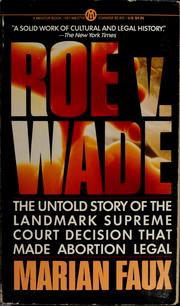
About Roe v. Wade: The untold story of the Landmark Supreme Court Decision that made abortion legal
Marian Faux's "Roe v. Wade: The untold story of the Landmark Supreme Court Decision that made abortion legal" offers a comprehensive and deeply human account of the legal battle that culminated in the landmark 1973 Supreme Court decision. The book meticulously traces the journey from the personal plight of Norma McCorvey, the anonymous "Jane Roe," a young, poor, and pregnant woman seeking an abortion in Texas, to the strategic legal efforts of her pioneering attorneys, Sarah Weddington and Linda Coffee. Faux illuminates the societal context of abortion in America before Roe, detailing the dangers of illegal procedures and the restrictive laws that governed women's reproductive choices.
The narrative is not merely a legal history but also a character-driven exploration, delving into the motivations and struggles of the key figures involved. It provides an intimate look at the legal arguments presented to the Supreme Court, the justices' deliberations, and the complex political and social pressures surrounding the case. Faux reveals the intricate interplay of personal stories, legal precedent, and constitutional interpretation that shaped one of the most significant and controversial rulings in American history. The book underscores why the decision remains a focal point of debate, examining its immediate impact and its enduring legacy on American law, politics, and women's rights.
Key takeaways
- Understand the pre-Roe v. Wade landscape where abortion was largely illegal and often unsafe, highlighting the dire circumstances many women faced.
- Recognize the pivotal roles of attorneys Sarah Weddington and Linda Coffee, who, despite their youth and limited experience, spearheaded the legal challenge.
- Appreciate that Norma McCorvey, "Jane Roe," was a real person whose personal struggles became the catalyst for a national legal revolution.
- Learn about the specific constitutional arguments, particularly the right to privacy, that formed the basis of the Roe v. Wade decision.
- Consider the complex and often contentious deliberations among the Supreme Court justices that led to the 7-2 ruling.
- Reflect on the immediate and long-term societal and political ramifications of Roe v. Wade, which continues to shape American discourse on reproductive rights.
- Grasp that the book emphasizes the human element behind the legal case, making the abstract legal concepts relatable through personal narratives.
Key ideas at a glance
Reproductive rights
- Learn about the specific constitutional arguments, particularly the right to privacy, that formed the basis of the Roe…
- Reflect on the immediate and long-term societal and political ramifications of Roe v. Wade, which continues to shape…
Legal history
- Recognize the pivotal roles of attorneys Sarah Weddington and Linda Coffee, who, despite their youth and limited…
- Appreciate that Norma McCorvey, "Jane Roe," was a real person whose personal struggles became the catalyst for a…
Women's autonomy
- Understand the pre-Roe v. Wade landscape where abortion was largely illegal and often unsafe, highlighting the dire…
Constitutional law
- Consider the complex and often contentious deliberations among the Supreme Court justices that led to the 7-2 ruling.
Social change
- Grasp that the book emphasizes the human element behind the legal case, making the abstract legal concepts relatable…
Chapter summaries
Abortion Before Roe: A Nation Divided
This chapter sets the stage by describing the legal and social landscape of abortion in the United States prior to the Roe v. Wade decision. It details the restrictive state laws that criminalized abortion in most circumstances, pushing the practice underground and leading to dangerous, often fatal, illegal procedures. Faux highlights the growing public health crisis and the nascent movement for abortion reform, illustrating the urgent need for legal change and the profound impact on women's lives.
Meet Jane Roe: Norma McCorvey's Story
Faux introduces Norma McCorvey, the real woman behind the pseudonym "Jane Roe." This chapter delves into McCorvey's personal background, her struggles with poverty, unstable relationships, and her third unplanned pregnancy. It portrays her as a vulnerable individual seeking a legal abortion, whose circumstances made her an ideal, albeit initially reluctant, plaintiff for a landmark legal challenge. Her story humanizes the abstract legal arguments that would follow.
The Lawyers: Weddington and Coffee
This section focuses on the two young, ambitious, and relatively inexperienced female attorneys, Sarah Weddington and Linda Coffee, who took on McCorvey's case. It explores their motivations, their commitment to women's rights, and their strategic decision to challenge Texas's abortion laws. Faux details their initial efforts to find a plaintiff and build a case, highlighting their determination against significant odds and limited resources.
Crafting the Legal Strategy
The chapter outlines the intricate legal strategy developed by Weddington and Coffee. It details their decision to base the challenge on the constitutional right to privacy, arguing that abortion laws infringed upon a woman's fundamental liberty. Faux explains how they navigated the legal system, from the initial filing in district court to preparing for the eventual appeal to the Supreme Court, meticulously building their arguments against the state of Texas.
Arguments Before the High Court
This chapter vividly recounts the two oral arguments presented before the U.S. Supreme Court in 1971 and 1972. Faux describes the atmosphere in the courtroom, the questions posed by the justices, and the performance of both the plaintiffs' and the state's attorneys. It provides insight into the complex legal and ethical considerations at play, showcasing the intellectual battle over constitutional interpretation and the future of reproductive rights.
The Justices Deliberate
Faux takes readers behind the closed doors of the Supreme Court, exploring the private deliberations among the nine justices. This chapter reveals the differing viewpoints, the internal debates, and the evolving positions of individual justices as they grappled with the profound implications of the case. It sheds light on the process of judicial decision-making, the influence of legal philosophy, and the search for consensus in a deeply divisive issue.
The Decision and Its Aftermath
This concluding section details the Supreme Court's 7-2 decision, handed down on January 22, 1973, establishing a woman's constitutional right to an abortion. Faux analyzes the majority opinion, the concurring opinions, and the dissenting views. It then explores the immediate reactions from various segments of society, from celebration among pro-choice advocates to outrage from anti-abortion groups, setting the stage for decades of ongoing controversy and legal challenges.
Full summary
Book Overview
"Roe v. Wade: The Untold Story of the Landmark Supreme Court Decision that Made Abortion Legal" by Marian Faux offers a detailed examination of the intricate legal and personal narratives surrounding the landmark 1973 Supreme Court case that fundamentally altered the landscape of reproductive rights in the United States. Drawing on interviews, legal documents, and historical context, Faux presents an insightful exploration of the case, its implications, and the societal debates it ignited.
Main Content/Plot
The book chronicles the origins of Roe v. Wade, which arose from the legal battle initiated by "Jane Roe," a pseudonym for Norma McCorvey, who sought to have an abortion in Texas, where the procedure was heavily restricted. Faux delves into the motivations and legal strategies of both Roe's attorneys and the opposing counsel for Henry Wade, the district attorney. The narrative unfolds through the trials and tribulations faced by McCorvey and her legal team, revealing the societal pressures and personal struggles that informed their fight.
Faux meticulously details the Supreme Court proceedings, highlighting the arguments presented, the justices' deliberations, and the eventual decision that recognized a woman's right to privacy under the Due Process Clause of the Fourteenth Amendment. The author emphasizes the significance of the ruling, which effectively legalized abortion across the United States and set a precedent for reproductive rights.
Key Themes
1. Right to Privacy: Central to the case is the theme of individual rights, particularly a woman's right to privacy in making personal medical decisions without government interference. Faux argues that this principle is paramount for safeguarding personal autonomy.
2. Gender Equality: The decision is also framed within the broader context of women's rights. Faux illustrates how Roe v. Wade contributed to advancing gender equality by allowing women greater control over their reproductive choices and life paths.
3. Legal and Political Landscape: The book explores the political climate of the 1970s, including the activism from both pro-choice and pro-life movements, thus reflecting the ongoing societal divide regarding reproductive rights.
4. Personal Narratives: Faux emphasizes the human stories behind the legal battle, highlighting the emotional and societal stakes involved in the case, which adds depth to the legal discourse and underscores the impact of the decision on individuals.
Important Takeaways
- Legal Precedent: Roe v. Wade set a crucial legal precedent that has influenced numerous subsequent rulings related to privacy and reproductive rights, reinforcing the importance of judicial interpretation
Memorable quotes
“The right to privacy, though not explicitly mentioned in the Constitution, was seen by the Court as broad enough to encompass a woman's decision whether or not to terminate her pregnancy.”
“For Norma McCorvey, the decision came too late; she had already given birth to her child. But for millions of other women, it was a lifeline.”
“The legal battle was not just about abortion; it was about who controlled a woman's body, her future, and her fundamental liberty.”
“Sarah Weddington and Linda Coffee, two young women barely out of law school, had taken on the establishment and won.”
Themes
- Reproductive rights
- Legal history
- Women's autonomy
- Constitutional law
- Social change
About Marian Faux
Marian Faux is an American journalist and author known for her insightful non-fiction works, particularly those exploring legal and social issues. In addition to "Roe v. Wade: The untold story of the Landmark Supreme Court Decision that made abortion legal," she has written books such as "The Complete Guide to the New Copyright Law." Faux's background in journalism enabled her to approach the complex subject of Roe v. Wade with a meticulous eye for detail and a commitment to telling the full, human story behind the legal precedent, making the intricacies of constitutional law accessible to a broad audience.
FAQ
What is Roe v. Wade: The untold story of the Landmark Supreme Court Decision that made abortion legal about?
The book chronicles the legal and personal journey behind the 1973 Supreme Court case Roe v. Wade. It tells the story of Norma McCorvey ("Jane Roe"), her attorneys Sarah Weddington and Linda Coffee, the legal strategies employed, the Supreme Court's deliberations, and the profound impact of the decision on American society and women's reproductive rights.
Is Roe v. Wade: The untold story of the Landmark Supreme Court Decision that made abortion legal worth reading?
Yes, it is highly recommended for anyone interested in American legal history, women's rights, or the history of abortion in the U.S. Faux provides a detailed, accessible, and human-centered account of a pivotal legal battle, making complex constitutional issues understandable and revealing the personal stakes involved in this landmark case.
How does Roe v. Wade: The untold story of the Landmark Supreme Court Decision that made abortion legal end?
Spoiler: The book culminates with the Supreme Court's 7-2 decision in January 1973, which affirmed a woman's constitutional right to an abortion, based on the right to privacy. It details the immediate reactions to the ruling, from widespread celebration among pro-choice advocates to intense opposition from anti-abortion groups, setting the stage for decades of ongoing legal and political conflict over reproductive rights in America.
Who should read Roe v. Wade: The untold story of the Landmark Supreme Court Decision that made abortion legal?
This book is ideal for students of law, history, and political science, as well as general readers interested in social justice, women's studies, or the evolution of constitutional rights. Anyone seeking a deeper understanding of the origins and implications of the Roe v. Wade decision will find it invaluable.
How long does it take to read Roe v. Wade: The untold story of the Landmark Supreme Court Decision that made abortion legal?
Given its depth and detail, a typical reader can expect to spend approximately 8 to 12 hours to read "Roe v. Wade: The untold story of the Landmark Supreme Court Decision that made abortion legal" cover to cover. This estimate can vary based on individual reading speed and engagement with the material.