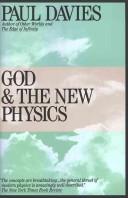
About god and the new physics
Paul Davies's "God and the New Physics" explores the profound implications of modern scientific discoveries, particularly in quantum mechanics and cosmology, for traditional theological and philosophical questions about the universe's origin, purpose, and the existence of a creator. Davies argues that rather than disproving God, the new physics offers a more sophisticated framework for understanding ultimate reality, moving beyond anthropomorphic concepts of a supernatural interventionist deity.
The book delves into concepts such as the Big Bang, the fine-tuning of cosmic constants (the anthropic principle), the nature of time, and the perplexing aspects of quantum theory. Davies suggests that the universe's inherent order, its mathematical elegance, and its apparent design for life might point towards a deeper, underlying intelligence or principle, which could be considered a 'God' compatible with scientific understanding. He aims to bridge the historical chasm between scientific inquiry and spiritual contemplation, proposing that both fields can mutually inform and enrich our understanding of existence.
Key takeaways
- Modern physics provides new conceptual tools for addressing ultimate questions about existence, traditionally explored by religion.
- The universe's fundamental physical laws and constants appear remarkably fine-tuned for the emergence of life, a phenomenon known as the anthropic principle.
- Quantum mechanics challenges classical notions of objective reality, causality, and the observer's role in shaping events, opening doors for new philosophical interpretations.
- Concepts like the Big Bang and the origin of time have profound implications for theological discussions about creation and eternity.
- Davies suggests that a 'God' compatible with new physics might be an impersonal, underlying principle of cosmic order rather than a supernatural being.
- The book encourages a re-evaluation of the relationship between science and religion, proposing they can be complementary paths to understanding the cosmos.
- The universe's inherent mathematical beauty and logical structure hint at a deeper rationality or design that science can explore.
Key ideas at a glance
Science and religion
- Modern physics provides new conceptual tools for addressing ultimate questions about existence, traditionally explored…
- The book encourages a re-evaluation of the relationship between science and religion, proposing they can be…
Cosmology
- Concepts like the Big Bang and the origin of time have profound implications for theological discussions about creation…
Quantum mechanics
- Quantum mechanics challenges classical notions of objective reality, causality, and the observer's role in shaping…
Nature of reality
- The universe's inherent mathematical beauty and logical structure hint at a deeper rationality or design that science…
Anthropic principle
- The universe's fundamental physical laws and constants appear remarkably fine-tuned for the emergence of life, a…
- Davies suggests that a 'God' compatible with new physics might be an impersonal, underlying principle of cosmic order…
Chapter summaries
The Revival of Teleology
Davies introduces the historical tension between science and religion, noting how modern physics, particularly cosmology and quantum mechanics, has reopened questions previously considered outside scientific purview. He argues that the universe's apparent order, fine-tuning, and the very existence of physical laws suggest a deeper meaning or design, challenging the purely mechanistic worldview that dominated science for centuries. He sets the stage for exploring how concepts like time, reality, and consciousness are re-evaluated in light of new physics, hinting at a 'new teleology' where purpose might be inherent in the cosmos.
The Nature of Reality
This chapter delves into the philosophical implications of quantum mechanics. Davies discusses how the observer's role in quantum measurements challenges classical notions of objective reality, introducing concepts like wave-particle duality, superposition, and the collapse of the wave function. He explores various interpretations of quantum theory, including the Copenhagen interpretation and the many-worlds interpretation, and their profound impact on our understanding of what constitutes 'reality' and whether it exists independently of consciousness. The chapter questions whether the universe is fundamentally a mental construct or if mind is an emergent property of a physical reality.
Time and Eternity
Davies examines the concept of time from both physical and philosophical perspectives. He discusses Einstein's relativity, which unifies space and time into spacetime, and the implications for simultaneity and the flow of time. He explores the 'arrow of time' – why time moves forward – linking it to thermodynamics (entropy) and cosmology (the expansion of the universe). The chapter also touches upon the beginning of time with the Big Bang and the potential end of time, raising questions about eternity and whether time itself is a fundamental aspect of reality or an emergent phenomenon.
The Cosmic Blueprint
This chapter focuses on the anthropic principle and the apparent fine-tuning of the universe. Davies details how numerous fundamental physical constants and initial conditions of the universe must fall within incredibly narrow ranges for life, or even stable matter, to exist. He discusses examples like the strength of fundamental forces, the expansion rate of the universe, and the proton-neutron mass difference. He explores various explanations for this fine-tuning, including chance, the multiverse hypothesis, and the idea of a deliberate design or 'cosmic blueprint,' prompting a re-evaluation of teleology in nature.
Mind and Cosmos
Davies explores the relationship between consciousness, the brain, and the physical universe. He discusses the hard problem of consciousness and whether it can be fully explained by classical physics or if quantum mechanics offers new insights. He touches upon theories suggesting a quantum basis for consciousness, such as Penrose and Hameroff's ideas. The chapter also considers the emergence of complexity and information in the universe, questioning whether mind is merely an epiphenomenon or if it plays a more fundamental role in the cosmos, perhaps even being a necessary component for reality to manifest.
The New Creation Story
This chapter provides an overview of modern cosmology, focusing on the Big Bang theory as the scientific account of the universe's origin. Davies explains the evidence supporting the Big Bang, such as the expansion of the universe and the cosmic microwave background radiation. He discusses the initial singularity, the inflationary epoch, and the formation of elements and structures. The chapter addresses the question of what existed 'before' the Big Bang and whether the universe could have created itself, exploring the implications of a universe with a definite beginning for philosophical and theological concepts of creation.
The Unifying Principle
Davies discusses the ongoing quest in physics for a 'Theory of Everything' (TOE) or a Grand Unified Theory (GUT) that would unify all fundamental forces and particles. He explains the standard model of particle physics and the challenges of incorporating gravity into a quantum framework. He explores theories like superstring theory and M-theory, which aim to provide a single, coherent description of all physical reality. The chapter considers whether such a theory, if found, would represent the ultimate understanding of the universe's laws and if these laws themselves require an explanation or are self-existent.
The End of the Universe
This chapter explores the ultimate fate of the cosmos according to current cosmological models. Davies discusses scenarios like the 'Big Crunch' (if the universe's expansion reverses), the 'Big Freeze' or 'Heat Death' (if it expands indefinitely, leading to maximum entropy), and the 'Big Rip.' He considers the implications of these scenarios for the long-term future of life, information, and the very concept of existence. The chapter also touches upon the cyclical universe models and the possibility of other universes, reflecting on the transient nature of our own cosmic epoch.
God and the New Physics
This is the core chapter where Davies directly addresses the implications of modern physics for the concept of God. He explores various conceptions of God – as a cosmic designer, a transcendent lawgiver, an immanent principle, or a personal deity. He argues that the new physics, with its emphasis on cosmic order, fine-tuning, and the mystery of existence, makes the idea of a 'God of the gaps' less appealing but opens avenues for a more sophisticated understanding of God as the ultimate ground of being or the source of the universe's rationality. He discusses how scientific laws themselves might be seen as divine attributes.
The Ultimate Explanation
In the concluding chapter, Davies grapples with the fundamental question of 'why there is something rather than nothing.' He discusses the limits of scientific explanation, arguing that while science can explain how the universe works, it may not be able to answer why it exists or why its laws are as they are. He explores the idea that the universe might be self-contained and self-explaining, or that its existence points to a deeper, non-physical reality. Davies suggests that the ultimate explanation might lie beyond empirical science, in a realm of metaphysics or even theology, where meaning and purpose might be found.
Full summary
In "God and the New Physics," Paul Davies explores the intersection of science and spirituality, questioning the implications of modern physics for understanding existence. He delves into concepts from quantum mechanics and cosmology, pondering whether scientific discoveries reveal a deeper meaning or divine presence in the universe.
Davies discusses key ideas like the anthropic principle, which suggests the universe's laws are finely tuned for life, and the role of time in understanding creation. He examines how theories such as string theory and the Big Bang challenge conventional views of a creator and the nature of reality.
Key concepts include the duality of science and faith, the implications of scientific findings on theological beliefs, and the search for a unifying theory of everything. Throughout, Davies navigates complex relationships between scientific inquiry and philosophical thought.
Ultimately, the book invites readers to contemplate profound questions about ex...
Memorable quotes
“Science and religion have both suffered from the same disease: a tendency to cling to outmoded concepts.”
“The truly amazing thing is not that life exists, but that the universe has provided the conditions for life to arise.”
“The laws of physics, as we know them, seem to be tailor-made for the emergence of complexity and consciousness.”
“The universe is not just 'there' and we are not just 'here'. There is more to it than that.”
Themes
- Science and religion
- Cosmology
- Quantum mechanics
- Nature of reality
- Existence of God
- Anthropic principle
About paul davies
Paul Davies is an acclaimed theoretical physicist, cosmologist, astrobiologist, and prolific popular science writer. He is known for his significant contributions to quantum field theory in curved spacetime and for his accessible books that explore the philosophical and theological implications of modern physics. Other notable works include "The Mind of God" and "The Fifth Miracle." Davies wrote "God and the New Physics" to demonstrate how contemporary scientific understanding, far from negating spiritual inquiry, can provide a richer and more profound framework for contemplating ultimate questions about the universe and our place within it.
FAQ
What is god and the new physics about?
Paul Davies's "God and the New Physics" explores how modern scientific discoveries, particularly in quantum mechanics and cosmology, offer new perspectives on traditional religious questions about the universe's origin, purpose, and the nature of God. It seeks to bridge the gap between scientific understanding and spiritual inquiry.
Is god and the new physics worth reading?
Yes, it is highly recommended for anyone interested in the intersection of science, philosophy, and religion. Davies presents complex scientific and philosophical ideas accessibly, prompting readers to reconsider fundamental questions about existence, cosmic design, and the potential for a scientific understanding of 'God'.
How does god and the new physics end?
Spoiler: The book concludes by suggesting that the 'God' compatible with new physics is not a supernatural interventionist but rather an impersonal, underlying principle of cosmic order, inherent in the universe's laws and fine-tuning. It posits a scientific basis for awe and wonder, integrating science and a revised concept of divinity.
Who should read god and the new physics?
Readers interested in popular science, cosmology, quantum mechanics, the philosophy of science, and the ongoing dialogue between scientific and religious thought will find this book engaging and thought-provoking. It appeals to those seeking a deeper understanding of the universe's ultimate questions.
How long does it take to read god and the new physics?
On average, it takes approximately 320 minutes (about 5-6 hours) to read "God and the New Physics" at a typical reading speed of 250 words per minute. This can vary based on individual reading pace and engagement with the complex concepts discussed.