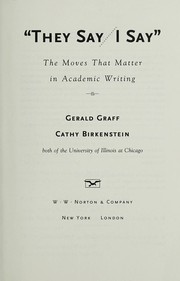
About They say I say
Gerald Graff and Cathy Birkenstein's "They Say / I Say" is a groundbreaking guide to academic writing that demystifies the process of argumentation by framing it as an act of entering a conversation. The book's central premise is that effective academic writing requires writers to not only present their own ideas ("I Say") but also to clearly articulate the ideas of others ("They Say") that their own arguments are responding to. It argues that all good writing involves a dialectical engagement with existing perspectives, making one's own contribution clear within a broader context.
The authors provide a series of practical templates and rhetorical moves designed to help students structure their arguments, integrate sources, and engage critically with different viewpoints. These templates cover various aspects of writing, from summarizing and quoting to agreeing, disagreeing, and qualifying arguments. The book emphasizes that these templates are not meant to stifle creativity but rather to provide a foundational structure, much like learning scales in music, enabling writers to focus on the substance of their ideas. "They Say / I Say" has become a staple in college writing courses, empowering students to overcome writer's block and develop more sophisticated, persuasive arguments by understanding writing as a dynamic, responsive process.
Key takeaways
- Always begin your writing by summarizing the 'They Say' – the existing conversation or common view – before introducing your own 'I Say' to provide context for your argument.
- Utilize templates provided in the book as starting points to structure your arguments, integrate sources, and articulate complex ideas, adapting them to fit your specific needs.
- Ensure your 'I Say' clearly responds to or engages with the 'They Say,' making the relationship between your ideas and others' explicit.
- Practice the art of 'quotation sandwiching' by introducing, presenting, and explaining every quote you use to ensure its relevance and meaning are clear to your reader.
- Employ metacommentary to guide your readers, clarifying what you mean, why your argument matters, and how different parts of your text relate to each other.
- Understand that academic writing is a conversation, and your goal is to contribute meaningfully to that ongoing dialogue, not just to state isolated facts or opinions.
- Revise your writing to ensure a strong thesis, clear transitions, and a consistent voice that effectively balances summarizing others' views with presenting your own.
Key ideas at a glance
Academic writing
- Always begin your writing by summarizing the 'They Say' – the existing conversation or common view – before introducing…
- Understand that academic writing is a conversation, and your goal is to contribute meaningfully to that ongoing…
Argumentation
- Employ metacommentary to guide your readers, clarifying what you mean, why your argument matters, and how different…
Rhetoric
- Ensure your 'I Say' clearly responds to or engages with the 'They Say,' making the relationship between your ideas and…
Critical thinking
- Practice the art of 'quotation sandwiching' by introducing, presenting, and explaining every quote you use to ensure…
Source integration
- Utilize templates provided in the book as starting points to structure your arguments, integrate sources, and…
Intellectual conversation
- Revise your writing to ensure a strong thesis, clear transitions, and a consistent voice that effectively balances…
Chapter summaries
Entering the Conversation
This foundational chapter introduces the book's central premise: that effective academic writing requires entering an ongoing conversation. It emphasizes the importance of starting with "what others are saying" (the "They Say") before presenting one's own argument (the "I Say"). The authors provide basic templates for introducing summaries and arguments, illustrating how writers can position their ideas in relation to existing discussions, rather than presenting them in a vacuum. It argues that understanding and engaging with previous arguments is crucial for making one's own contribution meaningful and relevant to the audience, establishing the conversational model for all subsequent writing tasks.
The Art of Summarizing
This chapter focuses on how to summarize effectively and fairly, even when one intends to disagree with the source. It introduces the "believing game" as a strategy to accurately represent an author's argument before critiquing it. The chapter provides templates for introducing summaries, explaining that a good summary requires balancing the original author's ideas with the summarizing writer's own focus. It warns against "list summaries" that merely itemize points and encourages summaries that are concise, accurate, and serve the writer's larger argument, often with a specific "twist" or angle that foreshadows the writer's response.
The Art of Quoting
This chapter explains how to integrate direct quotations smoothly and effectively into one's writing. It stresses the importance of framing quotations, meaning that every quote should be introduced with a signal phrase and followed by an explanation of its relevance to the writer's argument. The chapter provides templates for introducing quotes and for explaining them, emphasizing that quotes should never be left to "speak for themselves." It also discusses how to select relevant portions of text, avoid "hit-and-run" quoting, and ensure that quotations are seamlessly woven into the writer's own prose, supporting their claims rather than merely decorating the text.
Three Ways to Respond
Moving into the "I Say" section, this chapter outlines the three primary ways a writer can respond to the "They Say": agreeing, disagreeing, or a combination of both. It provides templates for each type of response, encouraging writers to be explicit about their stance. The authors argue that even when agreeing, writers should add their own "twist" or unique contribution, rather than simply reiterating what has already been said. Similarly, when disagreeing, writers are encouraged to explain why they disagree. The chapter emphasizes that a strong argument requires a clear and nuanced position in relation to others' ideas.
Distinguishing What You Say from What They Say
This chapter focuses on the crucial skill of clearly indicating whose voice is speaking at any given moment in a text. It discusses the use of "voice markers" and signal phrases to avoid confusion between the writer's own ideas and those being summarized or quoted from others. The chapter provides templates for attributing ideas and for making clear transitions between different perspectives, ensuring that readers can easily follow the flow of argument and identify the source of each claim. It highlights that ambiguity in attribution can lead to misinterpretations or even accusations of plagiarism, stressing clarity for the reader.
Skeptics May Object: Planting a Naysayer in Your Text
This chapter teaches writers how to anticipate and address counterarguments or objections to their own claims. It argues that incorporating a "naysayer" strengthens an argument by demonstrating a writer's awareness of alternative perspectives and their ability to respond to them. The chapter provides templates for introducing and responding to objections, such as "Some might object..." or "Of course, many will disagree..." It emphasizes that engaging with potential critics makes one's own argument more robust, credible, and persuasive, showing that the writer has considered the complexities of the issue.
So What? Who Cares?: Explaining Why Your Argument Matters
This chapter addresses the importance of articulating the significance and implications of one's argument. It encourages writers to explicitly answer the "so what?" and "who cares?" questions for their readers, explaining why their claims are important and to whom. The chapter provides templates for explaining significance, such as "This matters because..." or "Ultimately, what is at stake here is..." It argues that a strong argument not only makes a clear claim but also demonstrates its broader relevance, impact, and the real-world consequences or intellectual stakes involved, ensuring the audience understands its value.
Connecting the Parts: Transitioning and Cohesion
This chapter focuses on strategies for creating smooth transitions and ensuring coherence throughout a piece of writing. It discusses the effective use of transition words and phrases (e.g., "however," "therefore," "in addition"), pointing words (e.g., "this," "that," "these"), and the strategic repetition of key terms and phrases. The chapter provides templates for various types of transitions, helping writers guide their readers through their arguments logically and clearly. It emphasizes that good writing flows seamlessly from one idea to the next, preventing abrupt shifts and maintaining a clear line of reasoning.
Metacommentary: Explaining What You Mean
This chapter introduces the concept of metacommentary, which is the act of commenting on one's own claims and telling readers how to interpret them. It explains that metacommentary helps writers clarify, elaborate, and qualify their arguments, ensuring that readers understand their intended meaning. The chapter provides templates for using metacommentary, such as "In other words..." or "What I mean by this is..." It argues that metacommentary is a powerful tool for preventing misunderstandings, anticipating objections, and strengthening one's argument by guiding the reader's interpretation of complex ideas or nuanced positions.
The Academic 'I': Does It Make You Sound Self-Absorbed?
This chapter explores the debate surrounding the use of the first-person pronoun "I" in academic writing. It challenges the traditional rule that "I" should be avoided, arguing that using "I" can often make writing clearer, more direct, and more engaging, especially when expressing one's own argument or stance. The chapter provides templates for using "I" effectively and discusses contexts where it is appropriate or less appropriate, encouraging writers to use it judiciously to clarify their position and avoid passive or overly convoluted phrasing, ultimately promoting a more confident and authoritative voice.
But Is It Plagiarism?
This chapter addresses the critical issue of academic integrity and how to avoid plagiarism. It clarifies what constitutes plagiarism, emphasizing that it's not just about copying words but also about failing to properly attribute ideas, even when paraphrasing. The chapter provides practical advice on how to cite sources correctly, paraphrase effectively, and integrate source material ethically. It reinforces the importance of distinguishing between one's own ideas and those of others, a core theme throughout the book, to ensure academic honesty and to properly engage in scholarly conversation without misrepresenting sources.
Analyzing Literature
This chapter applies the "They Say / I Say" framework specifically to the task of writing about literature. It demonstrates how literary analysis involves entering a conversation about a text, summarizing existing interpretations ("They Say"), and then offering one's own unique reading or argument ("I Say"). The chapter provides templates tailored for literary essays, such as introducing critical interpretations, analyzing textual evidence, and responding to different scholarly views on a work. It encourages students to move beyond simple plot summary to engage in sophisticated textual interpretation and contribute to ongoing literary debates.
Writing in the Social Sciences
This chapter extends the book's core principles to the context of social science writing, such as sociology, psychology, or political science. It shows how social scientists engage in conversations by reviewing existing research, presenting data, and interpreting findings in relation to previous studies. The chapter offers templates for summarizing research, introducing data, discussing methodologies, and interpreting implications within social science discourse. It emphasizes the need to situate one's empirical work within a broader academic dialogue, explaining how one's findings confirm, challenge, or extend existing theories and research.
Writing in the Sciences
This chapter adapts the "They Say / I Say" framework for writing in the natural and physical sciences. It illustrates how scientific writing, despite its objective appearance, also involves entering a conversation by reviewing prior research, stating hypotheses, presenting methods and results, and discussing findings in the context of existing scientific knowledge. The chapter provides templates for summarizing scientific literature, introducing experiments, interpreting data, and explaining the significance of one's scientific contributions, helping scientists articulate their work within ongoing scientific debates and contribute to the collective body of knowledge.
Research Writing
This chapter focuses on the comprehensive process of conducting and writing a research paper, integrating all the "They Say / I Say" moves learned throughout the book. It guides students through identifying a research question, finding and evaluating sources, synthesizing information from multiple perspectives, and constructing an argument that responds to existing scholarship. The chapter provides templates for introducing research questions, summarizing multiple sources, and positioning one's own research within a larger body of work, emphasizing the iterative and conversational nature of research as a dialogue with existing knowledge.
Readings for Further Discussion
This section typically presents a collection of diverse essays, articles, and sometimes literary texts from various disciplines. The primary purpose of these readings is to provide students with concrete examples of the "They Say / I Say" moves in action, allowing them to analyze how professional writers engage in academic conversations. Students are encouraged to apply the templates and analytical strategies learned in previous chapters to these texts, identifying summaries, responses, counterarguments, metacommentary, and the overall conversational structure within the provided examples, thereby deepening their understanding of the book's core principles.
Full summary
Opening Context (150 chars):
In Chapter 11 of "They Say / I Say," Gerald Graff emphasizes the importance of substantial revision in academic writing for clarity and coherence.
Main Content (400 chars):
This chapter highlights that revision is not merely about correcting grammar or typos, but about rethinking arguments and structure. Graff advocates for a recursive writing process where writers engage deeply with their ideas, ensuring their claims are well-supported and organized. Key strategies include assessing the effectiveness of the thesis, enhancing evidence, and refining the overall narrative flow, thus transforming initial drafts into compelling arguments.
Key Elements (250 chars):
Graff introduces concepts like "the revision process" and "feedback loops." He stresses collaboration with peers or mentors to gain diverse perspectives. The chapter showcases examples of revised works, illustrating how substantive changes can lead to more persuasive and engagin...
Memorable quotes
“The central piece of advice in this book is that you need to enter a conversation, using what others say (or might say) as a springboard for your own ideas.”
“Good academic writing should offer some version of what we call the 'They Say / I Say' formula.”
“To do justice to the people you cite, you need to represent their positions accurately and with enough detail for a reader to understand where they're coming from.”
“The best academic writing has one underlying feature: it is deeply engaged in some way with other people's ideas.”
“You need to do more than just summarize what 'they say.' You also need to present 'your say,' your own argument, as a response to what 'they' have said.”
“In fact, the best writers do more than just make an argument. They also make an argument about their argument.”
Themes
- Academic writing
- Argumentation
- Rhetoric
- Critical thinking
- Source integration
- Intellectual conversation
About Gerald graff
Gerald Graff is a professor of English and education, and Cathy Birkenstein is a lecturer at the University of Illinois at Chicago. Together, they co-authored "They Say / I Say: The Moves That Matter in Academic Writing," which has become a widely adopted textbook in college writing courses. Graff is known for his work on educational reform and making academic discourse more accessible, notably through his book "Clueless in Academe." Birkenstein's expertise lies in teaching writing and developing pedagogical strategies. They wrote "They Say / I Say" to address common challenges students face in academic writing, providing a practical, template-based approach to help them engage effectively with scholarly conversations.
FAQ
What is They say I say about?
They Say / I Say is a guide to academic writing that teaches students how to structure arguments by engaging with existing ideas. It provides templates and strategies for summarizing others' views ('They Say') and then presenting one's own response ('I Say'), framing writing as entering a conversation. The book aims to improve clarity, coherence, and persuasiveness in academic discourse.
Is They say I say worth reading?
Yes, They Say / I Say is highly recommended for anyone looking to improve their academic writing, particularly college students. Its practical, template-based approach simplifies complex rhetorical moves, making it easier to construct clear, well-supported arguments. It's widely used in universities for its effectiveness in teaching critical thinking and effective communication.
Who should read They say I say?
They Say / I Say is ideal for college students, high school students preparing for college, and anyone who writes academic papers, essays, or argumentative pieces. It's particularly useful for those struggling with organizing their thoughts, integrating sources, or understanding how to contribute to scholarly conversations.
How long does it take to read They say I say?
Reading They Say / I Say typically takes about 4 to 6 hours. The book is relatively concise, and while it's often used as a textbook, a focused reader can get through the core instructional chapters fairly quickly. The time may vary depending on how much one engages with the exercises and example readings.