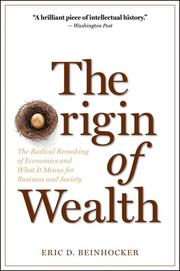
About The origin of wealth
Eric D. Beinhocker's "The Origin of Wealth" fundamentally challenges the prevailing equilibrium theory of economics, which has dominated the field for over a century. Beinhocker argues that traditional economic models, based on assumptions of rationality, perfect information, and market equilibrium, are ill-equipped to explain the dynamic, ever-changing nature of real-world economies and the astonishing growth of wealth. He contends that these models fail to account for innovation, technological progress, and the disequilibrium that characterizes actual markets.
Instead, Beinhocker proposes a new framework rooted in complexity economics, drawing insights from fields like biology, physics, and computer science. He posits that economies are complex adaptive systems, akin to evolving ecosystems, where wealth is generated through an evolutionary process of variation, selection, and replication of 'designs' – encompassing both physical technologies (like tools and machines) and social technologies (like institutions, business models, and legal systems). The book explores how these designs explore a vast 'design space' of possibilities, leading to continuous innovation and the emergence of novel forms of wealth. This perspective offers a more robust explanation for economic growth, market dynamics, and the persistent challenges of development, urging a re-evaluation of how we understand and manage economic systems.
Key takeaways
- Recognize that traditional equilibrium economics often fails to explain real-world economic phenomena like innovation and sustained growth.
- Understand that economies are complex adaptive systems, constantly evolving rather than tending towards a static equilibrium.
- Embrace an evolutionary view of wealth creation, where new 'designs' (physical and social technologies) are continuously generated, selected, and replicated.
- Foster environments that encourage experimentation, variation, and selection of new ideas and business models to drive economic progress.
- Shift policy focus from optimizing static systems to nurturing dynamic, adaptive processes that can explore the 'design space' of possibilities.
- Appreciate the interconnectedness of physical technology, social technology, and business strategy in driving economic evolution.
- Challenge assumptions of perfect rationality and information, acknowledging the bounded rationality and emergent properties of economic agents.
Key ideas at a glance
Complexity economics
- Recognize that traditional equilibrium economics often fails to explain real-world economic phenomena like innovation…
- Understand that economies are complex adaptive systems, constantly evolving rather than tending towards a static…
Evolutionary wealth creation
- Embrace an evolutionary view of wealth creation, where new 'designs' (physical and social technologies) are…
- Appreciate the interconnectedness of physical technology, social technology, and business strategy in driving economic…
Beyond equilibrium
- Foster environments that encourage experimentation, variation, and selection of new ideas and business models to drive…
Innovation and design
- Challenge assumptions of perfect rationality and information, acknowledging the bounded rationality and emergent…
Adaptive systems
- Shift policy focus from optimizing static systems to nurturing dynamic, adaptive processes that can explore the 'design…
Chapter summaries
Chapter 1: The Mystery of Wealth
Beinhocker opens by highlighting the vast disparities in wealth across nations and the inability of traditional economic theories to fully explain this phenomenon. He introduces the central question: what is the origin of wealth? He critiques the limitations of neoclassical economics, particularly its reliance on equilibrium models, which struggle to account for innovation, change, and the dynamic nature of real-world economies. The chapter sets the stage for introducing a new framework—complexity economics—that can better address the creation and distribution of wealth in a constantly evolving system. He emphasizes that wealth is not merely about resource allocation but about the generation of novel solutions to human problems.
Chapter 2: The Limits of Equilibrium
This chapter delves deeper into the critique of traditional economics, specifically the general equilibrium theory. Beinhocker argues that the assumptions underlying these models—rational agents, perfect information, diminishing returns, and a tendency towards equilibrium—are fundamentally flawed when applied to dynamic, innovative economies. He explains why these models, while elegant, fail to capture the essence of wealth creation, which is characterized by constant disequilibrium, increasing returns, and emergent properties. The chapter illustrates how the real world is far from the static, predictable system envisioned by equilibrium economics, paving the way for a more appropriate, evolutionary perspective.
Chapter 3: The Algorithm of Evolution
Beinhocker introduces the concept of evolution not just as a biological process but as a general algorithm for generating complexity and adaptation. He breaks down evolution into its three core components: variation, selection, and retention. Variation refers to the generation of new ideas, designs, or behaviors. Selection involves testing these variations against an environment, where some succeed and others fail. Retention is the process by which successful variations are preserved and propagated. This chapter establishes evolution as a powerful, non-linear process capable of creating highly complex and adaptive systems without central planning, laying the groundwork for applying this framework to economic phenomena.
Chapter 4: The Design Space
This chapter introduces the concept of a "design space," which is an abstract, multi-dimensional space representing all possible solutions or designs for a given problem. In an economic context, this could be the space of all possible business models, technologies, or organizational structures. Beinhocker explains that wealth creation involves exploring and navigating this vast design space to discover novel and effective solutions. He emphasizes that this space is often immense and largely unexplored, highlighting the role of creativity and experimentation in economic progress. The design space provides a conceptual map for understanding where new economic forms originate.
Chapter 5: The Fitness Landscape
Building on the concept of the design space, Beinhocker introduces the "fitness landscape." This landscape maps the "fitness" or success of different designs within the design space. Peaks represent highly successful designs, while valleys represent less successful ones. The landscape is not static but constantly shifting due to changing environmental conditions, consumer preferences, and technological advancements. This dynamic nature means that what is "fit" today may not be tomorrow, necessitating continuous adaptation and exploration. The chapter explains how economic agents (firms, entrepreneurs) are constantly trying to climb fitness peaks, often through trial and error, in a landscape that is rugged and ever-changing.
Chapter 6: The Economy as an Evolutionary System
This chapter synthesizes the previous concepts, presenting the economy itself as a complex adaptive system operating under the algorithm of evolution. Beinhocker argues that business models, technologies, products, and even institutions are "designs" that undergo variation, selection, and retention. Firms are constantly experimenting with new business models (variation), markets select the successful ones (selection), and these successful models are then replicated and scaled (retention). This perspective fundamentally shifts the understanding of economic activity from a static allocation problem to a dynamic process of continuous innovation, adaptation, and transformation, driven by decentralized experimentation.
Chapter 7: The Origin of Business Models
Beinhocker applies the evolutionary framework to explain how new business models emerge and propagate. He defines business models as "recipes" for creating and delivering value, and argues that they are the primary unit of selection in the economy. New business models arise through recombination of existing ideas, mutation, and experimentation. The market then acts as a selection mechanism, favoring those models that are more "fit" in terms of profitability, customer satisfaction, and efficiency. The chapter provides examples of how innovative business models, rather than just new products, have driven significant economic growth and disruption, illustrating the power of evolutionary dynamics in shaping industries.
Chapter 8: The Origin of Technology
This chapter explores the evolutionary nature of technology. Beinhocker argues that technologies are also designs that evolve through variation, selection, and retention. New technologies often emerge from the recombination of existing components or principles, undergoing iterative improvements and adaptations. The market and scientific community act as selection environments, favoring technologies that are more effective, efficient, or solve problems better. He discusses how technological progress is not a linear march but a branching, path-dependent process, with many dead ends and unexpected breakthroughs. The chapter emphasizes the co-evolution of technology with business models and institutions.
Chapter 9: The Origin of Institutions
Beinhocker extends the evolutionary framework to explain the origin and evolution of institutions, including laws, regulations, social norms, and organizational structures. He argues that institutions are also "designs" that emerge to solve collective action problems, reduce transaction costs, or coordinate behavior. Like technologies and business models, institutions undergo a process of variation (new laws, norms), selection (adoption, enforcement, societal acceptance), and retention (codification, cultural embedding). The chapter highlights how effective institutions can significantly enhance a society's ability to create wealth by providing stability and incentives for innovation, while poorly designed ones can hinder it.
Chapter 10: The Origin of Strategy
This chapter examines corporate strategy through the lens of complexity economics. Beinhocker argues that strategy is not about finding an optimal, static position in a stable market, but about navigating a constantly evolving fitness landscape. Effective strategy involves fostering internal variation (experimentation, innovation), developing robust selection mechanisms (market testing, internal evaluation), and efficiently retaining successful designs. He contrasts this dynamic, adaptive view with traditional strategic planning models, emphasizing the importance of agility, learning, and the ability to adapt to unpredictable changes in the environment. Strategy becomes an ongoing evolutionary process within the firm.
Chapter 11: The Design of Organizations
Beinhocker applies the principles of complexity economics to organizational design. He argues that organizations should be designed as adaptive systems capable of continuous learning and evolution, rather than rigid hierarchies optimized for efficiency in a static environment. Key elements include fostering internal variation (decentralized decision-making, diverse teams), creating effective internal selection mechanisms (performance metrics, feedback loops), and enabling the retention and scaling of successful practices. The chapter advocates for structures that promote experimentation, rapid iteration, and the ability to reconfigure in response to changing market conditions, moving away from command-and-control models.
Chapter 12: The Design of Markets
This chapter explores how markets themselves can be designed to better facilitate wealth creation. Beinhocker argues that markets are not natural phenomena but designed institutions, and their effectiveness depends on their structure. He discusses how well-designed markets can enhance variation (by lowering entry barriers, promoting competition), improve selection (through transparent pricing, efficient information flow), and aid retention (by facilitating capital allocation to successful ventures). He examines various market structures and regulatory frameworks, suggesting ways to optimize them for innovation and adaptability, rather than just static efficiency, emphasizing the role of rules in shaping economic outcomes.
Chapter 13: The Design of Policy
Beinhocker extends the implications of complexity economics to public policy. He argues that government policies should aim to foster an evolutionary economy by promoting variation, selection, and retention. This includes policies that encourage entrepreneurship and innovation (variation), ensure fair competition and efficient resource allocation (selection), and support education, infrastructure, and stable institutions (retention). He critiques policies based on static equilibrium models and advocates for adaptive, experimental policy-making that acknowledges uncertainty and embraces learning. The chapter offers a framework for designing policies that enhance a nation's capacity for wealth creation in a dynamic world.
Chapter 14: The Future of Wealth
In the concluding chapter, Beinhocker summarizes the core arguments of the book and offers a vision for the future of wealth. He reiterates that wealth is not a fixed pie but an emergent property of an evolutionary system, constantly being created through the generation and selection of novel designs. He emphasizes the profound implications of complexity economics for understanding economic growth, inequality, and sustainability. The chapter calls for a shift in mindset from viewing the economy as a machine to understanding it as a living, evolving system, suggesting that embracing this perspective is crucial for navigating the challenges and opportunities of the 21st century.
Full summary
Book Overview
"The Origin of Wealth: Evolution, Complexity, and the Radical Remaking of Economics" by Eric D. Beinhocker presents a transformative perspective on economics, exploring the intricate processes that drive wealth creation through the lens of evolutionary theory and complexity science. Beinhocker challenges traditional economic models, arguing that the dynamics of markets and economies are akin to biological ecosystems, influenced by the interactions of various agents and the environment in which they operate.
Main Content/Plot
Beinhocker's work is structured around a series of interconnected ideas and chapters that progressively build on the concept of wealth creation as a complex adaptive system. The book is divided into three main sections:
1. The Nature of Wealth: Beinhocker begins by defining wealth in a broader context than just money, emphasizing the importance of resources, knowledge, and relationships in wealth creation. He critiques classical economics for its oversimplified models and introduces the idea of wealth as an emergent property of complex systems.
2. The Evolution of Economic Systems: This section delves into the evolutionary processes at play in economies. Beinhocker employs concepts from evolutionary biology to explain how competition, innovation, and adaptation contribute to economic evolution. He discusses the role of entrepreneurs as key agents in this ecosystem, driving change and fostering new economic structures through creative destruction.
3. The Future of Economics: The final chapters explore implications for future economic theories and policies. Beinhocker suggests that understanding economies as complex adaptive systems can lead to more effective interventions and policies. He also touches on the impact of technology and globalization on wealth creation.
Key Themes
1. Complexity and Adaptation: The book emphasizes that economies are not linear systems but rather complex networks that adapt and evolve over time, shaped by interactions among various agents.
2. Innovation and Entrepreneurship: Beinhocker highlights the crucial role of innovation and entrepreneurial activity in driving economic growth and wealth creation, viewing them as fundamental elements of the economic ecosystem.
3. Systems Thinking: The author advocates for a systems-based approach to economics, pushing for a paradigm shift from traditional models to one that recognizes the interconnectedness of various economic elements.
4. Cultural and Institutional Factors: Beinhocker acknowledges the influence of culture, institutions, and social structures on economic outcomes, arguing that these factors play a significant role in shaping economic behavior.
Important Takeaways
- Wealth Creation is Multifaceted: Wealth is not merely a
Memorable quotes
“The economy is not a machine, it is a complex adaptive system.”
“Wealth is the physical embodiment of useful knowledge.”
“The process of wealth creation is fundamentally an evolutionary process.”
“The real action in an economy is not in equilibrium, but in disequilibrium.”
Themes
- Complexity economics
- Evolutionary wealth creation
- Beyond equilibrium
- Innovation and design
- Adaptive systems
About Eric D. Beinhocker
Eric D. Beinhocker is an American economist and academic, known for his work on complexity economics. He is currently a Professor of Public Policy Practice at the Blavatnik School of Government at the University of Oxford and Executive Director of the Institute for New Economic Thinking at the Oxford Martin School. Before his academic career, Beinhocker spent many years at McKinsey & Company. He wrote "The Origin of Wealth" to challenge the limitations of conventional economic theory and introduce a more dynamic, evolutionary framework for understanding how economies function and generate prosperity, drawing on insights from various scientific disciplines.
FAQ
What is The origin of wealth about?
The book argues that traditional economics fails to explain real-world wealth creation and proposes a new framework: complexity economics. It views economies as complex adaptive systems where wealth emerges through an evolutionary process of generating, selecting, and replicating 'designs' – both physical and social technologies. It offers a dynamic, non-equilibrium perspective on economic growth.
Is The origin of wealth worth reading?
Yes, it is highly recommended for anyone interested in a fresh, multidisciplinary perspective on economics. It provides a compelling critique of conventional economic thought and introduces a powerful alternative framework rooted in complexity science. It's particularly valuable for those seeking to understand innovation, growth, and market dynamics beyond traditional models.
Who should read The origin of wealth?
This book is essential reading for economists, business leaders, policymakers, and anyone interested in understanding the fundamental drivers of economic growth and innovation. It appeals to those who find traditional economic theories insufficient and are open to interdisciplinary approaches from fields like biology, physics, and computer science.
How long does it take to read The origin of wealth?
Given its depth and substantial length (around 500 pages), reading "The Origin of Wealth" typically takes about 750 minutes, or approximately 12.5 hours, at an average reading speed of 250 words per minute. Its complex ideas may require slower reading and reflection.