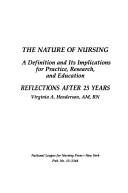
the nature of nursing
In 60 seconds
Virginia Henderson, a nurse with decades of practice and teaching behind her, sits down to define her profession. She finds no one has done it cleanly, so she builds the definition herself: nursing assists the sick or well toward activities that health or a peaceful death require, activities they would do unaided given the strength, will, or knowledge. She traces the word back through dictionaries and centuries, separates nursing from medicine, and insists it deserves its own research and its own place among the professions. The result became the backbone of modern nursing theory.
Before you start
Why it matters
This slim essay did what no dictionary or medical text had: it defined nursing on nursing's own terms. If you are a nurse, a student, or anyone shaping health policy, this is the root document of your profession's identity. Henderson's definition still anchors curricula and licensure debates worldwide, and her insistence on nursing's independence reads as fresh today as it did in 1966.
4 ideas, in the book's order
The big ideas
- 1The Nature of Nursing (essay opening)
A definition built from the dictionary up
Henderson opens with a confession: she has spent her career in nursing, yet when asked to define it, she reaches for the dictionary. She works through the Oxford English Dictionary and Webster's, pulling out the old senses of the word, including the obsolete meaning of nursing a drink or a grievance. She notes that the word traces back to the Latin nutrix, nourishing mother. The exercise is playful but pointed: if the dictionaries cannot settle what a nurse does, the profession itself must say so.
The idea
Henderson's method matters as much as her conclusion. She refuses to accept a vague, inherited sense of her profession and instead interrogates the very word, finding that its oldest meaning, nourishment, still fits the work. The surprise is that a technical definition can begin in a dictionary's obsolete entries. Precision about language, she shows, is the first step toward professional independence.
Try this: Take your own job title and look it up in a full dictionary, then write one sentence defining what you actually do that the dictionary misses.
- 2The Nature of Nursing (central definition)
The definition that fits on a postcard
After the word-work, Henderson delivers the sentence she is remembered for. Nursing, she writes, is primarily assisting the individual, sick or well, in the performance of those activities contributing to health, or a peaceful death, that he would perform unaided if he had the necessary strength, will, or knowledge. She frames it as a working definition, offered so others can attack and improve it. The stakes are real: without such a sentence, nursing cannot teach, license, or defend itself.
The idea
Notice what the definition does not say. It never mentions doctors, hospitals, or cures; nursing exists wherever a person lacks strength, will, or knowledge, which makes it older than medicine and larger than the sickroom. The peaceful-death clause startled readers, since it names death as an outcome nursing serves rather than a failure it prevents. Henderson invites disagreement on purpose, treating a definition as a hypothesis to be tested rather than a creed.
Try this: Write your own one-sentence definition of your work, then test it against a real task you did today to see if it holds.
- 3The Nature of Nursing (nursing versus medicine)
Nursing is not medicine's little sister
Henderson draws a hard line between the two professions. Medicine, she says, is concerned with the pathological condition, curing disease, while nursing helps the person perform the activities of daily living that illness has interrupted. The nurse's unique function is to get the person back on their feet, doing for them temporarily what they would do for themselves. She warns that when nursing imitates medicine, it loses the very thing that makes it a profession.
The idea
The distinction sounds obvious until you watch a hospital ward, where the two blur constantly. Henderson's split gives nurses a client, the whole person, rather than a disease, and a goal, independence, rather than a cure. That reframing explains why a nurse's work continues when no treatment is running, and why it matters most at the edges of life. It also sets up her later argument that nursing needs its own research agenda.
Try this: Next time you describe your work to a stranger, name one thing you do that no other profession on the team does.
- 4The Nature of Nursing (research and professionalism)
A profession without research is a trade
Henderson closes with a demand. For nursing to take its place among the professions, she argues, it must have its own field of research, its own body of knowledge built by nurses studying nursing. She points out that nursing has borrowed heavily from medicine and the natural and social sciences, which is useful but not sufficient. The essay ends by treating the definition she proposed as a starting point for that research program.
The idea
This is the essay's quiet radicalism: Henderson ties professional status not to pay, uniforms, or licensure, but to knowledge production. A field that only consumes other fields' findings, she implies, remains an apprentice trade no matter how skilled. The surprise is her humility, since she offers her own definition as raw material for study rather than a finished monument. Identity, for her, is something a profession earns in the laboratory.
Try this: Pick one routine practice in your field and ask what evidence, produced by your own profession, actually supports it.
A fair critique
Where it falls short
The essay is a product of 1966, and its language of 'he' and its assumptions about the nurse's role reflect that era. Henderson offers a definition and a research agenda but little guidance on how to fund or organize that research, and she does not address the economics or working conditions that shape nursing practice. Critics have also noted that her individual-centered definition sits awkwardly with public health and community nursing, where the client is a population, not one person.
In one sentence
Nursing is helping people do, unaided, what they would do for themselves if they had the strength, will, or knowledge, and a profession is only as real as the knowledge it builds.
Is it for you?
Who should read it
Nursing students and educators who want the root document of their profession's identity, and anyone who argues about what counts as a profession. It is short, sharp, and still cited in curricula worldwide.
4 questions
Quick quiz: how well do you know the nature of nursing?
0 of 4 answered
FAQ
What is the nature of nursing about?
The Nature of Nursing by Virginia Henderson defines the unique function of the nurse as assisting individuals, sick or well, in performing activities contributing to health or recovery that they would do independently if able. It outlines 14 basic human needs that guide nursing care, aiming to help patients achieve independence.
Is the nature of nursing worth reading?
Yes, it is considered a foundational text in nursing theory and is highly recommended. It provides essential insights into the core principles of nursing, its distinct role in healthcare, and its historical development, making it invaluable for students and practitioners.
How does the nature of nursing end?
Spoiler: The book concludes by reinforcing the nurse's distinct and vital role in promoting patient independence and well-being. Henderson advocates for a clear identity for the nursing profession, emphasizing its unique contribution to health and recovery, and its implications for education and research.
Who should read the nature of nursing?
This book is essential reading for nursing students, educators, and practitioners seeking a deeper understanding of the theoretical underpinnings of their profession. Anyone interested in the philosophy of nursing or the historical evolution of healthcare roles would also find it highly informative.
How long does it take to read the nature of nursing?
Given its academic nature and relatively concise length, a thorough reading of The Nature of Nursing, allowing for reflection and comprehension, would likely take approximately 4 hours.
Who wrote the nature of nursing?
the nature of nursing was written by virginia hendarson and first published in 1966.
What genre is the nature of nursing?
the nature of nursing is listed under Philosophy.
More Philosophy summariesHow many pages is the nature of nursing?
the nature of nursing is about 100 pages long (the median page count across its editions, per Open Library).