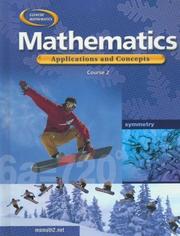
About MATHEMATICS
The book "Mathematics" by David Bergamini, part of the Life Science Library series, offers a comprehensive and accessible introduction to the vast world of mathematics for the general reader. Published in 1963, it aims to demystify complex mathematical concepts, tracing their historical development from ancient counting systems to modern abstract theories. The book emphasizes the practical applications of mathematics in various fields, including science, engineering, and everyday life, while also exploring its aesthetic beauty and its role as a fundamental language for understanding the universe. It argues that mathematics is not merely a collection of formulas but a dynamic human endeavor driven by curiosity and problem-solving.
Bergamini's work highlights key milestones and influential figures in mathematical history, illustrating how different branches of mathematics, such as arithmetic, geometry, algebra, and calculus, evolved to address specific challenges and expand human knowledge. Through clear explanations and engaging illustrations, the book makes abstract ideas tangible, demonstrating the logical progression of mathematical thought. It underscores the idea that mathematics provides a powerful framework for logical reasoning and and critical thinking, essential not just for scientists but for anyone seeking to comprehend the underlying structures of the world. The book ultimately serves as an invitation to appreciate mathematics as both an indispensable tool and a profound intellectual pursuit.
Key takeaways
- Mathematics is a fundamental language for understanding the universe, evolving from practical needs to abstract theories.
- The history of mathematics is intertwined with human progress, with each era contributing new concepts and methods.
- Key branches like arithmetic, geometry, algebra, and calculus developed to solve specific problems and expand human knowledge.
- Mathematics is not just about calculations but also about logical reasoning, pattern recognition, and abstract thought.
- Understanding mathematical principles enhances critical thinking and provides a powerful framework for problem-solving in various fields.
- The aesthetic beauty and intellectual challenge of mathematics are as significant as its practical applications.
Key ideas at a glance
Historical Development
- The history of mathematics is intertwined with human progress, with each era contributing new concepts and methods.
- Key branches like arithmetic, geometry, algebra, and calculus developed to solve specific problems and expand human…
Abstract Reasoning
- Mathematics is a fundamental language for understanding the universe, evolving from practical needs to abstract…
- Mathematics is not just about calculations but also about logical reasoning, pattern recognition, and abstract thought.
Practical Applications
- The aesthetic beauty and intellectual challenge of mathematics are as significant as its practical applications.
Problem Solving
- Understanding mathematical principles enhances critical thinking and provides a powerful framework for problem-solving…
Chapter summaries
The Language of Numbers
This section explores the origins of counting and number systems, from primitive tallies to the development of place-value systems and the concept of zero. It delves into the properties of different types of numbers, such as primes, and introduces fundamental arithmetic operations, illustrating how numbers form the bedrock of all mathematical thought and measurement.
The Realm of Geometry
This part traces the evolution of geometry from ancient Egyptian land surveying to Euclidean postulates and beyond. It covers basic shapes, spatial relationships, and the concepts of measurement, area, and volume. It also touches upon non-Euclidean geometries, demonstrating how geometry provides a framework for understanding space and form.
The Power of Algebra
This section introduces algebra as a method for solving problems using symbols and variables, moving beyond specific numbers to generalize mathematical relationships. It covers the development of algebraic equations, functions, and their application in modeling real-world phenomena, showcasing algebra's role in abstract reasoning and problem-solving.
The Logic of Chance
This part explores the mathematical theories of probability and statistics, explaining how they quantify uncertainty and analyze data. It discusses concepts like permutations, combinations, and statistical distributions, illustrating their use in fields ranging from games of chance to scientific research and risk assessment.
The Calculus of Change
This section delves into the revolutionary concepts of calculus, including differentiation and integration. It explains how calculus provides tools to understand rates of change, accumulation, and optimization, making it indispensable for physics, engineering, and economics, and demonstrating its power in analyzing dynamic systems.
The New Mathematics
This part discusses more modern developments in mathematics, such as set theory, logic, and abstract algebra, which emerged in the 19th and 20th centuries. It highlights the increasing abstraction and rigor in mathematics, exploring its foundational principles and its expansion into new, complex domains.
Full summary
"MATHEMATICS" delves into the intricate world of mathematical concepts, exploring their evolution and significance throughout history. The book serves as a comprehensive guide to understanding the fundamentals of mathematics, from basic arithmetic to advanced theories, emphasizing its role in shaping human thought and society.
The main content unfolds through a meticulous examination of key mathematical ideas such as algebra, geometry, calculus, and statistics. It highlights major themes like the interconnectedness of mathematics and science, the impact of mathematics on technology, and the philosophical questions that arise from mathematical inquiry. Important developments, such as the introduction of zero and the invention of calculus, are discussed in depth.
Key elements include influential mathematicians like Euclid, Newton, and Gödel, whose relationships with their work and each other are explored. Concepts like mathematical proofs, theorems, and theorems’ implications furthe...
Themes
- Historical Development
- Abstract Reasoning
- Practical Applications
- Logical Structure
- Beauty of Patterns
- Problem Solving
About the author
David Bergamini (1928-1983) was an American author and journalist, best known for his contributions to the Life Science Library series. He wrote several books on scientific topics, including "Mathematics" and "The Universe." Bergamini had a talent for making complex scientific subjects engaging and understandable for a general audience, often blending historical context with clear explanations of scientific principles. His work aimed to popularize science and mathematics, making these fields accessible to a broader readership.
FAQ
What is MATHEMATICS about?
"Mathematics" by David Bergamini provides an accessible overview of the history, concepts, and applications of mathematics. It explores how mathematical ideas developed from ancient times to the modern era, covering key branches like arithmetic, geometry, algebra, and calculus, and demonstrating their relevance in understanding the world.
Is MATHEMATICS worth reading?
Yes, for anyone seeking a broad, non-technical introduction to mathematics, Bergamini's book is highly regarded. It makes complex ideas understandable and highlights the beauty and utility of mathematics, making it a valuable read for students and general readers alike.
How does MATHEMATICS end?
Spoiler: The book concludes by exploring "The New Mathematics," touching upon more abstract and foundational concepts like set theory and mathematical logic. It emphasizes the ongoing evolution of mathematics and its increasing abstraction, showcasing its continued expansion into new intellectual frontiers.
Who should read MATHEMATICS?
This book is ideal for general readers, students, and anyone with a curiosity about mathematics but without a specialized background. It serves as an excellent introduction for those who want to understand the fundamental principles and historical context of mathematical thought.
How long does it take to read MATHEMATICS?
Given its approximately 200 pages and accessible style, reading "Mathematics" by David Bergamini would likely take around 4 to 6 hours for an average reader. This estimate can vary based on reading speed and the depth of engagement with the concepts.