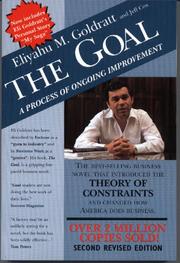
About The Goal
The Goal" by Eliyahu M. Goldratt is a groundbreaking business novel that introduces the author's Theory of Constraints (TOC) through an engaging narrative. The story follows Alex Rogo, a plant manager whose manufacturing facility is on the brink of closure. Faced with an ultimatum from his division vice president, Alex embarks on a desperate quest to turn his plant around, save his job, and mend his deteriorating personal life. His journey is guided by Jonah, a mysterious former physics professor who challenges Alex's conventional understanding of efficiency and productivity.
Through a series of Socratic dialogues and real-world applications, Alex learns that the true "goal" of any business is to make money, and that this goal is often obscured by local optima and misleading performance metrics. He discovers that a system's output is limited by its single weakest link, or "constraint" (a bottleneck). The core of TOC involves a five-step focusing process: identifying the constraint, exploiting it, subordinating everything else to it, elevating it, and then repeating the cycle. Alex and his team apply these principles to identify bottlenecks in their plant, such as specific machines and processes, and devise innovative solutions to maximize their throughput.
The book masterfully blends a compelling personal story with profound business insights, making complex operational management concepts accessible to a wide audience. It demonstrates that focusing on overall system performance, rather than individual departmental efficiencies, is crucial for profitability and survival. "The Goal" remains a foundational text in operations management, supply chain, and continuous improvement, influencing countless businesses to rethink their strategies for achieving their ultimate objective.
Key takeaways
- The ultimate goal of a for-profit business is to make money, which is measured by Throughput, Inventory, and Operating Expense.
- Identify the system's constraint (bottleneck) as the single factor limiting its ability to achieve its goal.
- Exploit the constraint by ensuring it is never idle and always working on the most critical tasks.
- Subordinate all other non-constraint resources to the pace and needs of the constraint to ensure smooth flow.
- Elevate the constraint's capacity by investing in more resources or improving its efficiency if the previous steps are insufficient.
- Continuously identify and address new constraints as they emerge, fostering a culture of ongoing improvement.
- Local efficiencies can be detrimental to the overall system's performance if they do not contribute to the constraint's output.
- Inventory is a liability that ties up capital and indicates unbalanced flow, not an asset to be maximized.
Chapter summaries
Chapters 1-5: The Crisis at Bearington Plant
Alex Rogo, plant manager, faces an ultimatum from division VP Bill Peach: turn his struggling Bearington plant around in three months or it will be shut down. The plant is plagued by missed deadlines, high inventory, and low morale. Alex's personal life with his wife, Julie, is also under strain due to his demanding job. He initially focuses on traditional efficiency metrics, pushing his team (Lou, Bob Donovan, Stacey, Ralph) to improve individual machine utilization and reduce costs, but these efforts fail to yield overall positive results, only exacerbating the problems with inventory and lead times. The pressure mounts as the deadline looms, and Alex feels increasingly overwhelmed by the complexity of the plant's issues.
Chapters 6-10: The Enigmatic Jonah
During a chance encounter at an airport, Alex meets Jonah, his former physics professor. Jonah challenges Alex's fundamental assumptions about productivity, efficiency, and the role of robots in manufacturing. He poses cryptic questions like, "What is the goal of your company?" and "Are your robots helping you achieve that goal, or just creating more inventory?" Jonah suggests that local efficiencies do not necessarily translate to overall system efficiency and that Alex should look for "bottlenecks" that truly limit the plant's output. This encounter sparks a new way of thinking for Alex, forcing him to question long-held industry beliefs.
Chapters 11-15: Defining the Goal and Measurements
Alex and his team grapple with Jonah's questions, eventually concluding that the goal of a manufacturing organization is "to make money." They then work to define three operational measurements that align with this goal: Throughput (the rate at which the system generates money through sales), Inventory (all the money the system has invested in purchasing things it intends to sell), and Operating Expense (all the money the system spends to turn inventory into throughput). This shift in perspective helps them realize that traditional cost accounting metrics often conflict with the true goal, leading to suboptimal decisions.
Chapters 16-20: The Scout Troop Revelation
While leading his son's scout troop on a hike, Alex observes a real-world demonstration of dependent events and statistical fluctuations. He notices that the speed of the entire line of scouts is determined by the slowest scout, Herbie, and that variations in individual speeds accumulate, causing gaps and pile-ups. This experience provides a profound insight: the output of a system is limited by its weakest link, and simply making everyone work faster doesn't solve the problem; it only increases work-in-process inventory and chaos. This analogy becomes crucial for understanding bottlenecks in the plant.
Chapters 21-25: Identifying the Bottlenecks
Applying the lessons from the scout hike, Alex and his team return to the plant with a new understanding. They identify the NCX-10 machine and the heat treat department as the true bottlenecks, the resources that constrain the entire plant's output. They realize these aren't necessarily the machines with the highest utilization, but rather those whose capacity is less than the market demand. This discovery is a turning point, allowing them to focus their improvement efforts on the critical areas that truly impact the plant's overall performance, rather than chasing local efficiencies.
Chapters 26-30: Exploiting the Bottlenecks
With the bottlenecks identified, the team focuses on "exploiting" them, meaning maximizing their output. They implement strategies such as ensuring that only good parts arrive at the NCX-10 and heat treat (quality control upstream), meticulously scheduling work for these machines, and even moving lunch breaks to keep them running continuously. They learn that every minute a bottleneck is idle or working on defective parts is a minute of lost throughput for the entire plant, emphasizing the critical importance of these specific resources.
Chapters 31-35: Subordinating Everything Else (Drum-Buffer-Rope)
To protect the bottlenecks and ensure they are always fed, the team develops the "drum-buffer-rope" (DBR) system. The bottleneck (the "drum") sets the pace for the entire plant. A buffer of inventory is placed directly in front of the bottleneck to protect it from upstream disruptions. The release of raw materials (the "rope") is tied to the bottleneck's schedule, preventing excessive work-in-process inventory. They use a visual system of red and green tags to prioritize work, ensuring non-bottleneck resources support the bottleneck's schedule.
Chapters 36-40: Elevating the Bottlenecks and New Challenges
The plant's performance improves dramatically with DBR in place, leading to increased throughput and reduced inventory. The team explores ways to further "elevate" the capacity of the bottlenecks, such as using older, less efficient machines for non-bottleneck work to free up the NCX-10. However, new challenges emerge as the plant now produces more than sales can sell, indicating a shift in the system's constraint from production to the market. Alex's personal life with Julie also experiences renewed tension as he remains consumed by work.
Chapters 41-45: Applying TOC to the Market
Recognizing the market as the new bottleneck, Alex and his team, now collaborating with marketing and sales, identify a specific product that can be quickly produced and delivered, leveraging the plant's newfound speed and reliability. They work with Bill Peach to secure a crucial order for 1,000 units in two weeks, demonstrating the plant's ability to offer short lead times as a competitive advantage. This strategic move helps to increase sales and proves that the principles of the Theory of Constraints can be applied beyond the factory floor.
Chapters 46-49: The Five Focusing Steps and Promotion
The Bearington plant is saved, exceeding its performance targets. Alex is promoted to division manager, tasked with applying his new understanding to other struggling plants. He formalizes the process they followed into the "Five Focusing Steps" of the Theory of Constraints: 1. Identify the system's constraints. 2. Exploit the constraints. 3. Subordinate everything else to the exploitation. 4. Elevate the constraints. 5. If a constraint is broken, go back to step 1 (but don't let inertia set in). Alex also reconciles with Julie, finding a better balance between his professional success and personal life.
Full summary
Book Overview
"The Goal" by Eliyahu M. Goldratt is a seminal work in the field of operations management and business theory, first published in 1984. Written in a novel format, it follows the journey of Alex Rogo, a plant manager who is tasked with saving his struggling manufacturing facility from closure. Through this narrative, Goldratt introduces the Theory of Constraints (TOC), a management philosophy that focuses on identifying and managing the bottlenecks that hinder organizational performance.
Main Content/Plot
The story is set in a manufacturing plant owned by UniCo, where Alex Rogo faces a dire situation: his plant is underperforming, and he has just three months to turn it around or risk losing his job. As he grapples with the complexities of production processes, employee morale, and financial pressures, Alex encounters a former professor, Jonah, who serves as a mentor. Jonah challenges Alex to rethink traditional management practices and introduces him to the concept of constraints—factors that limit the system's performance.
Throughout the narrative, Alex and his team identify the critical bottlenecks in their operations, such as outdated machinery and inefficient workflows. They implement strategies to optimize these constraints, which leads to increased throughput, reduced inventory, and improved profitability. The story culminates in Alex’s realization that the goal of any business is not merely to maximize efficiency but to generate cash flow and ensure long-term sustainability.
Key Themes
1. Theory of Constraints (TOC): The central theme of the book, TOC emphasizes the importance of identifying and managing constraints to improve overall system performance.
2. Continuous Improvement: The narrative illustrates the necessity for ongoing evaluation and adaptation in business practices to foster growth and efficiency.
3. Holistic View of Management: Goldratt advocates for a comprehensive understanding of organizational processes rather than isolated improvements, highlighting the interdependence of various components.
4. Leadership and Teamwork: The book underscores the significance of effective leadership and collaboration among team members in overcoming challenges and achieving common goals.
5. The Nature of Goals: Goldratt prompts readers to rethink what constitutes a "goal" within a business context, shifting the focus from maximizing local efficiencies to enhancing overall organizational effectiveness.
Important Takeaways
- Identify Constraints: The first step in improving any process is to identify the bottlenecks that limit the system's throughput.
- Focus on the Goal: The ultimate objective