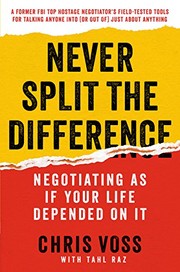
About Never split the difference
Chris Voss's "Never Split the Difference" revolutionizes the approach to negotiation by drawing on his extensive experience as a lead international hostage negotiator for the FBI. The book argues against traditional negotiation tactics that often advocate for compromise or a win-win scenario, instead proposing a method rooted in emotional intelligence, tactical empathy, and active listening. Voss asserts that true negotiation success comes not from logical persuasion alone, but from understanding and influencing the other party's emotions and underlying motivations.
The core of Voss's methodology involves techniques like mirroring, labeling emotions, calibrated questions, and the strategic use of "no" to uncover deeper truths and build rapport. He demonstrates how these high-stakes strategies, honed in life-or-death situations, are incredibly effective in everyday business deals, salary negotiations, and personal conflicts. The book empowers readers to gain leverage by making the other party feel understood and in control, ultimately guiding them towards an outcome that serves the negotiator's interests while satisfying the other side's perceived needs. It's a practical guide that transforms negotiation from a confrontational battle into a process of collaborative discovery, aiming for outcomes far superior to a mere split down the middle.
Key takeaways
- Practice tactical empathy by actively listening and verbally acknowledging the other party's emotions and perspective to build rapport and trust.
- Use mirroring (repeating the last one to three words) to encourage the other person to elaborate and reveal more information.
- Label the other person's emotions ("It sounds like you're feeling...") to diffuse negative feelings and make them feel understood.
- Aim for a "that's right" response, indicating the other party feels genuinely understood, rather than a superficial "yes."
- Employ calibrated questions (open-ended questions starting with "What" or "How") to gently guide the conversation and make the other side feel in control of the solution.
- Anchor your initial offer or demand strategically, either extremely high or low, to influence the other party's perception of value.
- Search for "Black Swans" – hidden, unexpected pieces of information that can fundamentally alter the negotiation's dynamics and lead to breakthroughs.
- Never split the difference; instead, dig deeper to find creative solutions that address the underlying needs and fears of both parties.
Key ideas at a glance
Tactical empathy
- Practice tactical empathy by actively listening and verbally acknowledging the other party's emotions and perspective…
Active listening
- Use mirroring (repeating the last one to three words) to encourage the other person to elaborate and reveal more…
Emotional intelligence
- Label the other person's emotions ("It sounds like you're feeling...") to diffuse negative feelings and make them feel…
Persuasion
- Aim for a "that's right" response, indicating the other party feels genuinely understood, rather than a superficial…
Influence
- Anchor your initial offer or demand strategically, either extremely high or low, to influence the other party's…
Negotiation strategy
- Search for "Black Swans" – hidden, unexpected pieces of information that can fundamentally alter the negotiation's…
Chapter summaries
Chapter 1: The New Rules
This chapter introduces the core philosophy of "tactical empathy" as a superior negotiation strategy, moving away from traditional win-win models. Chris Voss argues that negotiation is about information gathering and influencing behavior, not just reaching a compromise. He recounts his early experiences as an FBI hostage negotiator, highlighting the critical shift from trying to make people say "yes" to understanding the power of "no" as a safe starting point. The chapter emphasizes that emotions are not obstacles but tools, and that understanding the other party's worldview is paramount. It sets the stage for the practical techniques that follow, stressing that effective negotiation is a learnable skill rooted in active listening and emotional intelligence, rather than brute force or logical argument alone.
Chapter 2: Be a Mirror
Voss introduces mirroring as a fundamental, deceptively simple technique to build rapport and gather information. Mirroring involves repeating the last one to three words of what the other person has just said, often with an upward inflection. This encourages the speaker to elaborate, making them feel heard and understood without the negotiator having to offer an opinion or ask direct questions. The chapter provides examples from hostage situations, such as the Chase Manhattan Bank robbery, where mirroring helped de-escalate tension and extract critical details from the perpetrators. It explains that mirroring taps into a human desire for connection and validation, subtly guiding the conversation and revealing the other party's underlying thoughts and feelings, thereby creating an illusion of safety and control for them.
Chapter 3: Don't Feel Their Pain, Label It
This chapter delves into the concept of tactical empathy, which is the conscious effort to understand the other person's feelings and perspective, then verbalizing that understanding. Voss explains how to "label" emotions by using phrases like "It sounds like...", "It looks like...", or "It seems like..." to acknowledge the other party's feelings without agreeing with them. This technique helps to de-escalate negative emotions and build trust, as people feel understood and less defensive. He differentiates tactical empathy from sympathy, stressing that it's a strategic tool for gaining leverage. Examples include its use in hostage negotiations to calm agitated subjects and in business deals to address unspoken concerns, ultimately creating an environment conducive to problem-solving and collaboration.
Chapter 4: Beware "Yes"—Master "No"
Voss challenges the conventional wisdom that "yes" is the ultimate goal in negotiation, arguing that "no" is often a more powerful and safe starting point. He explains that "no" makes people feel in control and secure, allowing them to relax and engage more openly. The chapter teaches how to elicit "no" strategically, for example, by asking questions like "Is now a bad time to talk?" or "Are you against X?" This approach disarms the other party and prevents them from feeling cornered. Voss recounts how getting a "no" from a bank robber allowed the FBI to gain crucial time and information. He emphasizes that a "no" is not a rejection of the negotiator, but a protection of the other party's autonomy, opening the door for genuine dialogue and discovery.
Chapter 5: Trigger the Two Words That Immediately Transform Any Negotiation
This chapter highlights the profound impact of getting the other person to say "That's Right." Voss explains that "That's Right" signifies a genuine breakthrough in understanding, indicating that the other party feels truly heard and accurately represented. It's distinct from "You're Right," which can be a dismissive or superficial agreement. To achieve "That's Right," the negotiator must actively listen, use mirroring and labeling, and then summarize the other party's perspective and feelings so accurately that they affirm it. This moment builds immense trust and rapport, shifting the negotiation from conflict to collaboration. Voss illustrates this with examples where accurately summarizing a hostage-taker's grievances led to de-escalation and progress towards a resolution.
Chapter 6: Bend Their Reality
This chapter focuses on influencing the other party's perception of value and fairness, essentially "bending their reality." Voss introduces the concept of "anchoring" by setting an extreme initial offer or demand to make subsequent, more reasonable offers seem more attractive. He also discusses the "accusation audit," where the negotiator preemptively lists all the negative things the other party might be thinking about them, disarming criticism and building trust. The chapter emphasizes the psychological impact of deadlines, explaining how to use them to your advantage without being manipulated. Voss provides strategies for framing offers and demands in a way that resonates with the other party's worldview, making them feel that the proposed solution is their idea or is inherently fair, even when it heavily favors the negotiator.
Chapter 7: Create the Illusion of Control
This chapter focuses on using "calibrated questions" to subtly guide the other party towards your desired outcome while making them feel completely in control. Calibrated questions are open-ended, non-judgmental questions that typically start with "What" or "How" (and sometimes "Why," used carefully). Examples include "How am I supposed to do that?" or "What about this is important to you?" These questions force the other party to pause, think, and articulate their own solutions, often leading them to propose what the negotiator wanted all along. Voss explains how this technique was crucial in hostage negotiations, getting subjects to think through the logistics of surrender. It's about empowering the other side to solve your problems, thereby increasing their commitment to the solution.
Chapter 8: Guarantee Execution
This chapter addresses the critical step of ensuring that agreements made during negotiation are actually executed. Voss emphasizes that getting a "yes" is only half the battle; the real challenge is follow-through. He introduces the power of "How" questions to prompt the other party to think through the implementation details and potential obstacles. Questions like "How will we know we're on track?" or "How will you do that?" push the responsibility for execution onto them, increasing their commitment. The chapter also discusses the importance of identifying and addressing potential "Black Swans" – hidden, critical pieces of information that could derail the agreement. Voss stresses that true commitment comes from the other party feeling ownership over the solution and its implementation, rather than being told what to do.
Chapter 9: Bargain Hard
This chapter provides practical strategies for navigating the bargaining phase, especially when dealing with aggressive or difficult negotiators. Voss introduces the concept of different negotiation styles (Analyst, Accommodator, Assertive) and how to adapt your approach to each. He reiterates the importance of the "accusation audit" to disarm the other side before making an offer. The chapter details the "Ackerman Bargaining Model," a systematic process for making offers that involves setting an extreme anchor, making decreasing offers with empathy and "no" oriented questions, and using non-round numbers. Voss emphasizes that effective bargaining is not about being aggressive, but about being strategically empathetic, understanding the other party's walk-away point, and making them feel that they've won a fair deal.
Chapter 10: Find the Black Swan
This concluding chapter focuses on the ultimate goal of uncovering "Black Swans"—the hidden, game-changing pieces of information that can dramatically alter the course and outcome of a negotiation. Voss explains that these are often emotional, identity-based, or worldview-driven insights that are not immediately apparent. He stresses that finding Black Swans requires deep active listening, keen observation, and the strategic use of all the techniques previously discussed, particularly calibrated questions and tactical empathy. The chapter provides examples where uncovering a seemingly minor detail, like a specific religious belief or a hidden fear, completely shifted the power dynamic and led to a successful resolution in high-stakes situations. It reinforces that the best negotiators are relentless information gatherers, always seeking to understand the other party's true motivations and constraints.
Full summary
Book Overview
"Never Split the Difference: Negotiating As If Your Life Depended On It" is a compelling guide on negotiation tactics authored by Chris Voss, a former FBI hostage negotiator. Drawing from his extensive experience in high-stakes negotiations, Voss presents practical strategies that can be applied in everyday situations, transforming traditional negotiation approaches into a more effective and empathetic art.
Main Content/Plot
The book is structured around Voss's personal experiences and pivotal case studies from his career. It opens with a gripping anecdote about a hostage negotiation that sets the tone for the urgency and importance of negotiation skills. Voss introduces various techniques and principles that redefine conventional negotiation wisdom, such as the importance of emotional intelligence, active listening, and the use of tactical empathy.
Throughout the chapters, Voss outlines key strategies, including:
- Mirroring: Reflecting the last few words of your counterpart to build rapport.
- Labeling: Acknowledging the emotions of the other party to defuse tension.
- Accusation Audit: Preemptively addressing potential objections before they arise.
- The “Black Swan”: Identifying hidden information that can change the negotiation dynamics.
Each concept is supported by real-life examples, making the content relatable and actionable.
Key Themes
1. Empathy in Negotiation: Voss emphasizes that understanding the emotions and motivations of the other party is crucial to successful negotiations. This theme underscores the shift from adversarial approaches to collaborative problem-solving.
2. The Power of Listening: Active listening is portrayed as a vital skill that can lead to better outcomes. Voss advocates for listening more than speaking, allowing negotiators to gather valuable information.
3. Tactical Strategies: The book presents a variety of tactical strategies that can be applied in various negotiation contexts, from business deals to personal relationships, highlighting that negotiation is a skill that can be learned and refined.
4. Preparation and Adaptation: Voss stresses the importance of thorough preparation and the ability to adapt strategies in real-time, ensuring negotiators can respond effectively to changing circumstances.
Important Takeaways
- Negotiation is Not a Zero-Sum Game: Voss argues against the notion of compromise as the best solution. Instead, he advocates for solutions that satisfy all parties involved, enhancing relationships rather than damaging them.
- Emotional Intelligence is Key: Successful negotiators must understand and manage their emotions
Memorable quotes
“Negotiation is not an act of battle; it's an act of discovery.”
“He who has learned to disagree without being disagreeable has discovered the most valuable secret of negotiation.”
“The beauty of 'no' is that it is often a temporary answer, not a final one.”
“The most dangerous negotiation is the one you don't know you're in.”
“The goal is not to get a 'yes' but a 'that's right.'”
“Don't commit to anything in the first offer. You'll always regret it.”
Themes
- Tactical empathy
- Active listening
- Emotional intelligence
- Persuasion
- Influence
- Negotiation strategy
About Chris Voss
Chris Voss is a former FBI lead international hostage negotiator and the CEO and founder of The Black Swan Group, a consulting firm that provides negotiation training. During his 24-year tenure with the FBI, he handled over 150 international hostage cases, including some of the most high-profile kidnappings. He wrote "Never Split the Difference" to distill the high-stakes negotiation techniques he developed and used in the FBI, making them accessible and applicable to everyday business and personal interactions for a broader audience.
FAQ
What is Never split the difference about?
It's about a revolutionary approach to negotiation, based on the author's experience as an FBI hostage negotiator. It teaches readers how to use emotional intelligence, tactical empathy, and specific communication techniques to achieve better outcomes in any negotiation, from business deals to personal interactions, moving beyond traditional compromise.
Is Never split the difference worth reading?
Yes, it is highly regarded for its practical, actionable advice on negotiation. It offers a fresh perspective that moves beyond traditional win-win strategies, providing powerful tools that can be applied immediately in various contexts, making it valuable for anyone looking to improve their persuasive and communication skills.
How does Never split the difference end?
Spoiler: The book concludes by emphasizing the importance of continuously seeking "Black Swans" – hidden, unexpected information that can fundamentally change the negotiation dynamic. It reinforces that negotiation is an ongoing process of discovery and adaptation, where the most successful outcomes come from understanding the other party's deepest needs and motivations.
Who should read Never split the difference?
This book is ideal for anyone who engages in negotiations, whether in business (sales, management, entrepreneurship), personal life (family, friends), or high-stakes situations. It's particularly beneficial for those who want to improve their communication, persuasion, and conflict resolution skills by leveraging emotional intelligence.
How long does it take to read Never split the difference?
The book is approximately 272 pages long. At an average reading speed of 250 words per minute, it would take roughly 4 to 5 hours (around 270 minutes) to read the full book.