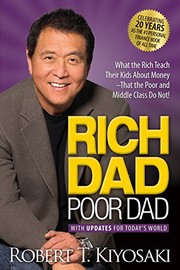
About Rich dad poor dad
Rich Dad Poor Dad by Robert T. Kiyosaki is a personal finance book that challenges conventional wisdom about money and investing. It tells the story of Kiyosaki's two fathers: his 'poor dad' (his biological father), a highly educated man who struggled financially, and his 'rich dad' (the father of his best friend), an eighth-grade dropout who became one of the wealthiest men in Hawaii. The book contrasts their differing philosophies on money, work, and life, arguing that traditional schooling prepares people for the 'rat race' of working for money, rather than teaching them how to make money work for them.
Kiyosaki advocates for financial literacy, emphasizing the importance of understanding assets versus liabilities, the power of corporations, and the value of investing in income-generating assets like real estate and businesses. He argues that the rich acquire assets, while the middle class acquires liabilities they think are assets. The book encourages readers to take control of their financial future by educating themselves, taking calculated risks, and developing an entrepreneurial mindset, rather than solely relying on a paycheck or job security. It aims to shift readers' perspectives on wealth creation and financial independence.
Key takeaways
- Understand the fundamental difference between an asset (something that puts money in your pocket) and a liability (something that takes money out of your pocket).
- The rich don't work for money; instead, they learn how to make money work for them through smart investments and asset acquisition.
- Prioritize financial education over traditional academic education to gain true financial intelligence.
- Focus on building your 'asset column' by acquiring income-generating assets, rather than just working for a salary.
- Learn about taxes and the legal advantages available to corporations and investors.
- Overcome common financial obstacles like fear, cynicism, laziness, bad habits, and arrogance to achieve financial success.
- Work to learn new skills and gain experience, not just for the paycheck.
- Pay yourself first by setting aside money for investments before paying bills or discretionary expenses.
Key ideas at a glance
Financial literacy
- Prioritize financial education over traditional academic education to gain true financial intelligence.
- Overcome common financial obstacles like fear, cynicism, laziness, bad habits, and arrogance to achieve financial…
Asset building
- Understand the fundamental difference between an asset (something that puts money in your pocket) and a liability…
- Focus on building your 'asset column' by acquiring income-generating assets, rather than just working for a salary.
Entrepreneurial mindset
- The rich don't work for money; instead, they learn how to make money work for them through smart investments and asset…
Passive income
- Learn about taxes and the legal advantages available to corporations and investors.
Financial independence
- Work to learn new skills and gain experience, not just for the paycheck.
Chapter summaries
Introduction: Rich Dad, Poor Dad
Kiyosaki introduces his two fathers: his biological "poor dad" (highly educated, government employee) and his best friend Mike's "rich dad" (eighth-grade dropout, successful entrepreneur). He explains how both men offered him contrasting advice on money, work, and life, shaping his financial philosophy. The introduction sets the stage for the book's central theme: the different mindsets and approaches to wealth building that he learned from each man, emphasizing that true education about money often comes from outside traditional schooling. He highlights the confusion and internal conflict he experienced trying to reconcile these two powerful, yet opposing, influences.
Lesson 1: The Rich Don't Work for Money
This lesson begins with young Robert and Mike working for Rich Dad for a meager 10 cents an hour, then being "fired" to teach them a lesson. Rich Dad explains that the poor and middle class work for money, while the rich have money work for them. He introduces the concept of the "Rat Race," where people get stuck in a cycle of earning, spending, and increasing expenses without building assets. The lesson emphasizes the importance of understanding the difference between an asset (something that puts money in your pocket) and a liability (something that takes money out of your pocket), and how fear and desire drive most people's financial decisions, keeping them trapped.
Lesson 2: Why Teach Financial Literacy?
Kiyosaki argues that schools teach professional skills but fail to teach financial literacy, leaving most people unprepared for the real world of money. He elaborates on the importance of understanding accounting, investing, markets, and the law. This lesson introduces the core concept of the income statement and balance sheet, explaining how the cash flow patterns differ for the poor, middle class, and rich. The poor and middle class often acquire liabilities they think are assets (like a house with a mortgage or a car), while the rich focus on acquiring income-generating assets that build their wealth over time, such as real estate, stocks, or businesses.
Lesson 3: Mind Your Own Business
This lesson stresses the importance of building and maintaining an asset column. Kiyosaki advises people to keep their day job but to start "minding their own business" by acquiring real assets outside of their primary employment. He distinguishes between a profession or job and a business, stating that one's profession might be a doctor, but their business should be investing in real estate, stocks, or other income-generating ventures. He warns against the common mistake of buying liabilities (like expensive cars or houses) before building a solid foundation of assets, emphasizing that true wealth comes from owning systems and investments that produce income.
Lesson 4: The History of Taxes and the Power of Corporations
Kiyosaki delves into the history of taxes, explaining how they were initially levied on the rich but eventually shifted to the middle class. He highlights the power of corporations as a legal structure that the rich use to protect their assets, minimize taxes, and defer income. He explains that corporations allow the rich to earn money, spend it, and then pay taxes on what's left, whereas employees earn, pay taxes, and then spend. This lesson introduces the concept of financial intelligence involving understanding tax laws and using legal structures to one's advantage, rather than simply earning more money.
Lesson 5: The Rich Invent Money
This lesson challenges the notion that you need money to make money. Kiyosaki argues that financial intelligence allows the rich to "invent" money by recognizing opportunities others miss, structuring deals creatively, and leveraging knowledge. He shares examples of how he and Rich Dad found undervalued assets, negotiated favorable terms, and created value where others saw none. The lesson emphasizes creativity, problem-solving, and the ability to see beyond conventional thinking. It highlights the importance of developing a strong financial IQ to identify and capitalize on market inefficiencies and create wealth from seemingly ordinary situations.
Lesson 6: Work to Learn—Don't Work for Money
Kiyosaki advises against working solely for a paycheck and instead encourages working to acquire valuable skills. He suggests that young people should seek jobs that offer learning opportunities in areas like sales, marketing, communication, negotiation, and accounting, even if the pay is not high. He contrasts this with his "poor dad's" advice to specialize in one field. The lesson advocates for a broad range of skills, particularly "soft skills" and understanding systems, which are crucial for entrepreneurship and investing. It emphasizes that the most valuable asset is one's mind and the ability to learn and adapt.
Overcoming Obstacles
This section addresses the common personal obstacles that prevent people from becoming financially independent. Kiyosaki identifies five main hurdles: fear (of losing money), cynicism (doubting opportunities), laziness (often disguised as busyness), bad habits (like spending before saving), and arrogance (believing one knows everything). He provides strategies for overcoming each, such as managing fear by taking calculated risks, combating cynicism with education, and overcoming laziness by paying oneself first. This part focuses on the psychological and emotional aspects of wealth building, stressing that mindset is as crucial as financial knowledge.
Getting Started (Ten Steps to Develop Your Financial Genius)
This section provides actionable steps for readers to begin their journey toward financial freedom. Kiyosaki outlines ten practical steps, including: finding a reason greater than reality, making daily choices, choosing friends carefully, mastering a formula and then learning a new one, paying yourself first, paying your brokers well, being an "Indian giver" (getting something back for free), using assets to buy luxuries, choosing heroes, and teaching to receive. These steps are designed to cultivate financial intelligence, encourage proactive behavior, and shift one's mindset from consumer to investor.
Still Want More? (Actionable Advice)
This concluding section offers further encouragement and practical advice for those committed to financial education. Kiyosaki reiterates the importance of continuous learning, taking action, and seeking out mentors. He emphasizes that financial education is an ongoing process and that the journey to wealth is about making conscious choices every day. He encourages readers to start small, learn from mistakes, and persist in their pursuit of financial freedom, reinforcing the book's core message that financial intelligence is a skill that can be developed and applied by anyone willing to learn.
Full summary
Book Overview
"Rich Dad Poor Dad" by Robert T. Kiyosaki is a personal finance classic that contrasts two distinct financial philosophies through the lens of the author’s two father figures: his biological father (the "Poor Dad"), a well-educated but financially struggling man, and his best friend’s father (the "Rich Dad"), a successful entrepreneur with an unconventional approach to wealth-building. First published in 1997, the book emphasizes financial literacy, investing, and the importance of understanding how money works to achieve true financial independence.
Main Content/Plot
The narrative is structured around Kiyosaki’s experiences growing up in Hawaii, where he learned valuable lessons from both his "Rich Dad" and "Poor Dad." The book is divided into several chapters, each detailing life lessons and financial principles.
- Lessons from Poor Dad: Kiyosaki’s biological father, despite his academic achievements and stable job, struggled financially due to a traditional mindset that emphasized job security and saving.
- Lessons from Rich Dad: In contrast, Rich Dad taught Kiyosaki about the importance of financial education, entrepreneurship, and investing in assets rather than liabilities. He encouraged Kiyosaki to take calculated risks, understand the value of money, and think outside the box.
Kiyosaki shares anecdotes from his youth, including his experiences of working for Rich Dad’s company and the lessons learned from failing and succeeding in various ventures. The narrative culminates in a call to action for readers to break free from conventional financial wisdom and to seek their own path to wealth.
Key Themes
1. Financial Literacy: The book emphasizes the necessity of understanding money management, investments, and financial strategies beyond traditional education.
2. Assets vs. Liabilities: Kiyosaki introduces the concept of distinguishing between assets (which put money in your pocket) and liabilities (which take money out), advocating for the acquisition of income-generating assets.
3. Entrepreneurial Mindset: The importance of cultivating an entrepreneurial spirit is highlighted, encouraging readers to seek opportunities and innovate rather than rely solely on employment.
4. The Importance of Failure: Kiyosaki discusses how failure is an essential part of learning and growth, particularly in the realm of finance and business.
5. Mindset and Attitude: The book underscores the significance of having a positive attitude towards money and the belief that anyone can achieve financial success through the
Memorable quotes
“The single most powerful asset we all have is our mind. If it is trained well, it can create enormous wealth in what seems to be an instant.”
“An asset puts money in your pocket. A liability takes money out of your pocket.”
“The rich acquire assets. The poor and middle class acquire liabilities that they think are assets.”
“It's not how much money you make, but how much money you keep, how hard it works for you, and how many generations you keep it for.”
“The primary difference between a rich person and a poor person is how they manage fear.”
“The poor and the middle class work for money. The rich have money work for them.”
“Financial struggle is often the direct result of people working all their lives for someone else.”
Themes
- Financial literacy
- Asset building
- Entrepreneurial mindset
- Passive income
- Financial independence
About Robert T. Kiyosaki
Robert T. Kiyosaki is an American businessman, investor, and author, best known for his Rich Dad Poor Dad series of books. Born in Hawaii, he served in the Marine Corps and worked in sales before co-founding an international education company. He wrote Rich Dad Poor Dad to share the financial lessons he learned from his 'rich dad,' aiming to provide financial education that he felt was missing from traditional schooling. Kiyosaki has authored over 26 books, including "Rich Dad's CASHFLOW Quadrant" and "Rich Dad's Guide to Investing," continuing to advocate for financial literacy and entrepreneurship.
FAQ
What is Rich dad poor dad about?
Rich Dad Poor Dad is about the contrasting financial philosophies of Robert Kiyosaki's two 'dads'—his highly educated biological father and his wealthy best friend's father. It advocates for financial literacy, investing in assets, and developing an entrepreneurial mindset to achieve financial independence, challenging the traditional advice of getting a good job and saving money.
Is Rich dad poor dad worth reading?
Yes, Rich Dad Poor Dad is widely considered worth reading for its ability to shift perspectives on money and wealth. It introduces fundamental concepts like assets vs. liabilities and the importance of financial education, which can be eye-opening for many readers, especially those new to personal finance. It provides a strong foundational mindset for wealth building.
Who should read Rich dad poor dad?
Rich Dad Poor Dad is ideal for anyone interested in personal finance, investing, and entrepreneurship. It's particularly beneficial for young adults, students, or individuals feeling stuck in the 'rat race' who are looking for alternative perspectives on how to build wealth and achieve financial freedom beyond traditional employment.
How long does it take to read Rich dad poor dad?
On average, it takes approximately 3 to 4 hours to read Rich Dad Poor Dad. This estimate is based on an average reading speed of 250 words per minute and the book's typical length of around 200-250 pages, which translates to roughly 50,000 to 60,000 words.
How does Rich dad poor dad end?
Spoiler: The book concludes by encouraging readers to take action and apply the lessons learned. Kiyosaki provides practical steps for getting started, such as finding a strong reason to be rich, making daily choices to learn, choosing friends wisely, paying yourself first, and teaching others. It emphasizes continuous learning and overcoming common obstacles to achieve financial success.