About Atomic Habits
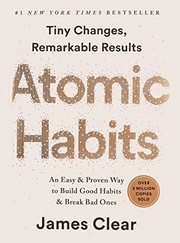
Atomic Habits" by James Clear presents a practical, evidence-based framework for improving every day by making tiny changes that yield remarkable results over time. Clear argues that true change comes not from monumental shifts, but from the aggregation of marginal gains—small, consistent improvements that compound to create significant impact. The book challenges the traditional focus on goals, instead emphasizing the importance of building robust systems that naturally lead to desired outcomes. It introduces the concept of "atomic habits" as small, easy-to-implement routines that are the fundamental units of an overall system.
The core of Clear's methodology is the Four Laws of Behavior Change: Make It Obvious, Make It Attractive, Make It Easy, and Make It Satisfying. These laws provide a comprehensive toolkit for designing environments that foster good habits and dismantle bad ones. Clear explains how understanding the psychology behind habit formation—including identity, environment, and reward—allows individuals to engineer their behavior for sustained personal growth. By shifting focus from what you want to achieve to who you wish to become, the book guides readers in creating an identity that supports their desired habits, making the process of change more intrinsic and less reliant on willpower.
This book matters because it demystifies habit formation, transforming it from an elusive struggle into a manageable, scientific process. It offers actionable strategies applicable to any area of life, from health and productivity to relationships and personal development. Clear's insights empower readers to take control of their daily actions, demonstrating that consistent, small efforts are far more powerful than sporadic, grand gestures in achieving lasting transformation and unlocking one's full potential.
Key takeaways
- Focus on building systems, not just setting goals, as systems are what drive continuous progress and sustained change.
- Your habits are a reflection of your identity; to change your habits, first decide what kind of person you want to become and then prove it to yourself with small wins.
- Make good habits obvious by designing your environment to cue desired behaviors and using habit stacking to link new habits to existing ones.
- Increase the attractiveness of good habits by pairing them with something you enjoy and joining a culture where your desired behavior is the normal behavior.
- Make good habits easy by reducing friction, starting with small steps (the Two-Minute Rule), and automating as much of the process as possible.
- Ensure good habits are satisfying by giving yourself immediate rewards and tracking your progress, as what is immediately rewarded is repeated.
- The greatest threat to long-term success is not failure, but boredom, so find ways to make the process of improvement enjoyable and sustainable.
- Regularly review and reflect on your habits to ensure they are still serving your desired identity and goals, adapting as needed.
Key ideas at a glance
Habit formation
- Make good habits obvious by designing your environment to cue desired behaviors and using habit stacking to link new…
- Increase the attractiveness of good habits by pairing them with something you enjoy and joining a culture where your…
Self-improvement
- The greatest threat to long-term success is not failure, but boredom, so find ways to make the process of improvement…
Behavioral psychology
- Make good habits easy by reducing friction, starting with small steps (the Two-Minute Rule), and automating as much of…
Continuous improvement
- Focus on building systems, not just setting goals, as systems are what drive continuous progress and sustained change.
Identity-based habits
- Your habits are a reflection of your identity; to change your habits, first decide what kind of person you want to…
- Regularly review and reflect on your habits to ensure they are still serving your desired identity and goals, adapting…
Systems thinking
- Ensure good habits are satisfying by giving yourself immediate rewards and tracking your progress, as what is…
Chapter summaries
Introduction: My Story
Clear shares his personal story of a severe baseball accident and his slow, incremental recovery, emphasizing how small, consistent improvements led to significant results over time. He introduces the core concept that tiny changes, or "atomic habits," compound to create remarkable outcomes, shifting focus from goals to systems. He argues that true behavior change comes from building better systems, not just setting ambitious goals, and that habits are the compound interest of self-improvement. This introduction sets the stage for the book's central premise: the power of marginal gains applied to personal habits.
Chapter 1: The Surprising Power of Atomic Habits
This chapter introduces the foundational idea that small changes, often dismissed as insignificant, compound over time to produce massive results. Clear uses examples like the British cycling team's "aggregation of marginal gains" to illustrate how a 1% improvement daily leads to a 37x improvement annually. He explains that habits are a double-edged sword, capable of both positive and negative compounding, and emphasizes focusing on systems rather than goals for long-term success. The chapter highlights that breakthroughs are often the result of many small actions building up, rather than a single monumental effort.
Chapter 2: How Your Habits Shape Your Identity (and Vice Versa)
Clear argues that true behavior change is identity-based, not outcome-based. Instead of focusing on what you want to achieve (e.g., "I want to run a marathon"), focus on who you want to become (e.g., "I am a runner"). He explains that every action is a vote for the type of person you wish to be, and as these votes accumulate, your identity shifts. This chapter highlights the importance of believing in your new identity to make habits stick, emphasizing that the ultimate form of intrinsic motivation is when a habit becomes part of who you are.
Chapter 3: How to Build Better Habits in 4 Simple Steps
This chapter introduces the four-step habit loop: Cue, Craving, Response, and Reward. Clear explains that a cue triggers a craving, which motivates a response, leading to a reward that satisfies the craving and reinforces the loop. He provides a biological explanation for why habits form and how understanding this loop is crucial for designing good habits and breaking bad ones. This framework sets up the four laws of behavior change, each corresponding to one step of the habit loop, providing a practical guide for habit formation.
Chapter 4: The Man Who Didn't Look Right (The 1st Law: Make It Obvious)
Clear begins the first law by emphasizing the power of environment. He recounts the story of a man who didn't look right, illustrating how subtle environmental cues can dictate behavior. He argues that our environment is the "invisible hand" that shapes our habits, often more powerfully than willpower. The chapter introduces strategies like designing your environment to make good habits visible and bad habits invisible, suggesting that awareness of cues is the first step to changing habits. He stresses that habits are often responses to the environment.
Chapter 5: The Best Way to Start a New Habit (Habit Stacking)
This chapter introduces "Habit Stacking" as a practical application of making habits obvious. Instead of trying to remember a new habit, you link it to an existing habit using the formula: "After [CURRENT HABIT], I will [NEW HABIT]." Clear provides examples like "After I pour my morning coffee, I will meditate for one minute," demonstrating how to leverage existing routines to seamlessly integrate new behaviors. This method reduces the need for motivation by attaching new behaviors to established cues, making them easier to initiate and sustain.
Chapter 6: Motivation Is Overrated; Environment Often Matters More
Clear reinforces the idea that self-control is not about having more willpower but about designing your environment to avoid temptations. He discusses how "choice architecture" influences our decisions and how we can proactively structure our surroundings to make good habits easier and bad habits harder. He suggests strategies like making cues for good habits prominent and cues for bad habits invisible, or even removing them entirely. This chapter emphasizes that a disciplined environment is more effective than a disciplined person in the long run.
Chapter 7: The Secret to Self-Control (The 2nd Law: Make It Attractive)
This chapter introduces the second law: Make It Attractive. Clear explains that habits are a dopamine-driven feedback loop, and by making habits more appealing, we increase the likelihood of performing them. He delves into the neuroscience of desire, explaining how the anticipation of a reward, rather than the reward itself, drives us to act. He suggests that by associating good habits with positive feelings and making them desirable, we can harness the brain's reward system to our advantage, making them easier to stick to.
Chapter 8: How to Make a Habit Irresistible (Temptation Bundling)
Clear introduces "Temptation Bundling," a strategy to make habits more attractive by pairing an action you want to do with an action you need to do. For example, only allowing yourself to watch your favorite show while exercising. He also discusses how joining a culture where your desired behavior is the normal behavior can make habits more appealing due to social influence. By making the process of habit formation enjoyable, we increase the likelihood of consistency and long-term adherence.
Chapter 9: The Role of Family and Friends in Shaping Your Habits
This chapter explores the powerful influence of social environment on our habits. Clear explains that we tend to imitate the habits of three groups: the close, the many, and the powerful. He advises joining a culture where your desired behavior is the normal behavior and where you already have something in common with the group, making good habits more attractive and easier to maintain. He emphasizes that our desire to fit in and belong is a strong motivator for adopting the habits of our social circles.
Chapter 10: How to Find and Fix the Causes of Your Bad Habits
Clear delves into how to reframe our cravings to make bad habits less attractive. He suggests that instead of viewing a habit as a burden, we should reframe it to highlight its benefits. For example, instead of "I have to go to work," think "I get to earn money and provide for my family." He also discusses how to make the act of not doing a bad habit more attractive by highlighting the benefits of avoidance. This chapter focuses on changing the narrative around our habits to shift our emotional response.
Chapter 11: Walk Slowly, But Never Backward (The 3rd Law: Make It Easy)
This chapter introduces the third law: Make It Easy. Clear emphasizes that the most effective form of learning is doing, not planning. He introduces the "Law of Least Effort," stating that humans naturally gravitate towards the path of least resistance. The goal is to reduce the friction associated with good habits and increase the friction for bad habits. He argues that the less energy a habit requires, the more likely it is to be performed consistently, making ease a critical factor in habit formation.
Chapter 12: The Law of Least Effort
Clear elaborates on reducing friction. He suggests strategies like "priming the environment" (e.g., laying out workout clothes the night before) to make the next action easier. He also discusses how to automate habits and use technology to simplify the process, making it almost effortless to perform desired behaviors. By minimizing the steps and effort required, good habits become the default choice, overcoming the natural human tendency towards inertia. He provides practical examples for making good habits frictionless.
Chapter 13: How to Stop Procrastinating by Using the Two-Minute Rule
This chapter introduces the "Two-Minute Rule," which states that when you start a new habit, it should take less than two minutes to do. The goal is to make the starting of the habit so easy that you can't say no. For example, "read before bed" becomes "read one page." This rule helps overcome procrastination and build momentum, ensuring you show up consistently. It's about mastering the art of showing up, even if it's just for a tiny fraction of the desired behavior, to build the habit of starting.
Chapter 14: How to Make Good Habits Inevitable and Bad Habits Impossible
Clear discusses commitment devices, which are choices you make in the present to control your actions in the future. Examples include pre-paying for a gym membership or removing tempting foods from your home. He also talks about automating habits through technology or design, making it nearly impossible to deviate from the desired behavior. By creating a "point of no return" or designing systems that force compliance, individuals can remove the need for willpower and ensure consistency in their habits.
Chapter 15: The Cardinal Rule of Behavior Change (The 4th Law: Make It Satisfying)
This chapter introduces the fourth law: Make It Satisfying. Clear states "What is immediately rewarded is repeated. What is immediately punished is avoided." He explains that while the long-term rewards of good habits are often delayed, our brains are wired for immediate gratification. The key is to find ways to make good habits immediately satisfying, even if the ultimate benefit is far off. This immediate gratification acts as a powerful reinforcer, closing the habit loop effectively.
Chapter 16: How to Stick with Good Habits Every Day (Habit Tracking)
Clear advocates for habit tracking as a powerful tool to make habits satisfying. He explains that tracking provides immediate visual proof of progress, which is inherently motivating. He also introduces the "never miss twice" rule, emphasizing that one slip-up is acceptable, but two in a row can derail progress, encouraging quick recovery. Habit tracking creates a visual cue, makes the habit attractive by showing progress, and provides an immediate, satisfying reward of completion.
Chapter 17: An Accountability Partner Can Change Everything
This chapter focuses on the power of external accountability to make bad habits unsatisfying. Clear suggests that having an an accountability partner or creating a "habit contract" can introduce immediate social or financial costs for failing to perform a desired action, making it less likely to be skipped. This leverages our desire to avoid pain and maintain our reputation. By making the consequences of inaction immediate and public, it adds a layer of external pressure that reinforces good habits and deters bad ones.
Chapter 18: The Truth About Talent (When Genes Matter and When They Don't)
Clear discusses the role of genetics and talent in habit formation and success. He argues that while genes provide certain predispositions, they don't determine destiny. The key is to "choose the right field of play" – to find habits and areas where your natural strengths give you an advantage, rather than fighting against your nature. He emphasizes finding a game you can win, where your unique talents align with the demands of the task, making it easier to excel and maintain motivation.
Conclusion: The Downside of Creating Good Habits, and the Secret to Great Results
Clear concludes by discussing the potential downsides of rigid habits, such as becoming complacent or losing self-awareness. He emphasizes the importance of continuous reflection and review to prevent stagnation. He introduces the concept of "mastery," which is the process of narrowing your focus to a tiny element of success and repeating it. The ultimate secret is to never stop improving and evolving your systems, always seeking to refine and adapt your habits rather than becoming stuck in a routine that no longer serves you.
Full summary
Book Overview
"Atomic Habits: An Easy & Proven Way to Build Good Habits & Break Bad Ones" by James Clear is a self-help book focused on the science of habit formation and the power of small changes. First published in 2018, the book provides practical strategies for developing effective habits and eliminating detrimental ones. Clear emphasizes that significant personal and professional growth can stem from minor, incremental changes, which he refers to as "atomic habits."
Main Content/Plot
The book is divided into four main parts, each detailing a specific aspect of habit formation:
1. The Fundamentals: Clear introduces the concept of atomic habits, emphasizing that small improvements compound over time. He explains the importance of understanding how habits work, outlining the cue, craving, response, and reward cycle.
2. The Four Laws of Behavior Change: This section presents a framework for creating good habits and breaking bad ones. The four laws are:
- Make It Obvious: Identify cues that trigger habits and design your environment to promote positive behaviors.
- Make It Attractive: Associate new habits with positive experiences to increase motivation.
- Make It Easy: Reduce friction for good habits and increase friction for bad ones.
- Make It Satisfying: Reinforce good habits with immediate rewards to encourage repetition.
3. Advanced Tactics: Clear discusses the importance of identity in habit formation. He argues that focusing on becoming the type of person you want to be is more effective than merely setting goals. This section also explores the concept of habit stacking and the two-minute rule, which suggests starting new habits with a manageable two-minute version.
4. The Role of Environment and Community: Clear emphasizes the significance of social environment and community support in sustaining habits. He discusses how surrounding oneself with positive influences can facilitate habit change.
Key Themes
1. Incremental Change: The core message is that small, consistent changes can lead to significant results over time.
2. Identity-Based Habits: The shift from outcome-based to identity-based habits highlights how changing one's self-image can be the key to lasting change.
3. The Power of Environment: The environment plays a crucial role in habit formation, as it can either facilitate or hinder behaviors.
4. Systems Over Goals: Clear advocates for focusing on systems and processes rather than solely on end goals, suggesting that the journey and the methods used are
Memorable quotes
“You do not rise to the level of your goals. You fall to the level of your systems.”
“Every action you take is a vote for the type of person you wish to become.”
“Goals are good for setting a direction, but systems are best for making progress.”
“The greatest threat to success is not failure, but boredom.”
“A habit is a behavior that has been repeated enough times to become automatic.”
“The purpose of setting goals is to win the game. The purpose of building systems is to continue playing the game.”
Themes
- Habit formation
- Self-improvement
- Behavioral psychology
- Continuous improvement
- Identity-based habits
- Systems thinking
About James Clear
James Clear is an author, speaker, and entrepreneur focused on habits, decision-making, and continuous improvement. He is known for his popular website, jamesclear.com, where he writes about these topics. "Atomic Habits" is his first book, which grew out of his extensive research and personal experience with the power of small habits, including overcoming a severe injury. His work aims to provide actionable strategies for building better habits and achieving remarkable results.
FAQ
What is Atomic Habits about?
"Atomic Habits" by James Clear is about a practical framework for improving every day through tiny, incremental changes. It explains how small habits, when consistently applied, compound over time to produce significant results. The book outlines four laws of behavior change—Make It Obvious, Attractive, Easy, and Satisfying—to help readers build good habits and break bad ones by focusing on systems rather than goals.
Is Atomic Habits worth reading?
Yes, "Atomic Habits" is widely considered worth reading for anyone looking to understand and improve their habits. It offers clear, actionable strategies backed by scientific research, making complex behavioral psychology accessible. Readers often find its practical advice transformative for personal growth, productivity, and achieving long-term goals.
Who should read Atomic Habits?
"Atomic Habits" is ideal for anyone struggling to build good habits, break bad ones, or achieve consistent progress in any area of life. It's particularly beneficial for individuals interested in self-improvement, productivity, personal development, or understanding the psychology behind human behavior and decision-making.
How long does it take to read Atomic Habits?
On average, it takes about 4 to 5 hours to read "Atomic Habits." This estimate assumes a reading speed of approximately 250 words per minute, and the book typically contains between 60,000 to 70,000 words. Actual reading time may vary based on individual reading speed and engagement with the material.