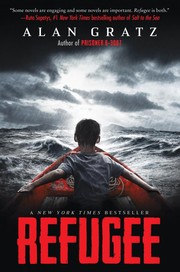
REFUGEE
In 60 seconds
In 1939, Jewish boy Josef sails on the MS St. Louis, hoping Cuba will take his family after his father's release from Dachau. In 1994, Cuban girl Isabel trades her trumpet for gasoline and races a storm to Miami. In 2015, Syrian boy Mahmoud's apartment is bombed, and his family walks across Europe toward Germany. Each child pays a terrible price to keep their family alive. Decades apart, their stories collide in one final, devastating connection.
Before you start
Why it matters
Gratz braids three real refugee crises into one novel, so history stops feeling like homework and starts feeling like family. Kids who think the 1930s have nothing to do with 2015 will see the pattern in a single sitting. It's ideal for middle-grade readers, classrooms, and any adult who wants to explain displacement without a lecture. Short chapters and cliffhangers make it nearly impossible to put down.
Spoilers ahead
The story
- 1
Act 1
Berlin, 1938: The Night They Came for Josef
Twelve-year-old Josef Landau is grabbed by Hitler Youth in his bedroom and dragged into the street while his little sister Ruthie screams. The boys cut off chunks of his hair and chant, 'Wake up, Jew! Wake up!' before a neighbor shouts at them to stop. The message lands: Josef is no longer safe in his own bedroom. Josef's father Aaron is released from Dachau concentration camp after six months, but he is skeletal, silent, and mentally shattered. He has been permanently changed by the torture and now hallucinates and trembles uncontrollably. The family's one hope is a ship: the MS St. Louis, bound for Cuba with Josef, Aaron, Rachel, and little Ruthie aboard. Josef celebrates his bar mitzvah on the ship. With his father hospitalized in Havana and his mother distraught, Josef reads from the Torah alone, marking his transition to manhood without his family whole. When the medical inspection for entry into Cuba arrives, Aaron crumbles, and Josef slaps his father across the face, threatening him to stay silent and act sane. Aaron complies, and Josef understands the roles have reversed: "You have to be a man now. You have to for Ruthie. You have to for all of us." Mariano Padron, a Cuban police officer, boards the ship and tells Josef's family they cannot enter Cuba. He says, 'I am sorry. Truly, I am,' but explains his government has ordered him to turn the Jewish refugees away.
- 2
Act 2
Havana, 1994: The Trumpet for Gasoline
Eleven-year-old Isabel Fernandez plays her trumpet on the streets of Havana while her father Geraldo worries about police retaliation after a riot over food shortages. Isabel's grandmother Lita drowned two years earlier during a cyclone in Havana. Isabel still carries the trauma of watching her grandmother swept away by floodwaters and being unable to save her. And she carries a quieter wound: she cannot count clave, the fundamental Cuban rhythm that is supposed to come naturally, and it makes her feel cut off from her own heritage. Isabel's father Geraldo fears arrest for protesting the government; Isabel rallies her family and the Castillo family to escape Cuba by boat to Miami. She trades her beloved trumpet to a fisherman for a full tank of gasoline so her family's makeshift boat can run. She hands it over without hesitation, knowing the escape is more important than the instrument. Aboard are her pregnant mother Teresa, her grandfather Lito, her father, and the Castillos, including her best friend Iván. The Straits of Florida show no mercy. Isabel's best friend Iván Castillo is thrown from the boat during a storm and eaten by sharks in the water. Isabel watches helplessly as the sharks tear him apart, and his blood spreads across the sea. Then Isabel's mother Teresa goes into labor on the boat in the middle of the ocean. Isabel helps deliver her baby brother, who is born alive and named Mariano, after her grandfather Lito.
- 3
Act 3
Aleppo to Berlin, 2015: Learning to Be Invisible
Twelve-year-old Mahmoud Bishara has learned to be invisible to survive the Syrian civil war. He keeps his head down, avoids eye contact, and stays quiet so no one notices him, a strategy he teaches his younger brother Waleed. A missile destroys the Bishara family's apartment building while they are inside. They survive by sheltering in an interior hallway, but their home is reduced to rubble, forcing them to flee Syria immediately. Mahmoud's family walks for days through rain and mud to reach the Greek border. They sleep in a field with hundreds of other refugees, and Mahmoud sees a dead man lying in a ditch, ignored by everyone passing by. The Bishara family's inflatable dinghy capsizes in the Mediterranean. Mahmoud is separated from his family in the water and nearly drowns before being pulled onto a passing rubber raft by strangers. Mahmoud hands his baby sister Hana to a passing boat that has no room for the rest of his family. He begs the strangers to take her, saying, 'Please, take my sister. Please save her.' Hana's fate remains unknown. Mahmoud and his family are held at gunpoint by Hungarian soldiers at a border crossing. The soldiers steal all their money and belongings, then force them to march for miles in the cold before releasing them. Mahmoud decides to stop being invisible. When his family is threatened by a guard, he leads a group of refugees in a protest, shouting and refusing to be ignored, which draws media attention and helps them cross the border.
- 4
Act 4
The Convergence: What Was Given Back
After Cuba, the United States, and Canada all refuse the refugees, Josef joins a group of passengers who attempt a mutiny to take control of the ship. They fail, but Captain Schröder refuses to return them to Germany and instead negotiates with European nations, arranging for the refugees to be divided among England, France, Belgium, and the Netherlands. Josef's family lands in France, where Rachel, grief-stricken since the separation, can barely care for Ruthie, so Josef does it for her. Nazis invade France and give Josef's mother Rachel an impossible choice: set only one of her children free. Josef volunteers himself, telling his mother, 'Take Ruthie. Take my sister.' He is taken to a concentration camp where he later dies. Josef and his mother Rachel later die in concentration camps. It is revealed that Josef's father survived in Cuba but died before Ruthie could reach him; Ruthie survives the Holocaust. Meanwhile, Isabel's grandfather Lito reveals he is Mariano Padron, the Cuban officer who turned away the MS St. Louis decades earlier. He says, 'I was the one who said no. I was the one who sent them back.' He jumps into the water to distract the U.S. Coast Guard so the boat can reach Miami. Isabel and her family wade ashore in Miami and are taken in by her great-uncle Guillermo. He gives her a new trumpet, and for the first time, Isabel can count clave, finally feeling connected to her Cuban identity. The Bishara family is taken in by an elderly Jewish couple in Berlin. The woman is Ruthie Landau, Josef's little sister, now an old woman who survived the Holocaust. She tells Mahmoud, 'I had a brother once. His name was Josef.'
Who's who
Characters
- Josef LandauA twelve-year-old German Jew forced to become the man of his family the night Hitler Youth come for him. He sacrifices himself in France so his sister Ruthie can live.
- Isabel FernandezAn eleven-year-old Havana trumpet player who cannot count clave and feels estranged from her own culture. She steers her family to Miami through storm, sharks, and a birth at sea.
- Mahmoud BisharaA twelve-year-old Syrian who survives by being invisible, until a missile takes his home and he must choose visibility. He gives up his baby sister Hana to strangers to save her life.
- Aaron LandauJosef's father, released from Dachau after six months skeletal and shattered. His breakdown forces Josef to slap him sane, and his survival in Cuba comes too late for his daughter.
- Lito / Mariano PadronIsabel's grandfather, revealed as the Cuban officer who turned away the St. Louis decades earlier. He jumps into the Straits of Florida to buy his family's landing.
- Ruthie LandauJosef's little sister, spared by his sacrifice. She survives the Holocaust and, as an old woman in Berlin, shelters Mahmoud's family.
- Captain Gustav SchröderThe St. Louis's captain, who refuses to sail his Jewish passengers back to Germany and bargains with European nations for their lives.
What it's really about
Themes
The cost of saying no
Mariano Padron turns away the St. Louis because his government orders it, telling Josef's family, "I am sorry. Truly, I am." Decades later he confesses to Isabel: "I was just a man following orders. A man who wanted to keep his job, and his family safe." His guilt outlives the paperwork, and his final act, jumping into the sea to distract the Coast Guard, is an attempt to pay a debt he can never fully settle. Gratz shows that obedience has a long memory, and that one refusal ripples across generations, landing on the granddaughter of the man who said it.
Invisibility as survival, visibility as salvation
Mahmoud lives by a rule: "If you were invisible, the bad people couldn't hurt you. That was why he was invisible." It works in Aleppo, where a lowered head keeps Waleed safe. But in Europe it fails him: refugees sleeping in fields, a dead man in a ditch everyone walks past, families ignored at borders. When a guard threatens his family in Austria, Mahmoud chooses to shout, to lead a protest, to be seen, and the cameras get his family across. The book argues that survival sometimes demands silence, but rescue demands that the world look at you.
Children forced into adulthood
Josef slaps his own father to get him through a medical inspection and tells him, "You have to be a man now. You have to for Ruthie. You have to for all of us." Isabel delivers her baby brother in the middle of the ocean and bails water for hours while grieving her best friend. Mahmoud decides which family member lives. None of these children get a childhood that ends on its own; war and persecution end it for them. The book's point is that refugee children do not grow up early by choice, they grow up early because the adults around them have been broken.
History repeating
The St. Louis is a real ship turned away by Cuba, the United States, and Canada in 1939; the 1994 balsero crisis and the 2015 Syrian refugee crisis are real too. Gratz sets the three stories side by side so the pattern becomes impossible to miss: families flee, borders close, children pay. When Ruthie Landau, the last of Josef's family, opens her Berlin door to a Syrian family in 2015, the novel closes its own loop. The message is not that history repeats exactly, but that the world keeps producing refugees and keeps being asked the same question: will you let them in?
Look closer
Symbols
- Isabel's trumpet
- The trumpet is Isabel's tie to Cuban music and identity, the thing she loves most. Trading it for gasoline is the price of her family's future, and receiving a new trumpet from her great-uncle Guillermo in Miami marks the moment she can finally count clave, whole again in a new place.
- Clave
- The rhythm Isabel cannot count stands for belonging itself. Her inability to feel it mirrors her disconnection from home and heritage; the moment she finally counts it in Miami, she has carried her culture across the water instead of losing it.
- The MS St. Louis
- A real ship carrying real refugees, the St. Louis embodies the world's refusal. Turned away from Cuba, the US, and Canada, it becomes the standard against which every later border in the book is measured, and the debt Lito spends his life trying to repay.
- Water
- Water is both escape and death: Lita drowns in a Havana cyclone, Iván is killed by sharks in the Straits, Mahmoud nearly drowns in the Mediterranean, and Lito leaps into the sea to save his family. Every crossing demands someone be given to the water.
Spoilers
Ending explained
The ending works as a single held breath released across eighty years. Josef's sacrifice, "Take Ruthie. Take my sister," looks like pure loss until Berlin, 2015, when an old woman tells Mahmoud, "I had a brother once. His name was Josef." Ruthie's survival reframes everything: Josef's death was not wasted, it purchased a life that then shelters a new generation of refugees. Some readers will see the connection as too neat, a coincidence engineered for catharsis. Others will read it as the book's actual argument, that kindness compounds across generations, that the family you shelter may one day shelter someone else. Lito's confession and leap complicate the same idea from the other direction: a man who once said no spends his last chance on the water saying yes. And Hana's unknown fate refuses easy comfort, keeping the ending honest. The book lands because it does not promise rescue; it promises that what you give away can outlive you.
For class or book club
Discussion questions
- 1.Is Josef's sacrifice heroic or a symptom of a world that forces children to make adult choices? Use the medical inspection slap and the French ultimatum as evidence.
- 2.Lito says he was "just a man following orders." Does the novel forgive him, judge him, or both? Compare his confession with his final act in the water.
- 3.Mahmoud's invisibility keeps him alive in Aleppo but nearly dooms him in Europe. When does staying silent stop being survival and start being surrender?
Worth remembering
Best lines
“Wake up, Jew! Wake up!”
“You have to be a man now. You have to for Ruthie. You have to for all of us.”
“I was the one who said no. I was the one who sent them back.”
“I had a brother once. His name was Josef.”
A fair critique
Where it falls short
The braided structure demands constant gear-switching, and some readers find the cliffhanger rhythm mechanical, three stories always pausing at the same dramatic beat. The final convergence, Ruthie appearing in Berlin to shelter Mahmoud's family, leans on coincidence in a way that can feel engineered rather than earned. Isabel's storyline resolves more warmly than Josef's, which can make the tonal balance feel uneven. And because the novel spans three crises in under a page count per crisis, historical context sometimes arrives in summary rather than depth, leaving adult readers wanting more than a middle-grade frame can hold.
In one sentence
Three children fleeing three wars, decades apart, discover that the family you save today may be the family that saves someone else tomorrow.
Is it for you?
Who should read it
Middle-grade readers and classrooms studying immigration, the Holocaust, or current events, plus any adult who wants a fast, emotionally direct entry into three refugee crises. Families reading together will find the short chapters built for discussion.
4 questions
Quick quiz: how well do you know REFUGEE?
0 of 4 answered
FAQ
Who wrote REFUGEE?
REFUGEE was written by Alan gratz and first published in 2017.
What genre is REFUGEE?
REFUGEE is listed under Children & Young Adult.
More Children & Young Adult summariesWhere is REFUGEE set?
REFUGEE is set in Cuba, Syria and Berlin.
How many pages is REFUGEE?
REFUGEE is about 352 pages long (the median page count across its editions, per Open Library).