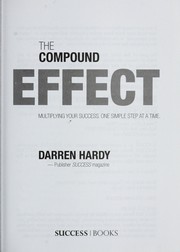
Compound effect
In 60 seconds
Darren Hardy says success isn't a giant leap—it's the sum of small, smart choices repeated long enough to compound like interest. Three friends start in the same place; tiny daily differences turn one into a promotion and a thriving marriage, another into an overweight, struggling mess. Your job is to choose deliberately, track everything, kill bad habits by starving their triggers, and build momentum. Then guard your inputs, your people, and your environment—and when you've done the boring work, do a little extra when everyone else quits.
Before you start
Why it matters
Most success books sell you a breakthrough. This one sells you arithmetic: what happens if you add 1% of effort, every day, for years. It's for anyone who feels stuck despite knowing what to do—the person who starts strong every January and fades by February. Hardy gives you tracking tools, habit triggers, and momentum mechanics you can apply tonight, not someday.
13 ideas, in the book's order
The big ideas
- 1Chapter 1: The Compound Effect in Action
The Penny That Beats $3 Million
Hardy presents a choice: $3 million in cash today or a single penny that doubles in value every day for 31 days. Most people take the $3 million because they underestimate the compound effect. But run the math: the penny's value grows slowly at first, then explodes near the end. By day 31, it's worth $10,737,418.24—more than three times the cash. Most people take the $3 million because they underestimate the compound effect, illustrating how compounding starts slow then explodes.
The idea
The compound effect is the principle of reaping huge rewards from a series of small, smart choices—success as accumulation, not a giant leap. What surprises people is the curve: nothing seems to happen for a long time, which is exactly why most quit right before the payoff. The same math works against you, too, when the small choices are careless ones. The delay isn't a flaw in the system; it's the price of admission.
Try this: Pick one small action—a page read, ten dollars saved—and do it every single day for 31 days before judging the results.
- 2Chapter 1: The Compound Effect in Action
Three Friends, 31 Months, Three Different Lives
Three friends, same age, same neighborhood, same income. Larry keeps living exactly as he always has. Scott starts making tiny positive adjustments—reading a bit, cutting a few calories, showing up a little better at work. Brad drifts the other way: one extra cheeseburger here, a skipped workout there, a little less effort on the job. Nothing dramatic happens to any of them for months. But after 31 months, Scott gets promoted and his marriage is thriving, Brad is overweight and struggling at work, and Larry is standing exactly where he started.
The idea
Hardy describes the 'elephant doesn't bite' principle: small, seemingly harmless choices—a cheeseburger, a skipped workout—never hurt you in the moment, so your brain files them as free. The damage only shows up as an accumulation. That's why nobody connects the outcome to the cause; the cause happened 30 months ago, one unremarkable day at a time. You're always compounding something. The only question is whether you chose what.
Try this: Write down one 'harmless' habit that's quietly working against you, and name the exact moment today it usually happens.
- 3Chapter 2: Choices
You Make Your Choices—Then They Make You
The author tracked every action for three weeks, including his spending. He expects to find nothing. Instead, the log catches a leak he never suspected: $250 to $300 a month going to coffee and snacks. Not one big splurge. A stream of small, forgettable swipes and grabs, each one feeling like nothing at the moment.
The idea
'You make your choices, and then your choices make you.' Every decision, however small, is quietly shaping your destiny—which means unconscious choices are still choices, just ones you've outsourced to habit and convenience. Tracking works because it drags those decisions back into the light. You can't fix what you can't see, and most of us have never actually looked.
Try this: Track every dollar you spend for the next seven days—no judgment, just the number at the end.
- 4Chapter 2: Choices
Write It Down or Watch It Fade
A study found that participants who wrote down their goals were 39% more likely to achieve them. The gap isn't talent or luck—it's the act of putting a plan on paper and tracking progress against it. To make that tracking stick, hang a calendar and put a red X on every day you complete the habit you're building. The instruction is simple—never break the chain. After a week of X's, you're not just doing a habit anymore; you're protecting a streak.
The idea
A written goal turns a wish into a measurable promise, and the 39% figure suggests your brain treats it differently the moment it exists outside your head. The calendar works for a sneakier reason: it makes skipping visible. Missing a day stops being a private shrug and becomes a glaring gap in a row of red marks. Visibility is the whole trick—what gets watched gets managed.
Try this: Hang a calendar tonight and mark a red X for every day this week you do your one keystone habit.
- 5Chapter 2: Choices
Big Mo: The Merry-Go-Round You Can't Stop
Picture a playground merry-go-round. The first shove barely moves it. You push again and again, and for a while it feels like nothing is happening—your arms ache, the thing creeps. Then it starts to turn on its own, faster and faster, until one light push keeps it spinning and it takes real effort to slow it down. Hardy calls this 'The Big Mo': momentum. Once positive choices become consistent, momentum builds and makes continuing easier than quitting.
The idea
Momentum flips the economics of effort. Early on, every repetition costs full price and pays nothing back; later, the same behavior nearly runs itself. That's why the first weeks of any change feel brutal and the third month feels strange to skip. The practical move is to protect your streak at all costs in the expensive early phase, because the cheap phase only arrives for people who survive the expensive one.
Try this: Choose the smallest version of your new habit—the version you can't talk yourself out of—and do it daily for two weeks to get the wheel turning.
- 6Chapter 3: Habits
Motivation Starts, Habit Finishes
Hardy credits Jim Rohn with the insight: 'Motivation is what gets you started. Habit is what keeps you going.' Hardy describes the 'Addiction to Easy': modern society conditions us to seek instant gratification. We want the result tonight, so we chase the motivational spike, feel great for three days, and collapse when the feeling fades. The compound effect runs on the opposite fuel: delayed gratification and consistent effort, repeated whether or not you feel like it.
The idea
Waiting to feel motivated is a trap, because motivation is weather—unreliable by design. Habits are infrastructure: they keep working when your enthusiasm is at zero. The surprise is that this is almost a relief; you don't need to be inspired every morning, you just need to not break the chain. The Addiction to Easy is the real enemy, and recognizing it in your own impulses is half the battle.
Try this: Decide tonight what you'll do tomorrow regardless of mood, and write it as a scheduled appointment with a time attached.
- 7Chapter 3: Habits
Starve the Cookie Jar
A man wanted to stop eating cookies at night. He identified the trigger: seeing the cookie jar on the counter. He removed the trigger by putting the cookies in a high cabinet and replaced the habit with a glass of water. The craving loses its cue, the routine loses its power, and he loses 8 pounds in a month. No diet, no gym, just a jar on a different shelf.
The idea
Hardy uses the 'Thanksgiving Dinner' metaphor: your bad habits are like the annoying relative at Thanksgiving dinner—if you stop inviting them, they eventually stop showing up. You don't defeat a bad habit in a head-on fight—you starve it by removing whatever triggers it. Willpower is a terrible long-term strategy because it's spent every single time you're tempted. Changing the environment spends that willpower once, at setup, and then works while you sleep.
Try this: Find your version of the cookie jar—one physical trigger for your worst habit—and remove it from sight today.
- 8Chapter 3: Habits
The Thank-You Walk
Hardy describes the 'Thank-You Walk'—a 30-minute walk three times a week where you focus only on what you're grateful for. It combines exercise, gratitude, and mental clarity. It's the compound effect in miniature—three small disciplines bundled into one repeatable routine.
The idea
The genius is the bundling. A single habit that pays out in three currencies is far easier to keep than three separate habits, because the cost stays low while the return stacks. Gratitude also changes what you notice for the rest of the day, which changes the choices you make next. Small, positive, repeatable—that's the whole formula wearing sneakers.
Try this: Schedule three 30-minute gratitude walks this week—phone in pocket, one topic only: what you're thankful for.
- 9Chapter 4: Momentum
80% of the Fuel Burns Before Liftoff
Momentum is described as 'Big Mo.' Getting started is the hardest part, like a rocket using 80% of its fuel just to escape Earth's gravity. Once it reaches orbit, staying in motion takes almost nothing. Momentum is described as 'Big Mo.' Consistent daily disciplines create a rhythm that carries you through tough times.
The idea
If 80% of the cost is in the launch, then quitting in the first weeks isn't a sign the plan failed—it's a sign you quit during the most expensive phase, right before the cheap part starts. The daily rhythm is what gets you through, because rhythm doesn't ask how you feel. When motivation dies, the routine is still there, and orbit is closer than it looks.
Try this: Identify the phase where you usually quit—week one, week three—and pre-commit to a smaller version of the habit for exactly that stretch.
- 10Chapter 4: Momentum
Win the Morning Before the World Wakes Up
The author's morning routine: wake at 5 a.m., exercise, read for 30 minutes, and plan his day. All of it happens before the world's distractions begin—before the emails, the noise, the demands that will happily eat the entire day if allowed. By the time most people are hitting snooze, his momentum for the day is already built. He credits the routine itself, not superhuman discipline, for the compounding advantage it creates.
The idea
The morning routine isn't about the specific hour—it's about sequencing. Whatever you do first sets the trajectory, and doing it before distractions arrive means the day starts on your terms instead of reacting to everyone else's. One early win creates a second, and the day compounds in your favor from the first hour. Lose the first hour, and you spend the rest of the day playing catch-up.
Try this: Tomorrow, do one deliberate thing—move, read, or plan—before you touch your phone or email.
- 11Chapter 5: Influences
You're the Average of Your Five
Hardy attributes to Jim Rohn: 'You are the average of the five people you spend the most time with.' Look at your five closest people—their income, health, attitude, ambitions—and you're looking at a mirror of where you're headed. Nobody plans to drift toward the average of their circle; it just happens, conversation by conversation, standard by standard. The people around you set the ceiling you don't even see.
The idea
This is uncomfortable because it makes your environment a choice, not an accident. If your five are complacent, your ambitions will quietly shrink to match; if they're hungry, you'll feel lazy standing still. You don't have to cut people off dramatically—you just have to notice who's on the list and who you're letting shape your defaults. Averages are patient. They always win eventually.
Try this: Write down the five people you spend the most time with, then honestly note what each one is average-ing you toward.
- 12Chapter 5: Influences
Inputs, Associations, Environment
Hardy sorts every influence in your life into three types: input—what you feed your mind; associations—the people you spend time with; and environment—your physical surroundings. All three are constantly programming you, and all three must be managed for the compound effect to work. The author stopped watching TV news and replaced it with educational and inspirational content. He says this single change dramatically improved his outlook and productivity.
The idea
The three-part framework matters because it catches what willpower can't. You can resist a negative thought, but it's easier to never consume it; you can fight a cluttered, draining space, or you can fix the space. Most people try to change their behavior while leaving every influence untouched, which is like dieting in a bakery. Change the inputs and the behavior follows.
Try this: Cut news and doom-scrolling for 30 days and replace that time with one book or podcast that feeds your goals.
- 13Chapter 6: Acceleration
Do More Than You're Paid For—Then Multiply It
Acceleration means doing more than you're paid for, more than the moment requires, more than the people around you are willing to do.
The idea
Acceleration works because the extra effort sits on top of a base most people never build. Once your habits and momentum are running, an extra push costs less and pays more than it would for someone starting from zero. And since nearly everyone quits at 'enough,' going a little beyond it puts you in almost no competition. The gap between good and exceptional is usually just a bit more, for a bit longer.
Try this: This week, pick one task and deliver 20% more than asked—then notice who notices.
Worth remembering
Best lines
“You make your choices, and then your choices make you.”
“Motivation is what gets you started. Habit is what keeps you going.”
“You are the average of the five people you spend the most time with.”
A fair critique
Where it falls short
The book leans on memorable anecdotes and simple arithmetic rather than deep research, so readers wanting rigorous evidence will find the support thin. Its examples—coffee spending, cookie jars, morning routines—skew toward personal productivity and finances, and translate less directly to complex careers or systemic obstacles. The tone can feel repetitive: the same small-choices principle restated across chapters with new packaging. And the promise of inevitable compounding understates luck, timing, and circumstances that effort alone doesn't control. It's a motivational manual, not a scientific one.
In one sentence
Small, smart choices + consistency + time = the life you can't even imagine yet—so guard every tiny decision like it's compound interest, because it is.
Is it for you?
Who should read it
Anyone who keeps starting big and quitting by week three—dieters, savers, side-hustlers, gym-joiners. It's also for the person who's doing fine but suspects a handful of small, invisible choices are quietly deciding their future.
4 questions
Quick quiz: how well do you know Compound effect?
0 of 4 answered
FAQ
What is Compound effect about?
The Compound Effect is about how small, consistent choices, whether positive or negative, accumulate over time to create significant results. It teaches readers to harness this principle to achieve success in all areas of life through deliberate habits and personal responsibility.
Is Compound effect worth reading?
Yes, The Compound Effect is highly regarded for its clear, actionable advice on personal development. It offers a practical, no-nonsense approach to building good habits and achieving long-term goals, making it a valuable read for anyone seeking self-improvement.
Who should read Compound effect?
This book is ideal for anyone looking to improve their life, whether in finances, relationships, health, or career. It's particularly beneficial for those who feel overwhelmed by big goals and need a clear, step-by-step guide to making consistent progress.
How long does it take to read Compound effect?
On average, it takes about 3 to 4 hours to read The Compound Effect. It's a relatively concise book, designed to be easily digestible and actionable, allowing readers to quickly grasp its core principles.
Who wrote Compound effect?
Compound effect was written by Darren Hardy and first published in 2010.
What genre is Compound effect?
Compound effect is listed under Self-Help.
More Self-Help summariesHow many pages is Compound effect?
Compound effect is about 172 pages long (the median page count across its editions, per Open Library).