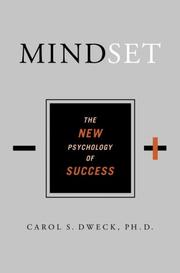
Mindset
In 60 seconds
Carol Dweck argues that people hold one of two beliefs about ability: a fixed mindset that treats talent as carved in stone, or a growth mindset that treats it as something you build through effort. The fixed mindset makes you prove yourself; the growth mindset makes you improve yourself. Through studies on praise, brain waves, and classrooms, Dweck shows how these beliefs shape grades, sports, business, and love. The good news: mindsets can change, and she shows how.
Before you start
Why it matters
This book explains why some people collapse after failure while others double down and learn. If you praise kids, manage employees, coach athletes, or simply want to stop avoiding challenges, Dweck's research gives you a concrete lever: change what you believe about ability, and effort, resilience, and achievement follow. It's essential for parents, teachers, and anyone stuck proving themselves instead of growing.
14 ideas, in the book's order
The big ideas
- 1Chapter 1: The Mindsets
Two beliefs about ability, two different lives
One believes your qualities are carved in stone. The other believes your basic qualities can be developed and cultivated through effort and learning. Dweck spells out the fixed mindset's rule: if you have only a certain amount of intelligence, a certain personality, and a certain moral character, you'd better prove you have a healthy dose of them—it simply wouldn't do to look or feel deficient in these most basic characteristics. Every task becomes a test of your worth. The growth-minded person faces the same situation with a different question: what can I learn from this?
The idea
The mindsets aren't about optimism or confidence—they're about what you believe ability is. If you think talent is fixed, every challenge threatens to expose you, so you avoid risk and stick to what you already do well. If you think ability grows, the same challenge becomes information. The surprising part is how invisible these beliefs are: they operate as quiet assumptions, shaping choices long before you consciously decide anything.
Try this: Notice one moment this week when you avoid a hard task, and ask what belief about your ability is behind it.
- 2Chapter 2: Inside the Mindsets
The praise experiment that broke kids
Dweck gave hundreds of adolescents ten fairly difficult IQ test questions, then split the praise. To some: 'You got 8 right. That's a really good score. You must be smart at this.' To others: 'You got 8 right. That's a really good score. You must have worked really hard.' Then came the choice: a task they could learn from but might not look smart on, or one that would make them look smart. 67% of the ability-praised kids chose the easy task to look smart; 92% of the effort-praised kids chose the challenging task to learn. On a much harder test, the effort-praised kids worked hard and enjoyed it while the intelligence-praised kids fell apart and lost enjoyment. On a final test of the original difficulty, the effort-praised group's score improved by about 30% while the intelligence-praised group's dropped by about 20%. Those praised for ability later lied about their scores 40% of the time; those praised for effort almost never lied.
The idea
Praising ability teaches children their worth is a fixed quantity to defend, while praising effort teaches them ability is something they can build. Told they were smart, kids avoided risk and protected the label; told they worked hard, they sought harder problems and improved. The lesson isn't 'praise more'; it's that what you praise changes what children believe ability is.
Try this: For one week, praise children (or yourself) for process and effort, never for being smart or talented.
- 3Chapter 2: Inside the Mindsets
Your brain ignores the answer when you only care about being right
Dweck and colleagues measured brain waves of people with fixed and growth mindsets. They answered hard questions and received feedback. Fixed-mindset people's brain waves showed attention only when told whether their answer was right or wrong. They ignored information about the correct answer. Growth-mindset people's brain waves showed high attention when told what the correct answer was, so they could learn.
The idea
This is the mindsets made physical. For fixed-mindset people, feedback is a verdict, and once the verdict is in, the details don't matter. For growth-mindset people, feedback is raw material. The stakes are enormous: the correct answer arrives for everyone, but only one group actually takes it in. Failure costs the fixed mindset twice—once in the moment, and again in every lesson it refuses to absorb afterward.
Try this: After your next mistake, force yourself to write down the correct approach before moving on.
- 4Chapter 3: The Truth About Ability and Accomplishment
Edison's thirty assistants and the lone-genius myth
Picture Edison alone in a lab, struck by a bolt of inspiration. Dweck says that picture is wrong. Edison had about thirty assistants, including well-trained scientists, working in a state-of-the-art corporate-funded laboratory in Menlo Park, New Jersey. His inventions came from relentless effort and collaboration, not sudden isolated genius. Mozart fits the same pattern: he labored for more than ten years before producing his first enduring work, and his early compositions were largely patchworks of other composers' pieces. The great works arrived only after years of intense, sustained effort.
The idea
We love the myth of the genius who simply is brilliant, because it flatters our fixed-mindset assumption that talent arrives fully formed. The record shows something less magical and more encouraging: even the most celebrated prodigies needed years of grinding work, collaboration, and revision. If Mozart needed a decade before his first enduring piece, the 'I'm just not talented' excuse looks very different.
Try this: Pick something you admire in someone else and list the years of unseen work behind it.
- 5Chapter 3: The Truth About Ability and Accomplishment
Darwin's decades, not a flash of genius
The Origin of Species reads like the work of a singular mind, but Dweck traces what it actually took: decades of collecting data, refining the theory, and collaborating with colleagues. It was not a sudden flash of genius. The book that changed biology was built slowly, piece by piece, through years of painstaking effort that no one saw when they marveled at the final result.
The idea
Darwin completes the pattern with Edison and Mozart: the achievements we attribute to raw brilliance are built on long, unglamorous accumulation. This matters because the myth does damage in both directions—it discourages people who don't feel instantly brilliant, and it lets accomplished people believe their gift, not their persistence, did the work. Slow, collaborative, iterative effort is what world-changing work actually looks like.
Try this: Take one long-avoided project and commit to a small, unglamorous piece of it today.
- 6Chapter 4: Sports: The Mindset of a Champion
Michael Jordan: cut from the varsity team
Michael Jordan was cut from his high school varsity basketball team. He was devastated—but he used it as fuel, practicing relentlessly, and even after becoming a star, his legendary practice habits continued. His coach called him 'a genius who constantly wants to upgrade his genius.' Jordan later put it plainly: 'I've failed over and over and over again in my life. And that is why I succeed.' Babe Ruth's line captures the same spirit: 'It's hard to beat a person who never gives up.'
The idea
The most talented athlete of his era was defined by rejection and relentless practice, not effortless gift. Jordan's genius, as his coach saw it, was the desire to keep upgrading it. Champions in Dweck's account aren't people who never fail—they're people who treat failure as instruction. The fixed mindset wants talent to be enough; the growth mindset knows talent is the starting bid, not the final price.
Try this: Identify the weakness you most avoid practicing and schedule three sessions with it this week.
- 7Chapter 4: Sports: The Mindset of a Champion
John McEnroe: talent that blamed everyone else
John McEnroe believed talent was everything. He never analyzed his losses or worked on his weaknesses. When he lost, the fault was always elsewhere—the temperature, the court, his diet, the umpire—never his own effort or preparation. Dweck sets him directly against Michael Jordan, who constantly worked on his weaknesses. Two enormous talents, two opposite relationships with failure: one defended it, the other mined it.
The idea
McEnroe shows the fixed mindset at its most human: if talent is everything and you have it, then losing must be someone else's fault. Blame protects the self-image but blocks improvement, because you can't fix a weakness you refuse to own. The contrast with Jordan is the point—equal greatness in gifts, opposite trajectories in growth, all traced back to what each man believed ability was.
Try this: Next time something goes wrong, list only the factors you controlled before blaming anything else.
- 8Chapter 5: Business: Mindset and Leadership
Lee Iacocca: the turnaround that turned inward
Lee Iacocca turned around Chrysler—a genuine triumph. Then his fixed mindset took over. He focused on his own image, legacy, and the stock price rather than improving the company's cars. He spent company funds on things that made him look good, ignored employee suggestions, fired critics, and produced similar cars year after year while the company stagnated. Chrysler eventually fell into trouble again. The man who saved it helped sink it twice.
The idea
Iacocca is the cautionary tale of success: the fixed mindset doesn't only haunt people who doubt themselves—it can capture the celebrated, too. Once the verdict 'genius' is in, every challenge becomes a threat to the legend, so critics get fired and the product stops evolving. Companies don't decline because leaders lack talent; they decline because leaders start defending their image instead of improving the work.
Try this: Ask a colleague what you've stopped improving, and don't defend yourself while they answer.
- 9Chapter 5: Business: Mindset and Leadership
Jack Welch and Lou Gerstner: building growth-minded companies
Jack Welch ran General Electric with a growth mindset: he chose executives for their capacity to grow, not their pedigree, valued teamwork and development over individual genius, regularly visited factories to talk to workers, and kept learning and adapting. At IBM, Lou Gerstner inherited a fixed-mindset culture of elitism and turf wars. He broke down the hierarchy, emphasized teamwork and customer focus, and valued learning over genius. IBM's turnaround was built on that culture shift. Gerstner's verdict: 'I came to see, in my time at IBM, that culture isn't just one aspect of the game—it is the game.'
The idea
Welch and Gerstner show the mindset operating at organizational scale. Pedigree-hiring and turf wars are fixed-mindset institutions in miniature—people defending status instead of growing. Both leaders made the same move: value learning over genius, teamwork over lone stars. Gerstner's line is the sharpest summary in the book's business section—culture isn't one factor among many; it's the whole playing field.
Try this: In your next hire or team decision, weigh capacity to grow over credentials.
- 10Chapter 6: Relationships: Mindsets in Love (or Not)
Love shouldn't be work—or should it?
Two people hit conflict in their relationship. The fixed-mindset partner believes that if a relationship requires work, it's not meant to be: partners should read each other's minds, agree on everything, and conflict signals a fatal flaw—a good relationship should be effortless, so friction means the partner is defective. Blame follows, then breakup. The growth-mindset partner sees the same conflict as an opportunity for communication and growth, doesn't expect perfect compatibility, and works to understand and develop with their partner.
The idea
The fixed mindset smuggles a fairy tale into love: true love is effortless, mind-reading, frictionless. By that standard, every real relationship fails, because every real relationship requires work. The growth mindset reframes effort as the sign of commitment, not the absence of destiny. The same disagreement that ends one relationship becomes the tool that strengthens another—the difference isn't the couple, it's the belief about what conflict means.
Try this: At your next disagreement, replace 'we're incompatible' with 'what is this trying to teach us?'
- 11Chapter 7: Parents, Teachers, and Coaches: Where Do Mindsets Come From?
The praise you give a one-year-old echoes at seven
Dweck and colleagues studied mothers' praise to their babies at ages 1, 2, and 3. The type of praise predicted the child's mindset and desire for challenge five years later: children praised for effort and process at ages 1–3 were more likely to have a growth mindset at ages 7–8. Marva Collins took the principle to its extreme, teaching Chicago children labeled 'learning disabled' or 'unteachable.' With high expectations, relentless effort, and love, she taught them Shakespeare, Aristotle, and advanced math—and many went on to college and successful careers.
The idea
Mindsets aren't born; they're taught, one sentence at a time, starting before children can talk. The praise study shows the earliest roots—what adults reward at age one shapes what children seek at seven. Collins proves the ceiling isn't ability but expectation: children labeled unteachable read Shakespeare when someone believed effort could get them there. Adults aren't describing children's limits when they praise or label; they're building them.
Try this: Audit your praise this week: count how many times you praise the person versus the process.
- 12Chapter 7: Parents, Teachers, and Coaches: Where Do Mindsets Come From?
A seven-year-old who raises her hand to grow
A seven-year-old explains her own mind: 'I think intelligence is something you have to work for... it isn't just given out to people... Most kids, if they're not sure of an answer, will not raise their hand to answer the question. But what I usually do is raise my hand, because if I'm wrong, then my mistake will be corrected. Or I will raise my hand and say, 'How would this be solved?' Just by doing that I'm increasing my intelligence.'
The idea
Here's the growth mindset in a child's own words: intelligence as something earned through exposure to correction. Most children hide uncertainty to protect their image; this one spends uncertainty like currency, converting every wrong answer into a lesson. The behavior is tiny—raising a hand—but the belief behind it compounds daily. Children can articulate this logic better than many adults, which suggests it's teachable early.
Try this: Once this week, ask a question you're afraid makes you look uninformed.
- 13Chapter 8: Changing Mindsets
Teaching seventh graders that the brain is a muscle
Dweck's team taught a growth-mindset workshop to seventh graders while a control group learned study skills. The workshop's message: 'Many people think the brain is a mystery... many people believe that a person is born either smart, average, or dumb—and stays that way for life. But new research shows that the brain is more like a muscle—it changes and gets stronger when you use it.' Students learned the brain grows new connections when you learn. The math grades of the growth-mindset group, which had been declining, reversed and improved significantly. The control group's grades kept falling.
The idea
This is the book's proof that mindsets can be changed—and that the change is cheap and fast. A workshop explaining one biological fact, that the brain strengthens with use, reversed a declining trajectory in weeks. The control group got useful study skills and kept declining, which isolates the active ingredient: not technique, but belief. Students stopped interpreting struggle as evidence of fixed limits and started treating it as the feeling of the brain building connections.
Try this: Learn one concrete fact about neuroplasticity and share it with a struggling student this week.
- 14Chapter 8: Changing Mindsets
Judged or improved: the choice in every room
Near the end, Dweck compresses the whole book into a single contrast: 'The fixed mindset makes you concerned with how you'll be judged; the growth mindset makes you concerned with improving.' And the engine of that improvement is passion: 'The passion for stretching yourself and sticking to it, even (or especially) when it's not going well, is the hallmark of the growth mindset.' Every classroom, office, and relationship hands you this choice daily—defend the verdict or pursue the improvement.
The idea
The final distinction is about attention. Both mindsets care deeply about outcomes; they differ in what they watch for. The fixed mindset monitors the judge—did I look smart, did I win, was I right? The growth mindset monitors the gap—what do I not know yet, what can I stretch toward? Dweck adds that this isn't grim discipline: it's passion, the appetite for stretching yourself precisely when things aren't going well.
Try this: Before your next evaluation or performance, write down one question about improving rather than one about being judged.
Worth remembering
Best lines
“The passion for stretching yourself and sticking to it, even (or especially) when it's not going well, is the hallmark of the growth mindset.”
“The fixed mindset makes you concerned with how you'll be judged; the growth mindset makes you concerned with improving.”
“I've failed over and over and over again in my life. And that is why I succeed.”
“I came to see, in my time at IBM, that culture isn't just one aspect of the game—it is the game.”
A fair critique
Where it falls short
The praise studies and mindset workshops are often smaller and harder to replicate than the book's confident tone suggests, and later large-scale replications of mindset interventions found much weaker effects than Dweck's early results. The book also leans heavily on vivid anecdotes—Jordan, Iacocca, Collins—where hindsight and selection are hard to rule out. Critics note it can understate poverty, resources, and systemic barriers by framing outcomes as mostly a matter of belief. Read it as a powerful lens, not a guaranteed formula.
In one sentence
Believing ability can be grown turns every failure into instruction, while believing it's fixed turns every challenge into a verdict.
Is it for you?
Who should read it
Parents, teachers, coaches, and managers who praise, evaluate, or develop other people will find immediate, practical tools here. It's equally for anyone who avoids challenges to protect their self-image and wants a research-backed way out.
4 questions
Quick quiz: how well do you know Mindset?
0 of 4 answered
FAQ
What is Mindset about?
Mindset by Carol Dweck explores two fundamental beliefs: the fixed mindset, where abilities are seen as static, and the growth mindset, where abilities can be developed through effort. The book details how these mindsets impact success, relationships, and personal fulfillment, and offers strategies for cultivating a growth mindset.
Is Mindset worth reading?
Yes, Mindset is highly regarded for its profound insights into human potential and motivation. It offers a transformative perspective on how our beliefs about ourselves shape our lives, providing actionable advice for personal and professional growth that many readers find invaluable.
How does Mindset end?
Spoiler: Mindset concludes by providing a clear, four-step process for developing a growth mindset. It emphasizes that this is an ongoing journey of recognizing fixed mindset triggers, consciously choosing growth-oriented responses, and embracing challenges as opportunities for continuous learning and development.
Who should read Mindset?
Mindset is highly recommended for anyone interested in personal development, parents, educators, business leaders, athletes, and individuals seeking to overcome challenges and unlock their full potential. Its lessons are broadly applicable across various aspects of life.
How long does it take to read Mindset?
On average, it takes approximately 4.5 to 5 hours to read Mindset, assuming a reading speed of around 250 words per minute. This can vary depending on individual reading pace and engagement with the material.
Who wrote Mindset?
Mindset was written by Carol Dweck and first published in 2006.
What genre is Mindset?
Mindset is listed under Self-Help.
More Self-Help summariesHow many pages is Mindset?
Mindset is about 288 pages long (the median page count across its editions, per Open Library).